Saturday, November 7, 2026 | Onetrader Weekend Market Update
India’s stock market enters the weekend in a markedly different position from where it stood at the end of October. A powerful five-day rally has lifted the Nifty 50 above 25,000, brought foreign investors back into Indian equities and pushed the Sensex beyond 81,000.
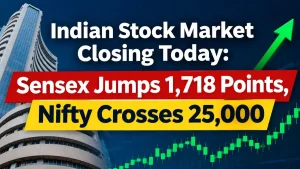
Friday’s closing figures provide the backdrop. The Sensex finished at 81,028.02, up 1,718.01 points or 2.17%, while the Nifty 50 settled at 25,030.35, gaining 493.75 points or 2.01%. Nifty Bank closed at 59,086.00. It was the seventh consecutive gaining session, and the first Nifty close above 25,000 since February 27, 2026.
With the NSE and BSE closed for regular trading on Saturday, attention has shifted to the weekend’s market assessments and the conditions awaiting investors when trading resumes on Monday, November 9.
Also Read: Indian Stock Market Weekly Wrap-Up: Nifty Reclaims 25,000, Sensex Surges as Foreign Investors Return
The latest weekly figures reveal a market recovering at extraordinary speed, but also show important differences between foreign and domestic investors, large companies and smaller businesses. These developments will matter more in the coming week than another account of Friday’s rally.
Foreign Investors Buy ₹45,960 Crore in One Week, Reversing October’s Entire Selling
The most important development emerging from Saturday’s institutional flow analysis is the scale of foreign investment returning to Indian equities.
Foreign institutional investors purchased a net ₹45,960 crore during the five trading sessions from November 2 to November 6. The buying was spread across all five sessions, extending a recovery in foreign participation after a prolonged period of selling.
The amount exceeded the approximately ₹45,162 crore that foreign investors had withdrawn during October.
| Institutional activity | Amount |
|---|---|
| FII net buying, November 2–6 | ₹45,960 crore |
| FII net selling during October | ₹45,162 crore |
| Excess weekly buying over October selling | ₹798 crore |
The comparison illustrates how quickly foreign portfolio positioning has changed. A month of withdrawals was more than offset by a single week of purchases.
The return of overseas capital has also helped explain why large-cap companies have performed particularly well.
The crucial issue now is whether these inflows represent a lasting reassessment of Indian equities or a rapid adjustment to global investment portfolios.
Domestic Institutions Sell ₹24,197 Crore as Foreign Buying Accelerates
The week’s institutional activity revealed an equally significant development on the domestic side.
Domestic institutional investors recorded net sales of approximately ₹24,197 crore during the five trading sessions, reversing an eleven-week buying streak.
| Institutional category | Weekly net activity |
|---|---|
| Foreign institutional investors | +₹45,960 crore |
| Domestic institutional investors | -₹24,197 crore |
| Combined net institutional activity | +₹21,763 crore |
The contrast is important because domestic institutions had provided considerable support during the earlier period of foreign selling.
Their shift toward selling suggests that some institutional portfolios were taking advantage of the rapid recovery to reduce exposure or realise gains.
The figures do not necessarily indicate a negative assessment of India’s long-term economic prospects. Institutional investors regularly rebalance portfolios when market prices change substantially.
Also Read: Top 10 Indian Stock Market News Today, November 6, 2026: Evening Edition
Nevertheless, the reversal leaves the near-term recovery more dependent on continued foreign participation.
If overseas inflows weaken while domestic selling persists, the market could face a more difficult test.
Nifty Midcap and Smallcap Stocks Lag Behind Large Companies
Saturday’s weekly market review shows that the recovery has not been equally strong across India’s listed companies.
While the benchmark indices advanced more than 8% during the week, the Nifty Midcap 100 gained 5.8% and the Nifty Smallcap 100 rose only 2.8%.
Also Read: Indian Stock Market Closing Today, November 6: Sensex Jumps 1,718 Points, Nifty Ends Above 25,000
| Market segment | Weekly change |
|---|---|
| Nifty Midcap 100 | +5.8% |
| Nifty Smallcap 100 | +2.8% |
| Difference in performance | 3.0 percentage points |
The weaker performance of smaller companies is particularly noteworthy after the sharp correction that affected mid-cap and small-cap shares in previous months.
Foreign institutional investors have concentrated much of their recent buying in larger companies, where liquidity is generally deeper and institutional positions can be adjusted more easily.
For smaller businesses, investors appear to remain more selective about valuations and earnings visibility.
The gap between large-cap and small-cap performance will be one of the important indicators to monitor in November. A more durable market recovery would generally benefit from broader participation across different company sizes.
Also Read: Top 10 Indian Stock Market News Today, November 6, 2026: Midday Update
Realty and Consumer Durables Emerge as the Week’s Strongest Sectors
The weekly sector breakdown revealed an important change in market leadership.
Real estate and consumer durables were among the strongest performers, supported by renewed interest in businesses linked to domestic demand.

| Sector | Weekly change |
|---|---|
| Nifty Realty | +10.2% |
| Nifty Consumer Durables | +10.1% |
| Nifty Oil & Gas | +9.6% |
| Nifty Auto | +9.4% |
| Nifty Private Bank | +9.1% |
The strength of real estate shares suggests that investors are reassessing companies exposed to property development and housing demand.
Consumer durables stocks also benefited from improving sentiment toward discretionary spending and domestic consumption.
Also Read: GIFT Nifty Today, November 6, 2026: Market Opening Sentiment and Key Levels
The recovery in automobiles and oil-related businesses indicates that buying was not limited to financial companies, even though banks remained important contributors to the benchmark rally.
The sectoral performance will matter next week because it offers an early indication of where institutional interest may be expanding beyond the largest benchmark constituents.
India VIX Jumps 14.2% Despite the Market’s Powerful Rally
One of the more unusual developments in the weekly data was the increase in market volatility despite strong gains in share prices.
India VIX, the market’s widely followed measure of expected near-term volatility, rose approximately 14.2% during the week and ended Friday at 17.55.
Also Read: Altcoin Market Today: Ethereum, Solana and XRP Slide as TRON Shows Relative Strength
| Volatility indicator | Weekly reading |
|---|---|
| India VIX closing level | 17.55 |
| Weekly change | +14.2% |
A rising volatility index during a market rally indicates that investors are expecting larger price movements, not necessarily a decline.
The distinction matters because a market can rise rapidly while uncertainty remains elevated.
After several consecutive sessions of strong gains, traders may be paying more to protect positions against unexpected reversals.
For the coming week, volatility could remain important as investors respond to international developments and reassess positions following the sharp advance.
Also Read: Bitcoin Faces $2.7 Billion Options Expiry as US Jobs Report Creates Critical Trading Window
The increase in VIX is therefore a reminder that improving market sentiment does not automatically mean trading conditions have become less risky.
Forty-Six Nifty Companies Finish the Week Higher
The latest weekly market breadth figures show that the recovery extended across most of the Nifty 50’s constituent companies.
Of the 50 stocks, 46 ended the week with gains, three declined and one finished unchanged.
| Weekly Nifty 50 breadth | Number of stocks |
|---|---|
| Gainers | 46 |
| Losers | 3 |
| Unchanged | 1 |
Shriram Finance led the weekly advances, rising 16.8%, followed by Bajaj Finance at 15.8% and Mahindra & Mahindra at 15.7%.
HDFC Bank gained 13.8%, while Reliance Industries advanced 13.3%.
Power Grid Corporation of India, Infosys and Tata Consultancy Services were the three companies that ended the week lower.
The figures suggest that the recovery had considerable breadth within the large-cap benchmark, even though the broader mid-cap and small-cap segments lagged.
This distinction is important. Strong participation among Nifty constituents is encouraging, but it does not necessarily indicate the same level of confidence across the entire listed market.
US Midterm Election Results Reshape Global Market Expectations
The outcome of the November 3 US midterm elections has become an important part of the global market discussion heading into the weekend.
The Democratic Party’s strong electoral performance has prompted investors to reconsider the prospects for US policy, international trade and geopolitical developments.
The result has coincided with a substantial adjustment in global commodity prices and investor positioning.
For India, the implications extend beyond immediate equity market movements. Changes in American trade policy, international relations and financial conditions can influence export demand, foreign investment and currency markets.
Indian technology services companies are particularly exposed to US business spending, while manufacturing exporters must consider the effect of changes in trade arrangements.
The election result alone does not determine future policy. Investors will be watching for concrete announcements and legislative developments rather than relying entirely on expectations formed immediately after the vote.
Brent Crude’s Weekly Collapse Changes the Outlook for India’s Import Costs
Saturday’s review of international energy markets shows just how dramatic the week’s correction in crude oil prices has been.
Brent crude declined more than 16% during the week, touching $93.22 per barrel before recovering to finish Friday around $97.75.
| Brent crude indicator | Price |
|---|---|
| Weekly low | $93.22 per barrel |
| Friday closing price | $97.75 per barrel |
| Weekly decline | More than 16% |
The decline was one of the steepest weekly corrections in decades, reflecting changing expectations surrounding geopolitical risks and energy supply.
For India, the important issue is not simply that crude has fallen below $100. The speed and sustainability of the decline could influence import costs, inflation expectations and the outlook for businesses that consume large quantities of energy.
The coming week will help establish whether the correction represents a lasting shift in the energy market or a temporary response to changing geopolitical expectations.
Oil prices will therefore remain an important external indicator for Indian equities when trading resumes on Monday.
November 9 Market Reopening Will Test the Strength of the Recovery
Indian equities will return to regular trading on Monday, November 9, following a week of unusually strong gains.
The market enters the new week with the Nifty above 25,000 for the first time since February 27 and the Sensex above 81,000.
The immediate challenge is whether buyers remain willing to commit additional capital after such a rapid advance.
Several factors will influence the opening session. Foreign institutional activity will remain important, particularly after domestic institutions turned net sellers during the previous week.
Also Read: Bitcoin Rebounds Above $78,000 as Binance Hack Puts Crypto Exchange Security Under Scrutiny
Investors will also monitor the performance of financial stocks, which have played a major role in the recovery, alongside real estate, automobiles and consumer-oriented businesses.
A period of consolidation after a sharp rally would not necessarily indicate a deterioration in the broader market outlook. Equally, the recent gains do not guarantee that the upward movement will continue.
The more meaningful test will be whether buying interest remains broad and whether the market can absorb profit-taking without losing substantial ground.
Global Markets, Institutional Flows and Volatility Set the Agenda for November 9–13
The week beginning November 9 will provide a fresh test of India’s market recovery as investors evaluate overseas developments and domestic financial conditions.
The sharp correction in global technology shares remains an important consideration. International fund managers are reassessing the balance between companies investing heavily in artificial intelligence infrastructure and businesses with more conventional earnings drivers.
India has benefited from some of this reassessment, but global investment preferences can change quickly.
Foreign institutional flows will be particularly important after the previous week’s exceptionally large purchases. Domestic institutional activity will also be closely followed to determine whether profit-booking continues.
Currency movements, international crude oil prices and changes in global bond yields could influence investor sentiment throughout the week.
Also Read: AMD Q3 2026 Earnings: Data Centre Growth Powers a Revenue Beat and Stronger Outlook
The increase in India VIX adds another dimension. Investors are entering the new trading week with greater expectations of price fluctuations, even after the strong market recovery.
The following calendar highlights the main developments to monitor.
| Period | Key development to watch |
|---|---|
| Monday, November 9 | Market reopening and institutional buying interest |
| November 9–10 | Foreign and domestic fund flows |
| November 9–13 | Global equity and technology-sector sentiment |
| Throughout the week | Crude oil prices and rupee movements |
| Throughout the week | Banking, realty and broader market participation |
| Friday, November 13 | Weekly closing performance and volatility |
The direction of the market will depend on how these factors interact rather than on any single announcement.
After an exceptionally strong week, the focus is shifting from the speed of the recovery to its durability.
Disclaimer: This article is published by Onetrader for educational and informational purposes only. It does not constitute investment advice or a recommendation to buy, sell or hold any security. Financial markets involve risk, and readers should conduct their own research or consult a qualified financial adviser before making investment decisions. Onetrader is not a SEBI-registered investment adviser or research analyst.




Keep learning with OneTrader
Explore structured lessons and practical guides to build your market knowledge.

Need a laugh after all that money talk?
Paisa LOL: India's funniest finance page, with memes, comics, jokes and long funny stories.