
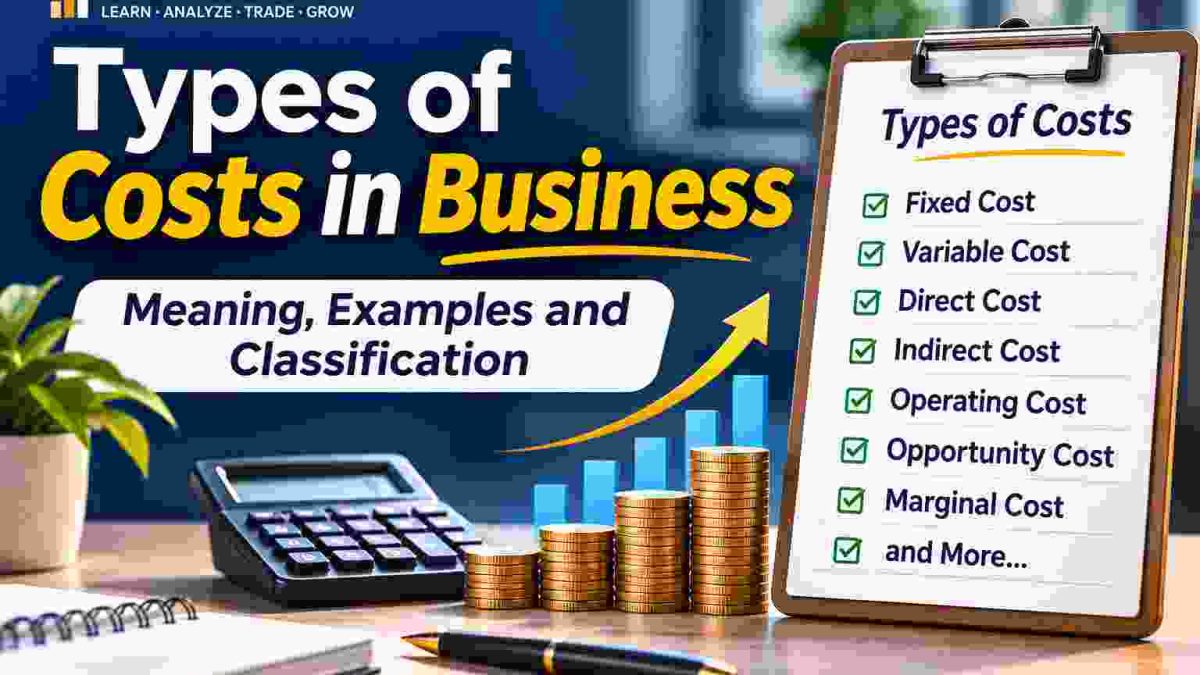
Every business has expenses, whether it is a small grocery shop, a manufacturing company, a restaurant or a multinational corporation. From paying employees and purchasing raw materials to maintaining offices and running marketing campaigns, money continuously flows out of a business to keep its operations running. However, not all expenses behave in the same way. Some remain almost unchanged regardless of how much a company produces, while others increase with every additional product manufactured. Certain expenses can be directly connected to a particular product, whereas others support the entire organisation.
Understanding these differences is an important part of financial management. Business owners need to know where their money is going, accountants need to classify expenses correctly, and investors need to understand how a company’s cost structure affects its profitability. Cost classification may sound like a basic accounting concept, but it influences decisions involving product pricing, business expansion, budgeting, production and long-term financial planning.
What Are Costs in Business?
In simple terms, a cost is the money or economic resource a business spends to produce goods, deliver services or conduct its regular activities. Consider a footwear manufacturing company. It purchases leather, employs factory workers, rents manufacturing facilities, maintains machinery and pays for transportation. Every one of these activities involves expenditure, but the purpose and behaviour of each expense are different. Management cannot make effective financial decisions by looking only at the total amount spent. It must understand how individual expenses behave, whether they can be controlled and how they contribute to the final product or service. This is why businesses divide their expenses into different cost categories.
Fixed Costs and Variable Costs
Fixed costs are expenses that generally remain unchanged within a particular period and relevant range of business activity, irrespective of how much a company produces. For example, imagine a manufacturing company paying ₹1 lakh in monthly factory rent. Whether it manufactures 1,000 products or 5,000 products during that month, the rent may remain the same. Insurance premiums, certain equipment lease payments and salaries of permanent administrative employees can also be fixed costs. However, fixed costs are not necessarily permanent. If the company expands its operations and moves into a larger factory, its rent may increase. The important distinction is that fixed costs do not change immediately with every increase or decrease in production.
Also Read: CEO vs CFO vs COO: Who Runs What in a Business and How the Three Roles Work Together
Variable costs behave differently because they generally change according to the level of production or business activity. A company manufacturing shirts requires fabric, buttons, packaging materials and other production inputs. If production increases from 1,000 shirts to 5,000 shirts, the requirement for these materials also increases. Raw materials, production-linked labour and packaging are common examples. Understanding variable costs helps businesses calculate how much additional money is required to manufacture more products and whether increasing production will improve profitability.
Some expenses contain elements of both fixed and variable costs. These are called semi-variable or mixed costs. Electricity bills are a familiar example. A factory may have a minimum electricity charge even when production is low, but the bill increases when machinery operates for longer hours. Certain sales commission structures may also contain a fixed salary component and an additional performance-based payment. Businesses must understand both components when preparing budgets because incorrectly classifying these expenses can lead to inaccurate financial forecasts.
Direct Costs and Indirect Costs
Another important classification is based on whether an expense can be directly connected to a particular product, service or project. Direct costs are expenses that can be traced to a specific product or activity. For example, the wood used to manufacture a dining table and the wages paid to workers directly involved in producing it are direct costs. These expenses help businesses calculate the cost of manufacturing individual products.

Indirect costs support the overall business or production process but cannot be conveniently linked to one particular product. Factory electricity, general maintenance, office supplies and administrative salaries are examples. A manufacturing company may produce hundreds of different products in the same facility, making it difficult to assign certain shared expenses directly to one item. Nevertheless, these expenses must be considered when calculating the overall cost of operating the business. A company that ignores indirect costs may incorrectly price its products and overestimate its actual profitability.
Also Read: Angel One’s Success Story: How Distribution Built One of India’s Largest Stockbrokers
Operating Costs and Non-Operating Costs
Operating costs are expenses associated with the regular activities through which a company earns revenue. For a retail business, these expenses may include employee salaries, store rent, electricity, transportation, marketing and other day-to-day operating requirements. These costs are important because they directly influence the company’s operating profitability.
Non-operating costs arise from activities outside the company’s core business operations. Interest expenses on borrowings and losses from the sale of assets are examples. Investors often examine operating and non-operating expenses separately because they want to understand whether a company’s financial performance is being affected by its main business activities or by other financial transactions. A company may have a profitable core business but report lower net profit because of substantial interest expenses.
Controllable Costs and Uncontrollable Costs
Businesses also classify costs according to whether management can influence them. Controllable costs are expenses that managers can influence through their decisions. Advertising budgets, departmental travel, certain operational purchases and discretionary spending are examples. If a department manager identifies unnecessary travel expenses, the department may be able to reduce them through better planning.
Uncontrollable costs are expenses that a particular manager cannot significantly influence within a given period. Centralised corporate charges, contractual obligations and certain regulatory expenses may fall into this category. However, the distinction depends on the level of management and the time involved. An expense that a department manager cannot change immediately may still be reviewed and adjusted by senior management over a longer period. This classification helps organisations establish responsibility and evaluate how effectively different departments manage their budgets.
Also Read: Groww’s Success Formula: How a Simple Investing App Overtook India’s Established Stockbrokers
Opportunity Cost: The Value of the Alternative You Give Up
Opportunity cost is one of the most interesting concepts in economics, business and personal finance. It represents the value of the next best alternative that a person or business gives up when making a decision. Imagine that you own a commercial property that could generate ₹40,000 in monthly rental income. Instead of renting it out, you decide to use the property for your own business. Although you are not making an actual rental payment, you are giving up the opportunity to earn that income. The ₹40,000 represents the opportunity cost of your decision. This concept is particularly useful when businesses compare different investment opportunities, decide how to use limited resources or evaluate whether an expansion project makes financial sense.
Sunk Cost: Money That Cannot Be Recovered
A sunk cost is an expense that has already been incurred and cannot be recovered. Imagine a company spending ₹20 lakh developing a new product. After completing market research and testing, management discovers that customer demand is far lower than expected. The company must now decide whether to continue investing or discontinue the project. The ₹20 lakh already spent is a sunk cost. It should not automatically justify spending another ₹20 lakh. Businesses sometimes continue unsuccessful projects because they feel uncomfortable accepting that previous investments have been wasted. This can lead to even greater financial losses. Good decision-making requires evaluating future costs and expected benefits rather than allowing past expenditure to control future decisions.
Marginal Cost: The Cost of Producing One More Unit
Marginal cost refers to the additional expense involved in producing one extra unit of a product or service. Consider a bakery that manufactures 100 cakes at a total production cost of ₹20,000. If producing the 101st cake increases the total cost to ₹20,150, the marginal cost of that additional cake is ₹150. This calculation helps businesses understand whether increasing production is financially worthwhile. If the additional revenue generated by selling another unit exceeds its marginal cost, producing that unit may improve profitability, provided other relevant costs and operational constraints are considered. Marginal cost becomes especially important for manufacturers when deciding production quantities, accepting additional orders and using available production capacity.
Standard Cost and Actual Cost
Before production begins, businesses often prepare estimates of how much each product should cost. This predetermined estimate is called standard cost. It is generally based on expected material requirements, labour time and production efficiency. Actual cost, on the other hand, represents the amount the business really spends. For example, a manufacturer may estimate that producing one unit requires ₹500 in materials and labour. After production, the actual expense may reach ₹540 because raw material prices increased or workers required additional production time. Comparing standard costs with actual costs helps management identify inefficiencies, investigate unexpected expenses and improve future budgeting. It also gives businesses a way to measure whether their operations are performing according to their financial expectations.
Product Cost and Period Cost
Product costs are expenses associated with manufacturing or acquiring products. They generally include direct materials, direct labour and manufacturing overhead. These expenses are initially included in inventory and are recognised as expenses through the cost of goods sold when the products are sold. Period costs are treated differently because they are generally recognised as expenses in the accounting period in which they are incurred. Office rent, administrative salaries and certain marketing expenses are common examples. This distinction is important when preparing financial statements because incorrectly classifying product and period costs can affect inventory valuation, reported expenses and profitability. It also helps businesses understand the financial resources required to manufacture products compared with the expenses required to operate the wider organisation.
Why Understanding Cost Types Matters for Business Owners and Investors
Cost classification is not simply an accounting exercise. It influences some of the most important decisions a business makes. A company planning to launch a new product must understand its direct costs, indirect costs and expected production expenses before deciding the selling price. A manufacturer considering expansion must examine whether additional production will justify the extra fixed expenses. Similarly, a business facing declining sales needs to identify which expenses can be reduced without damaging its ability to operate.
Investors can also learn a great deal by examining a company’s cost structure. A business with high fixed costs may experience significant improvements in profitability when sales increase, but the same structure can create financial pressure when demand declines. Companies with better control over operating expenses may be able to protect their margins during difficult economic conditions. When analysing financial statements, investors should therefore look beyond revenue and net profit and understand how efficiently management controls the expenses required to generate that revenue.
Disclaimer: This article is for educational and informational purposes only. It should not be considered financial, accounting or investment advice. Readers should consult qualified professionals for decisions involving their specific business or financial circumstances.



Keep learning with OneTrader
Explore structured lessons and practical guides to build your market knowledge.

Need a laugh after all that money talk?
Paisa LOL: India's funniest finance page, with memes, comics, jokes and long funny stories.