Introduction
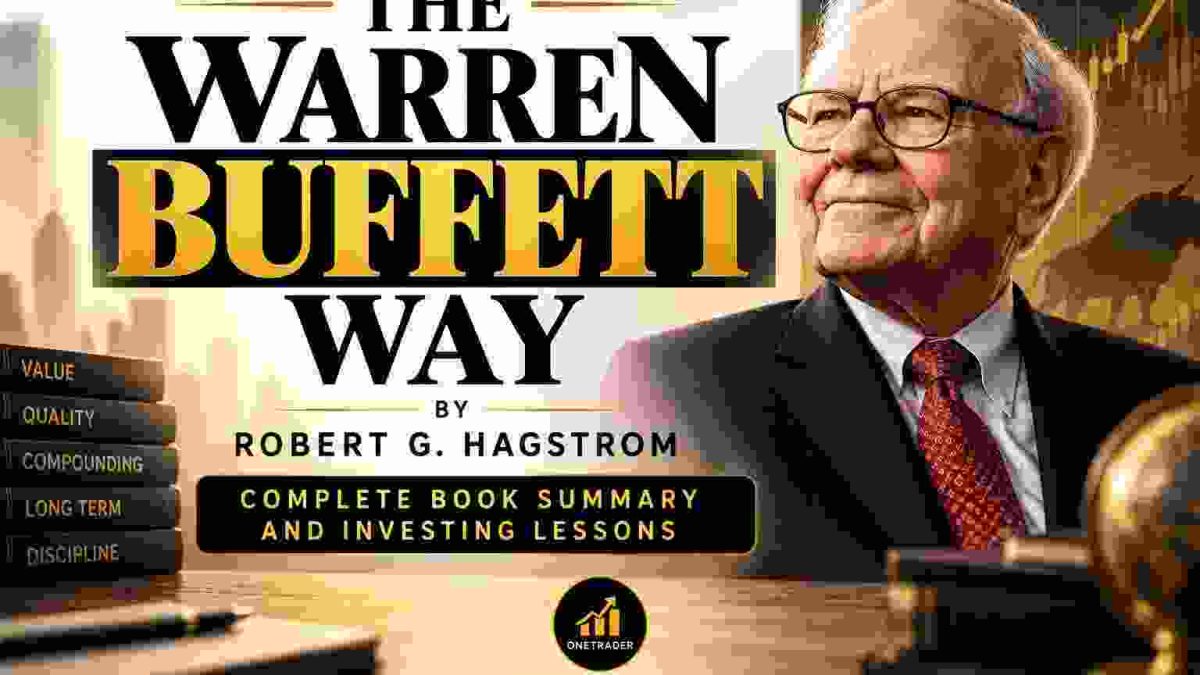
Warren Buffett is often described as one of the greatest investors in history, but the most useful lesson from his career is not simply the list of stocks he bought. It is the way he thinks about businesses, value, risk, management and long-term ownership. Robert G. Hagstrom’s The Warren Buffett Way examines the principles behind Buffett’s investment philosophy and explains how his approach developed from the ideas of Benjamin Graham, Philip Fisher and other influences. The book provides a framework for understanding why Buffett looks at stocks differently from traders who focus primarily on short-term price movements.
At the heart of Buffett’s philosophy is a simple change in perspective: instead of asking whether a stock price will rise tomorrow, think about whether the underlying business is worth owning for many years. A stock market quotation represents a price, but the investment itself represents ownership in a business. Once an investor begins thinking like a business owner, questions about earnings, competitive advantages, management quality, capital allocation and intrinsic value become much more important than daily market noise.
Think Like a Business Owner
One of the most important ideas in The Warren Buffett Way is that investors should view shares as fractional ownership of real businesses. When someone purchases 100 shares of a company, the investor is not merely buying a number that moves up and down on a screen. The investor is acquiring a small economic interest in an operating company with employees, customers, assets, competitors, revenues, expenses and future opportunities.
This mindset changes the way an investor evaluates a stock. Instead of becoming emotionally attached to a particular price, the investor can focus on whether the business is becoming more valuable over time. If the company’s earnings, cash generation and competitive position continue improving, short-term market fluctuations become less important.
Also Read: One Up On Wall Street by Peter Lynch: Complete Book Summary and Investing Lessons
For an Indian investor, imagine owning a small part of a well-established consumer company. The share price might fall 10% during a weak market even though the company’s sales, distribution network and profitability remain healthy. A business-oriented investor would investigate whether the underlying economics have changed rather than automatically assuming that the investment has become worse.
The Difference Between Price and Value
Buffett’s philosophy is strongly influenced by Benjamin Graham’s distinction between market price and intrinsic value. The price of a stock is the amount the market is currently willing to pay. Intrinsic value represents an estimate of what the underlying business is actually worth based on its future economic potential.
These two numbers can differ significantly.
A company’s share price can fall because investors are pessimistic, even while the business continues to perform well. Conversely, a stock can trade at a very high valuation because investors are extremely optimistic about its future.
Also Read: The Intelligent Investor by Benjamin Graham: Book Summary
The investor’s task is therefore not simply to identify a good business. It is to determine whether the price being paid is reasonable compared with the value and future earning potential of that business.
This is where Buffett’s approach becomes fundamentally different from speculation. The focus shifts from predicting short-term price movements to estimating long-term business value.
Focus on Economic Characteristics
Hagstrom explains that Buffett looks for businesses with strong and understandable economic characteristics. He is interested in companies capable of producing attractive returns on capital and generating substantial cash over long periods.
A company can increase its revenue without necessarily creating significant shareholder wealth. If growth requires enormous amounts of capital, the business may need to continuously reinvest large sums simply to maintain its operations. Another company may produce strong cash flows while requiring relatively little additional capital to grow.
Also Read: Poor Charlie’s Almanack Part 2 – Charlie Munger’s Mental Models for Investing
The second type of business can have a significant advantage because excess cash can potentially be reinvested, used for acquisitions, returned to shareholders or allocated in other productive ways.
For investors, this means that revenue growth should not be examined in isolation. Profitability, capital requirements, cash generation and returns on capital provide a deeper understanding of business quality.
Look for Durable Competitive Advantages
Buffett has frequently emphasized the importance of companies possessing an economic moat. A moat represents a durable competitive advantage that protects a business from competitors and allows it to maintain attractive economics over time.
A strong brand can create a moat because customers may remain loyal even when alternatives are available. A powerful distribution network can make it difficult for new competitors to reach customers. Network effects can make a platform more valuable as its user base grows. Low-cost operations can provide an advantage that competitors struggle to match.
Also Read: Poor Charlie’s Almanack Book Summary (Part 1)
The important word is durable.
A temporary advantage is not enough. Technology, consumer preferences, regulation and competition can change. An investor therefore needs to ask whether the company’s competitive advantage is likely to remain relevant several years into the future.
For an Indian investor, this could involve examining a company’s brand strength, distribution network, switching costs, cost advantage or market position rather than simply looking at its current earnings growth.
Invest in Understandable Businesses
Buffett has traditionally preferred businesses that he can understand. This does not mean the business must be simple in every technical detail. Rather, the investor should understand how the company makes money, what drives demand, what determines profitability and what could threaten its future.
This principle protects investors from buying businesses simply because they appear fashionable.
A company operating in an unfamiliar industry may have excellent growth prospects, but if the investor cannot understand the economics, estimating its intrinsic value becomes much harder. When uncertainty is already high, adding complexity can make the investment thesis even more fragile.
Understanding the business also makes it easier to monitor the investment after purchase. Instead of reacting to every market headline, the investor can concentrate on the fundamental factors that actually determine whether the original thesis remains valid.
Management Matters
A great business can still suffer under poor capital allocation, which is why management quality is another important part of Buffett’s framework.
Management teams make decisions about how profits are used. They can reinvest in the existing business, acquire other companies, reduce debt, pay dividends or repurchase shares. The quality of these decisions can have a major impact on long-term shareholder returns.
Buffett’s philosophy therefore encourages investors to examine whether management behaves like responsible owners of the business. Investors can study capital allocation decisions, communication with shareholders, acquisitions, debt management and the treatment of minority shareholders.
Management does not need to be perfect. But consistency, honesty and rational capital allocation can become significant advantages when combined with a strong business.
The Importance of Long-Term Earnings
Buffett’s approach is ultimately centered on the ability of a business to generate increasing economic value over time.
Short-term stock movements can be influenced by sentiment, liquidity, news and market expectations. Over longer periods, however, business performance becomes increasingly important.
If a company consistently increases its earnings and cash generation while maintaining strong returns on capital, its economic value can potentially increase substantially. If the market eventually recognizes that improvement, the share price may follow.
This does not mean that every profitable company is a good investment. Valuation still matters. A wonderful company purchased at an excessively high price can produce disappointing returns if future growth fails to meet the expectations already embedded in the stock price.
The Power of Compounding
Compounding is one of the most powerful concepts in Buffett’s investment philosophy.
When a business generates profits and those profits are reinvested at attractive rates of return, the company’s earning power can grow progressively. Over many years, even a moderate annual rate of compounding can produce a significant difference in wealth.
The same principle applies to an investor’s portfolio. If capital remains invested in high-quality businesses and those businesses continue to compound their intrinsic value, the investor can potentially benefit from both business growth and the reinvestment of returns.
This is why Buffett’s approach tends to emphasize patience. The most significant benefits of compounding often appear after many years rather than a few months.
Patience Is an Investment Advantage
Markets encourage constant activity. Every day brings new headlines, price movements, analyst opinions and economic forecasts. This can create the impression that investors need to constantly buy and sell to succeed.
Buffett’s philosophy challenges that assumption.
If an investor owns an excellent business purchased at a sensible price and the business continues to perform well, there may be no reason to sell simply because the stock has risen. Selling creates another decision: where will the capital be invested next, and will the new investment be better?
Long-term ownership can therefore reduce unnecessary activity and allow the underlying business to compound.
Patience does not mean ignoring problems. If the investment thesis fundamentally changes, selling can be appropriate. The point is that market volatility alone does not necessarily invalidate a long-term investment thesis.
The Role of Mr. Market
The concept of Mr. Market, inherited from Benjamin Graham, fits naturally into Buffett’s philosophy.
Imagine that a business partner offers you a different price for your share of the company every day. Some days the partner is extremely optimistic and offers a very high price. Other days the partner becomes pessimistic and offers a much lower price.
You do not have to accept either price.
The stock market works similarly. Market quotations provide opportunities to buy or sell, but they do not automatically determine what a business is worth.
This perspective can help investors remain calm during periods of volatility. A falling share price does not necessarily mean the business has become less valuable, just as a rising share price does not automatically mean the business has become more valuable.
The investor must examine what has actually changed.
Avoid Unnecessary Diversification
Buffett’s approach is sometimes described as concentrated investing, but the deeper lesson is not simply to own a small number of stocks. The important principle is that investors should have sufficient knowledge and conviction about the businesses they own.
Owning dozens of companies without understanding any of them deeply can create the appearance of diversification without necessarily creating informed decision-making.
At the same time, concentration increases the consequences of being wrong. Investors therefore need to distinguish between informed concentration and careless concentration. A portfolio should reflect the investor’s knowledge, risk tolerance and financial circumstances.
The broader lesson is to avoid buying companies merely to fill portfolio slots.
When Should an Investor Sell?
Buying a great company is only part of Buffett’s approach. Investors also need to understand when the original thesis has become invalid.
A stock may deserve reconsideration when the competitive advantage deteriorates, management begins allocating capital poorly, the business economics change materially or the valuation becomes disconnected from reasonable expectations.
A price decline by itself does not necessarily mean the investment should be sold. Likewise, a rising price does not automatically mean it should be sold.
The fundamental question is whether the business remains attractive relative to its current valuation and future prospects.
This approach encourages investors to make decisions based on business reality rather than emotional reactions to market movements.
Applying the Warren Buffett Way to Indian Stocks
Indian investors can apply many of these principles when analyzing companies listed on the NSE and BSE. Rather than beginning with the question of which stock might rise next month, an investor can start by identifying businesses with understandable operations, strong competitive positions, healthy balance sheets, consistent profitability and attractive returns on capital.
The next step is to examine management and capital allocation. How has the company used shareholder capital? Has debt remained manageable? Has the business generated consistent cash? Does management have a credible strategy for future growth?
Finally, valuation must be considered. Even a high-quality Indian company can become an unattractive investment if its share price assumes unrealistic growth for many years.
The objective is therefore not to find a perfect company. It is to find a business whose economics, management and valuation provide a reasonable foundation for long-term ownership.
The Biggest Lesson From The Warren Buffett Way
The most important lesson from The Warren Buffett Way is that investing should begin with understanding rather than prediction.
Instead of trying to forecast what the market will do tomorrow, investors can focus on identifying businesses that can create value over many years. They can study competitive advantages, management quality, earnings, cash generation, capital requirements and valuation. Once a high-quality business is purchased at a sensible price, patience can allow compounding to work.
This approach also requires emotional discipline. Markets will inevitably experience crashes, bubbles and periods of extreme optimism and pessimism. Investors who constantly react to these movements can undermine their own long-term strategy.
Buffett’s philosophy offers a different perspective: become a business owner, think independently, demand a margin between price and value, and allow time to become an ally.
Conclusion
The Warren Buffett Way provides a practical framework for understanding the investment philosophy that made Warren Buffett one of the most closely studied investors in the world. Robert Hagstrom’s explanation emphasizes that Buffett’s success was not built around predicting short-term market movements. It was built around understanding businesses, identifying durable competitive advantages, evaluating management, estimating value and allowing high-quality companies to compound over long periods.
For Indian investors, the philosophy remains highly relevant. The market contains businesses across banking, technology, consumer products, healthcare, manufacturing, financial services and many other industries. The challenge is not simply finding companies that are growing. It is determining which businesses have durable economics, capable management and enough room between their intrinsic value and market price.
The Warren Buffett Way ultimately teaches investors to slow down, think like owners and focus on what actually creates wealth: businesses that can generate and compound economic value over time.
Financial Disclaimer
The content published on Onetrader is for educational and informational purposes only. It is not investment advice, financial advice, or a buy/sell recommendation. Onetrader is not SEBI registered. Stock market investments involve risk, and past performance does not guarantee future results. Readers should conduct their own research and consider their financial goals, risk tolerance and financial situation before making any investment decision.