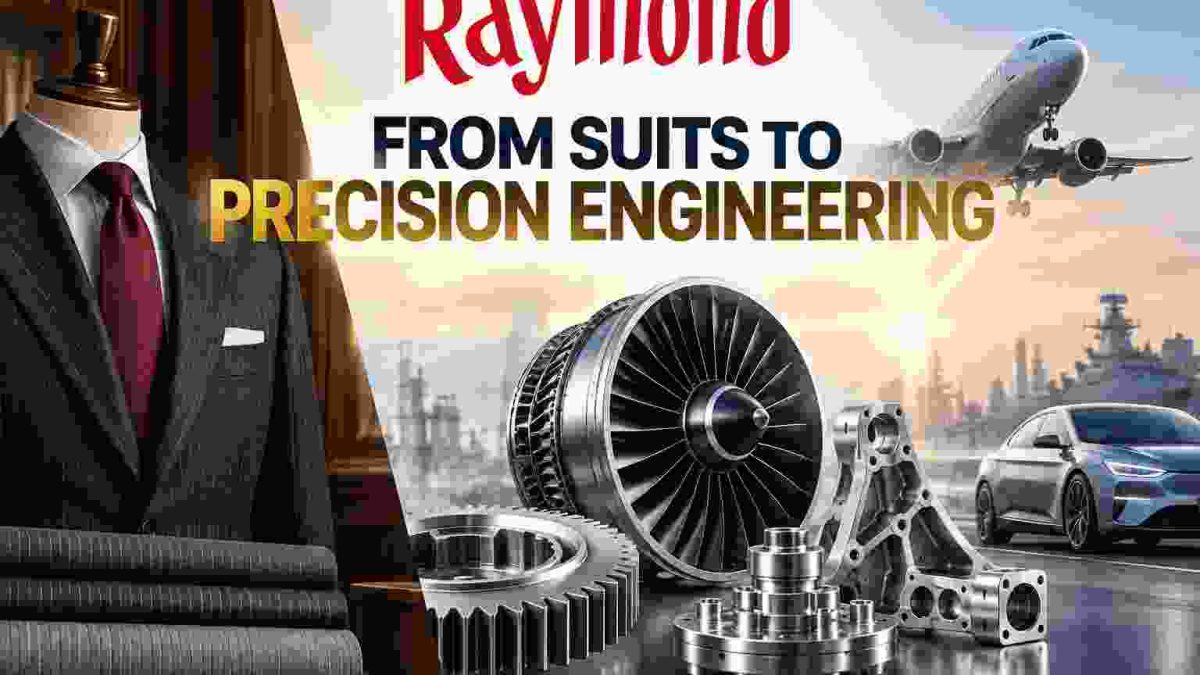
For decades, the Raymond name was almost synonymous with suits, fabrics and consumer-facing brands. But the Raymond Limited that investors see today is a very different business. Following the demerger and listing of Raymond Lifestyle in 2024 and Raymond Realty in 2025, the remaining Raymond Limited has become a focused engineering company built around precision technology, auto components, tools and aerospace & defence. The transformation is significant because the company is moving from a diversified legacy identity toward manufacturing businesses where engineering capability, customer qualification and precision can create much stronger entry barriers.
A Completely Different Raymond
Raymond’s engineering business now operates through two broad platforms: Precision Technology & Auto Components and Aerospace & Defence. The first includes tools and hardware as well as automotive and engineering components, while the second focuses on high-precision aerospace and defence manufacturing. The company has built a manufacturing network of 16 facilities supported by more than 1,800 machines and a workforce exceeding 5,250 people, with products reaching more than 65 export countries and 18-plus global customer locations.
This makes Raymond’s current business much more interesting than simply calling it an auto-component manufacturer. Its capabilities include steel files, cutting tools, hand tools, ring gears, flex plates, water-pump bearings, machined components and increasingly complex aerospace parts and assemblies. The common thread is precision manufacturing: producing components to customer-specific drawings, specifications and quality standards rather than selling a single standardised consumer product.
Precision Technology Creates the Manufacturing Foundation
The Precision Technology & Auto Components business provides Raymond with scale across automotive and industrial applications. Its portfolio includes more than 2,000 auto-component SKUs, serving areas such as passenger vehicles, commercial vehicles, electric and hybrid vehicles and broader industrial applications. This gives Raymond exposure to the transition in mobility without making the entire business dependent on one particular drivetrain technology.
Also Read: DMCC Speciality Chemicals: The 100-Year Chemical Company Building a New Specialty Business
The important shift is that the company is not merely producing traditional engine components. Its capabilities extend into components that can remain relevant as vehicle architectures change, while its precision-engineering expertise can also be applied to industrial and emerging applications. That creates a bridge between Raymond’s established manufacturing base and newer opportunities in EVs, industrial technology and other precision-engineered products.
Aerospace Is the Bigger Strategic Opportunity
The most transformative part of Raymond’s new identity is aerospace and defence. Raymond entered this space through its acquisition of Maini Precision Products, which gave the company access to specialised aerospace manufacturing capabilities and relationships with global aerospace customers. Today, the aerospace business manufactures precision-engineered aero-engine components, structural parts and assemblies, with more than 75% of its operations derived from complex aero-engine parts.
Aerospace manufacturing is fundamentally different from ordinary engineering because qualification, reliability, traceability and delivery performance matter enormously. Once a supplier is qualified for a particular aircraft or engine programme, the relationship can potentially last for many years. Raymond reported more than 100 new aerospace SKUs added during FY2026 and an order book exceeding ₹2,350 crore over the following five years, supported by advanced capabilities such as five-axis grinding, EDM, vacuum brazing and TIG welding.
The opportunity is also being reinforced by India’s growing role in the global aerospace supply chain. Raymond’s engineering leadership has highlighted the opportunity created by global supply-chain diversification, while the company’s aerospace operation now manufactures more than 1,350 different parts and continues adding new components as it expands its programme participation.
Also Read: Avalon Technologies: The EMS Company Quietly Building India’s Next Manufacturing Engine
Why Customer Qualification Can Become a Moat
One of the strongest characteristics of Raymond’s aerospace business is that manufacturing capability alone is not enough to compete. Aerospace suppliers need specialised processes, certifications, quality systems, engineering knowledge and successful qualification histories.
This creates a different competitive environment from ordinary component manufacturing. A customer cannot necessarily replace a qualified supplier overnight because new suppliers have to demonstrate that they can repeatedly manufacture components to extremely demanding specifications. Raymond’s long-standing relationships with global OEMs and Tier-1 suppliers therefore become strategically important, while its growing engineering library and increasing number of qualified parts can create additional depth within customer relationships.
New Orders Are Expanding the Opportunity
The aerospace story is also moving beyond exports. In September 2026, Raymond’s aerospace subsidiary secured new business from an Indian aerospace and defence company covering more than 300 part numbers and annual volumes exceeding 37,000 components. The programme includes precision-machined parts, aerospace castings, structural components and complex assemblies, with production scheduled to begin progressively through 2026 and 2027.
This is strategically important because it expands Raymond’s domestic aerospace customer base while demonstrating that its capabilities can extend across multiple stages of component manufacturing rather than remaining limited to a narrow product category.
Also Read: IREDA: The Green Financing Powerhouse Funding India’s Renewable Energy Boom
The Next Phase Is About Moving Up the Value Chain
Raymond is also investing to increase its manufacturing capacity and capabilities. The company’s strategy increasingly involves moving beyond straightforward build-to-print manufacturing toward more complex assemblies, co-design and value-engineering relationships with customers. Its planned investments include significant capacity expansion for aerospace as well as Precision Technology and Auto Components.
That direction could make the business structurally different over time. If Raymond becomes involved earlier in a customer’s product-development cycle and subsequently manufactures increasingly complex components and assemblies, its relationship can become deeper and harder to replace.
The Key Business Risks
The transformation also comes with risks. Aerospace programmes involve long qualification cycles and high manufacturing standards, meaning capacity expansion must be matched with successful customer programme conversion. Auto components remain exposed to vehicle-production cycles, customer concentration and changes in automotive technology. The company also has to manage the capital requirements and operational complexity of expanding multiple specialised manufacturing platforms.
The larger challenge is execution: Raymond must convert its engineering capabilities, new customer wins and aerospace pipeline into sustained production while maintaining quality and delivery standards.
Also Read: Sona BLW: From Auto Components to a Mobility Technology Company
Raymond’s Bigger Business Story
Raymond’s story today is no longer primarily about the consumer brand that made the name famous. The listed company has become a focused precision-manufacturing platform with two increasingly important engines: Precision Technology & Auto Components and Aerospace & Defence.
The more interesting question is how far this transformation can go. If Raymond continues adding qualified aerospace parts, winning global and domestic programmes, expanding EV and precision-engineering capabilities and moving toward higher-value manufacturing, its identity could increasingly shift from a legacy Indian brand to a specialised engineering supplier participating in global manufacturing supply chains.
That is the real Raymond story: not a company leaving its past behind, but a company using its manufacturing capabilities to build a completely different future.
Financial Disclaimer
This article is intended for educational and informational purposes only. It does not constitute investment advice, a recommendation to buy or sell any security, or a guarantee of future returns. Investors should conduct their own research and consider their financial objectives, risk tolerance and investment horizon before making any investment decision.
Also Read: Anlon Healthcare: The Small Pharma Company Building a Bigger Global Opportunity