When building a long-term investment portfolio, one of the biggest questions investors face is where to invest their money. Should you choose the stability of large-cap companies through the Nifty 50, look for higher growth potential through the Nifty Next 50, or take more risk with the Nifty Midcap 150?
All three indexes represent different segments of the Indian equity market. None is automatically the “best” choice for every investor. The right option depends on investment horizon, risk tolerance, financial goals and how much volatility an investor can handle.
Understanding the difference between these three indexes can help investors make better decisions when selecting index funds or ETFs.
What Is the Nifty 50?
The Nifty 50 is a benchmark index representing 50 large and prominent companies listed in India. These companies operate across different sectors of the economy.
Also Read: How to Start Trading in India : A Beginner’s Stock Market Guide
Because it focuses on large companies, the Nifty 50 is generally considered a core equity-market benchmark. Investors looking for broad exposure to established Indian businesses often use Nifty 50 index funds or ETFs.
The major advantage is diversification across multiple companies and sectors instead of depending on the performance of a single stock.
However, large companies are not immune to market corrections. A Nifty 50 ETF can still experience significant declines during periods of market stress.
For long-term investors who want a relatively simple equity strategy, Nifty 50 can be an attractive starting point.
Also Read: What Is the Right Time to Invest in the Stock Market?
What Is the Nifty Next 50?
The Nifty Next 50 represents the 50 companies that are positioned immediately below the Nifty 50 universe based on the index methodology.
These companies are generally larger businesses outside the Nifty 50. Some may eventually become part of the Nifty 50 if they grow sufficiently and meet the required criteria.
This gives the Nifty Next 50 an interesting combination of established businesses and potential future large-cap companies.
However, investors should not assume that the Nifty Next 50 will always outperform the Nifty 50. Performance can change significantly between different market cycles.
Also Read: Demat Account vs Trading Account – Difference Explained
The index can therefore be useful for investors who want additional growth exposure beyond the traditional Nifty 50.
What Is the Nifty Midcap 150?
The Nifty Midcap 150 represents 150 companies from the mid-cap segment of the Indian equity market.
Mid-cap companies are generally smaller than the companies represented in the Nifty 50 and Nifty Next 50. Many of them are businesses that have already established themselves but still have significant room to expand.
This creates the possibility of higher long-term growth, but it also comes with higher volatility.
Also Read: Best Stock Trading Platforms in India 2026: Fees & Features
During strong economic and market cycles, mid-cap companies can benefit significantly from increasing demand, investment and earnings growth. During weak market conditions, however, they can experience sharper corrections.
For this reason, Midcap 150 exposure generally requires a higher risk tolerance and a longer investment horizon.
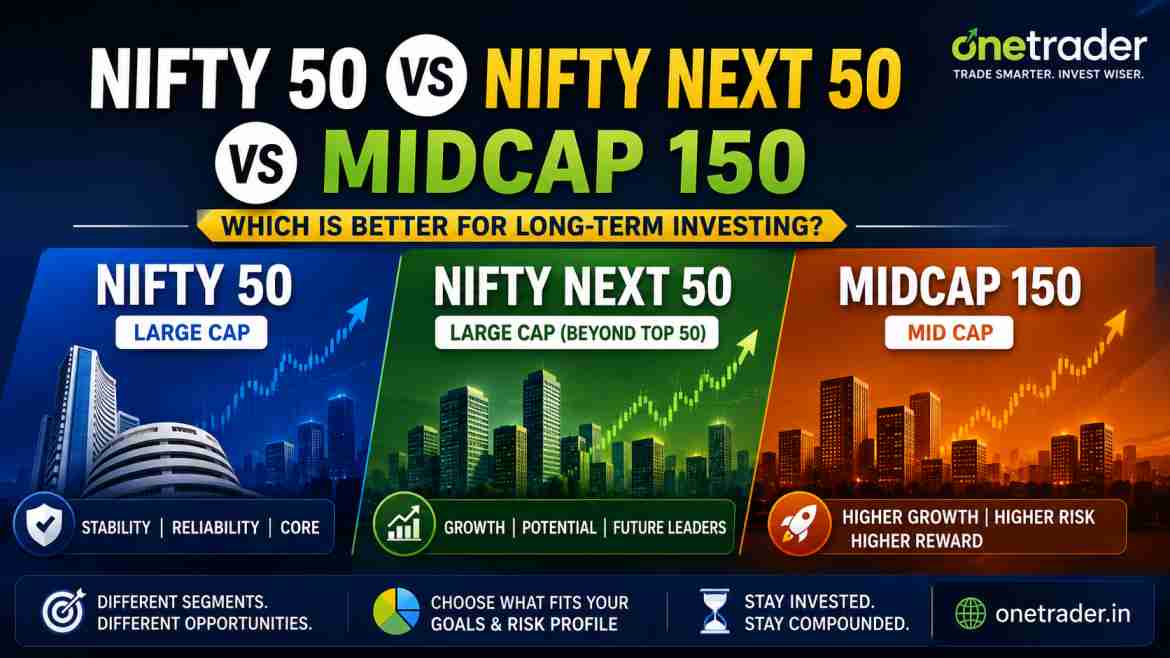
Nifty 50 vs Nifty Next 50 vs Midcap 150
The simplest way to understand the three indexes is to think of them as different layers of the market.
Nifty 50: Established large businesses and broad market exposure.
Also Read: What is a Dividend? Complete Guide for Indian Investors
Nifty Next 50: Large companies outside the Nifty 50 with additional growth potential.
Nifty Midcap 150: A broader group of mid-sized companies with potentially higher growth and higher volatility.
The important point is that higher potential returns usually come with higher risk. Investors should not select an index only because it has delivered stronger returns during a particular period.
Which One Is Better for Beginners?
For a beginner who wants a simple long-term equity investment, the Nifty 50 can be easier to understand.
Also Read: Why I Stopped Stock Picking and Switched to Broad-Market ETFs
A broad Nifty 50 ETF or index fund provides exposure to a diversified basket of major Indian companies without requiring the investor to research individual stocks.
Once an investor understands market volatility and becomes comfortable with long-term investing, additional exposure to Nifty Next 50 or Midcap 150 can be considered depending on the investor’s risk profile.
Beginners should avoid assuming that more volatility automatically means better returns.
Which One Has Higher Growth Potential?
There is no guaranteed winner.
Also Read: Biggest Stock Market Crashes in History and Lessons for Investors
Historically, different market segments have performed differently during different periods. Large caps may perform relatively better during some market conditions, while mid-caps or the Next 50 can outperform during other periods.
The Nifty Midcap 150 has greater exposure to mid-sized companies, which can provide more room for business expansion. The Nifty Next 50 also contains companies that can potentially become larger market leaders.
But growth potential comes with higher volatility. A portfolio that rises faster can also fall faster.
Therefore, investors should consider risk-adjusted returns and long-term consistency, rather than simply looking at which index generated the highest return recently.
Also Read: The 1.8 Crore Solapur Trading Tragedy: A Warning to Every Retail Trader
Which One Is More Suitable for Long-Term Investing?
The answer depends on the investor.
An investor who prioritizes simplicity and wants a core equity allocation may prefer the Nifty 50.
An investor who already has Nifty 50 exposure and wants additional growth potential may consider the Nifty Next 50.
An investor with a long investment horizon and a higher tolerance for volatility may consider adding Midcap 150 exposure.
Also Read: NSE/BSE competitor NCDEX ?
There is also no rule saying an investor must choose only one.
Can You Combine All Three?
Yes. Combining the three can provide exposure across different segments of the Indian market.
For example, an investor could use the Nifty 50 as the core allocation and add smaller allocations to Nifty Next 50 and Midcap 150.
The objective would be to create a balance between stability, growth potential and diversification.
Also Read: Mindspace REIT vs Embassy REIT vs Bagmane Prime Office REIT
However, adding multiple indexes does not automatically create a better portfolio. There can be overlap between companies and excessive exposure to equities can increase overall portfolio risk.
The allocation should therefore be based on the investor’s overall financial plan.
A Simple Way to Think About Allocation
Instead of copying someone else’s allocation, investors can think about the three indexes according to their role.
Nifty 50 = Core
Also Read: NCDEX vs MCX: Key Differences, Top Commodities & How to Trade (2026 Guide)
The foundation for broad large-cap exposure.
Nifty Next 50 = Growth
Additional exposure to large companies outside the Nifty 50.
Nifty Midcap 150 = Higher Growth / Higher Risk
Also Read: REIT Reclassification 2026: Why SEBI’s Equity Move is a Game Changer | OneTrader
Exposure to a wider group of mid-sized companies.
The more an investor moves toward Midcap 150, the more important it becomes to have a long investment horizon and the ability to tolerate larger temporary declines.
ETF or Index Fund?
Investors can access these indexes through both ETFs and index mutual funds, depending on what products are available for a particular index.
ETFs trade on the stock exchange during market hours, while index mutual funds are bought and redeemed through the mutual fund structure.
Also Read: REITs in India 2026: A Complete Guide to Real Estate Investing
For ETFs, investors should pay attention to liquidity, bid-ask spreads, expense ratios and tracking difference.
For index funds, investors should compare expense ratios, tracking performance and the fund’s overall structure.
The underlying index is important, but the specific product tracking that index also matters.
What Should Long-Term Investors Focus On?
The biggest mistake is trying to identify the single best-performing index every year.
Also Read: How to Start Investing in Stocks for Beginners in 2026 (Step-by-Step Guide) | Onetrader
Long-term investing is not about predicting which segment will outperform next month or next year. It is about choosing an asset allocation that an investor can maintain through different market cycles.
An investor who selects a highly volatile index but sells during a correction may achieve a worse result than someone who selected a less volatile index and stayed invested.
Consistency, diversification, reasonable costs and discipline are therefore more important than chasing recent performance.
Final Thoughts
Nifty 50, Nifty Next 50 and Nifty Midcap 150 serve different purposes.
Also Read: How to Identify Turnaround Companies Early (Before the Market Notices)
Nifty 50 can be considered the core option for investors seeking broad exposure to established large companies.
Nifty Next 50 can provide additional exposure to large companies outside the Nifty 50 and may suit investors looking for greater growth potential.
Nifty Midcap 150 provides broader exposure to mid-sized companies and can offer higher growth potential, but investors should also expect greater volatility.
Instead of asking which index is universally the best, investors should ask a more useful question:
Also Read: Infrastructure Investment Trusts (InvITs) in India – Complete Beginner Guide | Onetrader
Which combination fits my financial goals, investment horizon and risk tolerance?
For many long-term investors, a simple combination of broad-market exposure with carefully chosen additional allocations may be more practical than constantly switching between market segments.
Financial Disclaimer: This article is for educational and informational purposes only and should not be considered investment advice or a recommendation to buy or sell any stock, ETF, index fund or other financial product. Equity investments are subject to market risks, and past performance does not guarantee future returns. Investors should conduct their own research and consider consulting a SEBI-registered investment adviser before making investment decisions.
Also Read: Top Space-Tech Stocks in India – A Hidden Multibagger Opportunity (2025-2045)