
📘 Onetrader Futures & Options (F&O) Series — Complete Index
🎯 Series Goal
To simplify complex F&O concepts into easy, practical lessons for beginners, traders, and investors — with examples, charts, and real market insights.
🧩 PART 1: INTRODUCTION & BASICS
- What Are Futures and Options?
- Simple explanation of derivatives
- How F&O differ from equity trading
- Real examples using Nifty & Bank Nifty
- Understanding Derivatives Market
- What is derivative?
- Spot market vs derivative market
- How price discovery happens
- Why Do F&O Exist?
- Purpose: hedging, speculation, and arbitrage
- Real-life analogy (e.g., farmer & wholesaler example)
- SEBI’s regulation role
- Difference Between Futures and Options
- Comparison table
- Practical use cases
- Which suits traders vs investors
- Basic Terminology in F&O
- Contract, expiry, strike price, premium, lot size, margin, leverage
- Understanding underlying asset
- Example: Nifty Futures contract
⚙️ PART 2: FUTURES CONTRACTS EXPLAINED
- What is a Futures Contract?
- Meaning, buyer/seller obligations
- Index futures vs stock futures
- Example with payoff chart
- How Futures Contracts Work in India (NSE Example)
- Contract specifications
- Margin requirements
- Mark-to-Market (MTM) concept
- Understanding Leverage and Margin
- How leverage amplifies profits/losses
- SPAN margin + exposure margin
- Example with calculations
- Futures Expiry, Rollover & Settlement
- Monthly expiry cycle
- Physical vs cash settlement
- Rollover logic used by institutions
- How Institutions Use Futures (Hedging Example)
- FIIs, DIIs, and Hedgers
- Futures data interpretation
- Long build-up vs short covering
📊 PART 3: OPTIONS FUNDAMENTALS
- What is an Option Contract? (Call & Put Basics)
- Meaning and difference
- Rights vs obligations
- Real market example (Nifty Call option)
- Call Options Explained with Examples
- When to buy and sell Calls
- Profit/loss chart
- Premium concept
- Put Options Explained with Examples
- When to buy and sell Puts
- Hedging with Put
- Example with stock protection
- How Option Premium is Decided (Intrinsic + Time Value)
- Intrinsic value formula
- Time decay
- ATM, ITM, OTM options explained
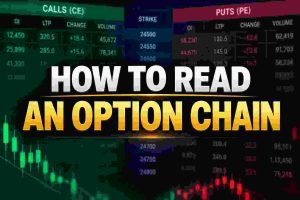
- Option Chain Data Explained
- Reading open interest (OI)
- Support & resistance zones
- Practical example with Nifty option chain
📈 PART 4: OPTION GREEKS SIMPLIFIED
- Introduction to Option Greeks
- Why Greeks matter
- Delta, Gamma, Theta, Vega, Rho overview
- Delta Explained with Real Example
- Meaning of Delta
- Relation with strike price movement
- Theta & Time Decay
- How options lose value over time
- Practical chart examples
- Gamma, Vega, and Rho Simplified
- How volatility and interest rates impact pricing
- How traders use these Greeks
- Practical Use of Greeks in Trading Decisions
- How to select strike prices using Greeks
- Risk management with Greeks
💡 PART 5: OPTION STRATEGIES (BEGINNER TO ADVANCED)
- Introduction to Option Strategies
- Why traders use strategies
- Single-leg vs multi-leg
- Basic Strategies for Beginners
- Covered Call
- Protective Put
- Long Straddle / Strangle
- Intermediate Strategies
- Bull Call Spread
- Bear Put Spread
- Butterfly Spread
- Advanced Strategies
- Iron Condor
- Iron Butterfly
- Ratio Spreads
- Calendar Spreads
- Strategy Selection Based on Market View
- Bullish, Bearish, Neutral, Volatile conditions
- Example setups for Nifty & stocks
📉 PART 6: DATA ANALYSIS & PSYCHOLOGY
- How to Use OI Data & PCR Ratio
- Interpreting OI, volume, and PCR
- How institutions position themselves
- Understanding Volatility Index (VIX)
- What is India VIX
- Relation between VIX & option premium
- How to Read FII/DII F&O Data
- Long-short positions
- How data impacts short-term market moves
- F&O Risk Management
- Position sizing
- Stop loss techniques
- Avoiding over-leverage
- F&O Trader Psychology
- Emotional discipline
- How smart traders survive in derivatives
🧠 PART 7: PRACTICAL LEARNING & TOOLS
- Live Option Chain Analysis (Nifty/Bank Nifty)
- Example interpretation using NSE site
- Best Tools & Websites for F&O Traders
- NSE India, Sensibull, Opstra, StockEdge, etc.
- Creating a Simple F&O Trading Journal
- Record entry, exit, strike, reason, and result
- Taxation on F&O Trading
- How F&O income is treated as business income
- Audit rules & tax filing tips
- Common Mistakes F&O Traders Make
- Overtrading, ignoring Greeks, averaging losses
🔔 BONUS SECTION
- Weekly Expiry Trading Strategies
- Thursday expiry setups
- Intraday premium decay logic
- Budget, Election & Event Trading in F&O
- How volatility spikes affect options
- Futures vs Options — Which is Better for You?
- Depends on risk profile, capital, and strategy
- How to Build a Monthly Income Using Options
- Safe positional option selling techniques
- Final Recap: From Beginner to Pro — Your F&O Journey with Onetrader
- Summary, guidance, and next steps
- Promotion of Onetrader tools & trading community
FAQ Section (for blog bottom)
Q1: What are Futures and Options in simple terms?
A: Futures and Options are financial contracts that derive their value from an underlying asset like stocks or indices. Futures involve an obligation to buy or sell, while Options give the right without obligation.
Q2: Is F&O trading risky for beginners?
A: Yes, F&O involves leverage and volatility. Beginners should start with learning and practice before live trading to manage risk properly.
Q3: How much capital is needed to start F&O trading in India?
A: Minimum margin for one lot of Nifty can range from ₹60,000 to ₹90,000 depending on market volatility and exchange requirements.
Also Read: How to Read an Option Chain: A Simple Guide for Beginners
Q4: What are Option Greeks?
A: Option Greeks — Delta, Gamma, Theta, Vega, and Rho — measure how option prices move with respect to time, volatility, and price changes.
Q5: Which is better — Futures or Options?
A: Futures suit directional traders with high capital, while Options provide flexibility through limited risk and various strategies for different market conditions.