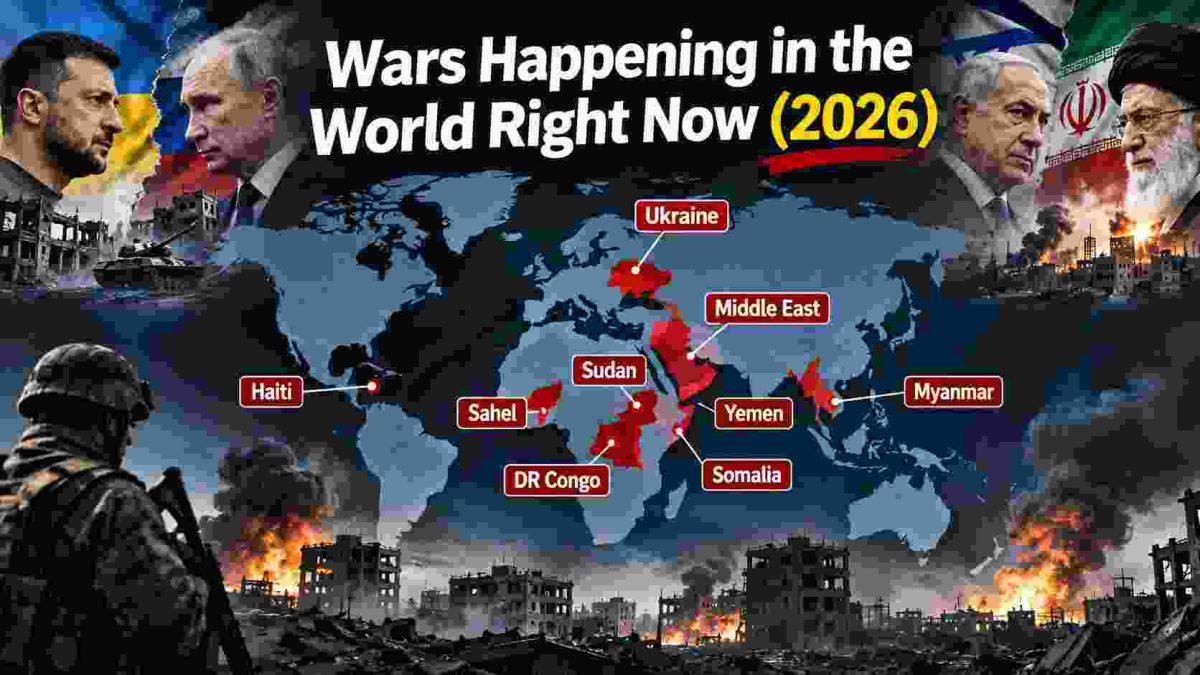
Wars are no longer confined to one part of the world. From the battlefields of Ukraine to the Middle East and the civil war in Sudan, armed conflicts are reshaping international relations, displacing millions of people and creating economic uncertainty across continents.
Some conflicts involve two countries fighting directly. Others are civil wars, insurgencies or prolonged struggles between governments and armed groups. Although their causes differ, their consequences often extend far beyond the countries where the fighting takes place.
As of November 2026, several major conflicts remain active around the world. The situation can change quickly, particularly in the Middle East, where military operations and diplomatic negotiations are unfolding simultaneously. This guide examines the most significant conflicts, how they began and why they matter to the rest of the world.
1. Russia–Ukraine War: A Conflict Reshaping Europe
The Russia–Ukraine war remains one of the most consequential military conflicts in the world. Its immediate origins date to February 2022, when Russia launched a full-scale invasion of Ukraine. However, the conflict’s roots go back further, including Russia’s annexation of Crimea in 2014 and the fighting that followed in eastern Ukraine.
Also Read: CEO vs CFO vs COO: Who Runs What in a Business and How the Three Roles Work Together
Russia has sought to exert control over Ukrainian territory and influence the country’s geopolitical direction. Ukraine has resisted the invasion, receiving military, financial and diplomatic support from Western countries.
The war has caused extensive destruction, civilian suffering and displacement. It has also changed European defence policy, increased NATO’s strategic importance and placed sustained pressure on relations between Russia and Western governments.
Its economic consequences extend well beyond Europe. Disruptions to energy markets, agricultural exports, shipping and international trade have demonstrated how a regional war can affect businesses and consumers around the world.
2. Israel, Iran and the Wider Middle East Conflict
The confrontation involving Israel and Iran has become a major source of international concern. The two countries were once unofficial partners, but their relationship deteriorated sharply after Iran’s 1979 Islamic Revolution.
Also Read: Understanding Different Types of Costs: How Businesses Calculate, Manage and Control Their Expenses
For decades, their rivalry was fought largely through covert operations, cyberattacks, regional armed groups and military actions in neighbouring countries. The conflict subsequently escalated into direct military confrontation.
In 2026, the war involving the United States, Israel and Iran has created additional risks for the wider region. Diplomatic efforts have continued, but negotiations remain difficult and military tensions have not been fully resolved. The Strait of Hormuz has become a particular concern because of its importance to international oil shipments.
The consequences could be significant for the global economy. Any sustained disruption to energy exports or commercial shipping can raise transportation costs, increase inflationary pressure and unsettle financial markets.
For countries such as India, which depend heavily on imported crude oil, prolonged instability in the Gulf could increase the import bill and put pressure on businesses and household budgets.
Also Read: Angel One’s Success Story: How Distribution Built One of India’s Largest Stockbrokers
3. Israel–Palestine Conflict: A Long-Running Dispute
The Israel–Palestine conflict predates the current wars in the region by many decades. Its roots include competing national movements, territorial claims, the displacement of Palestinians during the 1948 war and disagreements over borders, security and political sovereignty.
The conflict intensified dramatically after the Hamas-led attacks on Israel on October 7, 2023, and Israel’s subsequent military campaign in Gaza.
The fighting has caused extensive destruction and a severe humanitarian crisis. Civilians have faced displacement, shortages of essential supplies and damage to homes, hospitals and other infrastructure.
The central political questions remain difficult to resolve, including the future governance of Gaza, the security of Israelis, Palestinian statehood, the status of Jerusalem and the rights of displaced Palestinians.
Also Read: Groww’s Success Formula: How a Simple Investing App Overtook India’s Established Stockbrokers
Although international diplomacy has repeatedly sought to reduce the violence, a lasting political settlement remains a major challenge.
4. Sudan Civil War: A Humanitarian Crisis in Africa
Sudan’s civil war began in April 2023 when fighting erupted between the Sudanese Armed Forces and the paramilitary Rapid Support Forces.
The two forces had previously shared power following the removal of longtime ruler Omar al-Bashir in 2019. Tensions over political authority and plans to integrate the RSF into the regular military eventually developed into open warfare.
The conflict has devastated communities, damaged essential infrastructure and driven large numbers of people from their homes. Food insecurity and restricted humanitarian access have made conditions particularly dangerous for civilians.

Sudan’s crisis also has regional implications. Refugees have crossed into neighbouring countries, while continued instability threatens trade, agriculture and security across parts of northeastern Africa.
The war receives less international attention than some other conflicts, but its humanitarian consequences are among the most serious in the world.
5. Myanmar Civil War: The Struggle Against Military Rule
Myanmar has experienced renewed nationwide conflict since the military seized power in a February 2021 coup, overthrowing the elected government of Aung San Suu Kyi.
Protests against military rule developed into armed resistance. Pro-democracy groups and long-established ethnic armed organisations have fought the military across multiple regions.
The conflict has fragmented control over parts of the country and severely affected ordinary people. Airstrikes, fighting, displacement and restrictions on access to essential services have worsened the humanitarian situation.
Myanmar’s strategic location between South and Southeast Asia also makes its instability relevant to neighbouring countries, including India, China and Thailand. Border security, refugee movements and disruptions to trade are among the concerns.
A political settlement remains difficult because the opposing sides have sharply different objectives and there is no universally accepted path toward restoring stable civilian governance.
6. Yemen: A Civil War With International Consequences
Yemen’s conflict developed out of political instability following the country’s failed transition after the 2011 uprising. Fighting escalated in 2014 when Houthi forces took control of the capital, Sanaa. A Saudi-led military intervention followed in 2015 in support of Yemen’s internationally recognised government.
Over time, the conflict became more complicated, involving regional powers, rival Yemeni factions and armed groups with different political aims.
The war has contributed to widespread poverty, displacement and severe humanitarian needs. Even when front-line fighting decreases, the country continues to face challenges involving food security, public services and economic recovery.
Yemen is also strategically important because of its position near the Bab el-Mandeb Strait, a vital shipping passage linking the Red Sea with the Gulf of Aden. Attacks on commercial vessels and threats to shipping have raised international concerns about trade routes and maritime security.
7. Conflict in the Democratic Republic of the Congo
Eastern Democratic Republic of the Congo has endured decades of insecurity involving government forces, local militias and numerous armed groups.
One of the most prominent recent challenges has been the M23 rebellion. Fighting in the eastern provinces has displaced civilians and intensified tensions between the Democratic Republic of the Congo and Rwanda, which has faced international accusations of supporting M23. Rwanda has disputed aspects of these allegations.
The region’s mineral resources, including materials important to electronics and battery manufacturing, add an economic dimension to the conflict. However, the violence cannot be explained by minerals alone. Local political grievances, land disputes, ethnic tensions and regional security concerns are also important factors.
The continuing crisis threatens civilian safety and complicates efforts to establish stable governance across the region.
8. Sahel Insurgency: Violence Across West Africa
Parts of the Sahel, particularly Mali, Burkina Faso and Niger, continue to face attacks by Islamist armed groups and other security challenges.
The current crisis developed from conflicts in northern Mali and expanded across borders. Weak state institutions, political instability, local grievances and competition over resources have helped armed groups establish a presence in vulnerable areas.
Military governments have struggled to restore security despite repeated operations. Violence has displaced communities, disrupted farming and trade, and made humanitarian assistance difficult to deliver.
The conflict also affects international relations. Governments in the region have changed security partnerships, while neighbouring countries remain concerned about the possibility of further instability spreading across West Africa.
9. Somalia: The Fight Against al-Shabaab
Somalia continues to face a prolonged insurgency led by al-Shabaab, an armed extremist organisation linked to al-Qaeda.
The group has carried out attacks against Somali security forces, government institutions and civilians. Somali authorities, supported by international partners, have conducted military operations intended to weaken the organisation.
However, the conflict is difficult to end because of persistent security gaps, political divisions and the challenges of establishing effective governance across the country.
Drought, food insecurity and displacement add to the pressure on communities already affected by violence.
The situation matters beyond Somalia because instability can affect neighbouring countries, regional trade and security around the Horn of Africa and the western Indian Ocean.
10. Haiti: Armed Gangs and a Deepening Security Crisis
Haiti faces a severe security crisis involving heavily armed gangs, particularly in and around the capital, Port-au-Prince.
The situation is not a conventional war between two countries. Instead, armed groups have challenged state authority, fought over territory and disrupted transport, businesses and essential public services.
Political instability, weak institutions, poverty and limited access to security and justice have made it difficult to restore order.
The violence has forced families from their homes and complicated the delivery of food, medical care and humanitarian assistance.
International efforts to support Haitian security forces continue, but a durable solution will require more than security operations. Effective governance, functioning public institutions and economic recovery will also be essential.
Why These Conflicts Matter to the Global Economy
Wars create consequences that reach far beyond the battlefield. Energy supply, international trade, food production and financial markets can all be affected by prolonged instability.
The Middle East is particularly important to energy markets because of its oil and gas production and strategic shipping routes. A serious disruption to shipments through the Strait of Hormuz can affect oil prices, inflation expectations and the costs faced by energy-importing countries.
The Russia–Ukraine war has demonstrated how conflict can disrupt agricultural exports, energy supplies and regional investment. Meanwhile, insecurity in Africa and Asia can damage local production, interrupt supply chains and increase the need for humanitarian assistance.
Financial markets also react to geopolitical uncertainty. Investors may reduce exposure to risky assets, while gold, certain government bonds and the US dollar can attract additional demand. Energy and defence companies may benefit in some circumstances, but their performance depends on valuations, contracts, costs and the wider economic environment.
Importantly, not every war causes stock markets to fall for an extended period. Markets respond to the scale of the conflict, its likely economic consequences and whether events turn out better or worse than investors expected.
Is the World Moving Toward a Larger Global War?
The number of active conflicts is a serious concern, but several regional wars do not automatically mean that a third world war is inevitable.
Major powers have competing interests, military alliances and strategic rivalries. Direct confrontation between nuclear-armed states would carry enormous risks, which is one reason diplomacy, deterrence and crisis communication remain important.
At the same time, regional conflicts can spread when neighbouring countries intervene, armed groups expand their operations or vital trade routes come under threat. Miscalculation can make a dangerous situation even harder to control.
The most useful approach is to follow verified developments, distinguish direct military involvement from political support, and avoid treating every international dispute as the beginning of a global war.
Conclusion
The world’s current conflicts have different origins. Some stem from territorial disputes, others from struggles over political power, and many are shaped by historical grievances and regional rivalries.
Ukraine, the Middle East, Sudan, Myanmar and several other conflict zones show that war remains a major humanitarian and geopolitical challenge in 2026.
For the global economy, the consequences can include disrupted trade, higher energy costs, uncertain investment conditions and greater pressure on public finances. For civilians, the costs are far more immediate: lost homes, disrupted education, displacement and the constant threat of violence.
Understanding where these conflicts began, who is involved and why they continue is essential to understanding the wider world. Their future will depend on developments on the ground, diplomatic negotiations and whether political leaders can find workable paths toward lasting peace.
This geopolitical and economic analysis is presented by Onetrader. The article is for informational and educational purposes only and should not be treated as investment advice.





Keep learning with OneTrader
Explore structured lessons and practical guides to build your market knowledge.

Need a laugh after all that money talk?
Paisa LOL: India's funniest finance page, with memes, comics, jokes and long funny stories.