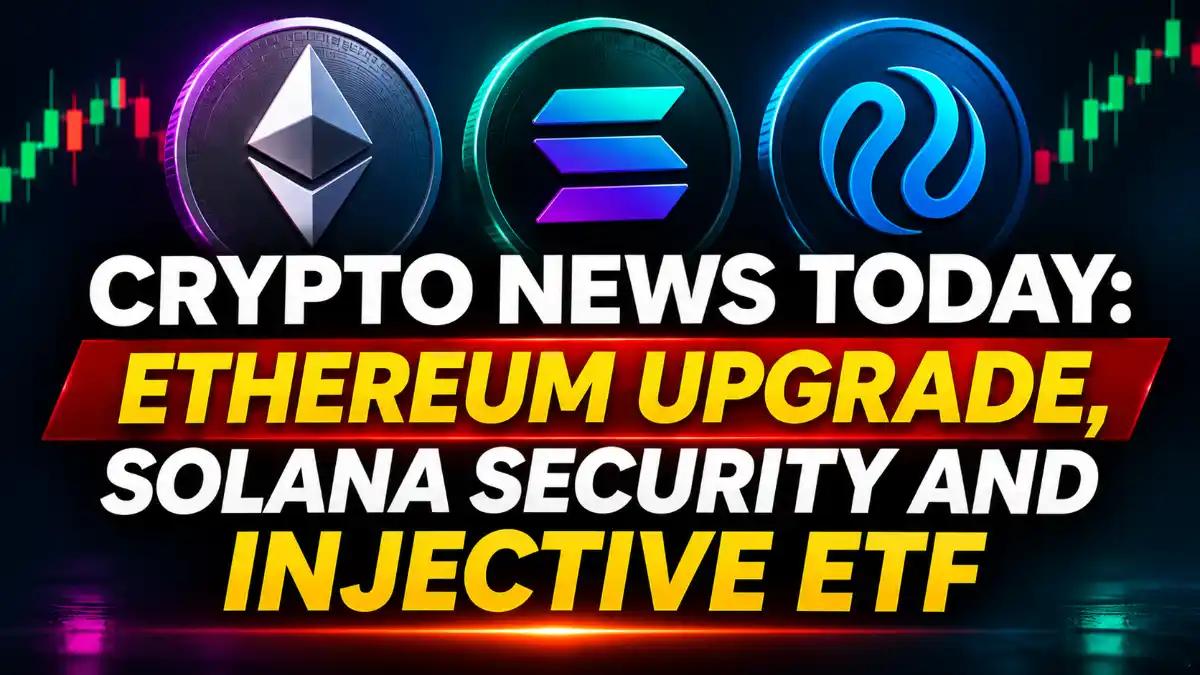
The cryptocurrency industry is facing an important week of infrastructure changes, with Ethereum developers working to prevent the next major network upgrade from disrupting existing applications, while Solana developers are proposing the removal of a transaction feature associated with a major DeFi security breach. At the same time, Injective has entered a new phase of institutional adoption after the launch of a staked cryptocurrency exchange-traded fund on Nasdaq.
These developments offer a different perspective on the digital-asset market. Beyond daily token prices, blockchain networks are increasingly being judged on their ability to protect existing applications, improve transaction security and provide financial products that traditional investors can access through regulated market infrastructure.
Ethereum’s Glamsterdam upgrade has become the most important technical discussion of the day, while Solana’s proposed changes highlight how security incidents can influence the long-term design of a blockchain.
In simple words: Major blockchain networks are changing how they operate to improve security, reliability and financial services. Ethereum is trying to avoid breaking existing applications, Solana wants to remove a transaction feature that attackers exploited, and Injective is attracting attention through a new Nasdaq-listed investment product.
Ethereum Glamsterdam Upgrade Faces Compatibility Questions
Ethereum’s upcoming Glamsterdam upgrade has encountered a significant development challenge after security researchers identified existing applications that could stop functioning correctly under proposed changes to transaction gas pricing.
The Ethereum Foundation has asked smart-contract developers and security auditors to examine how their applications depend on the network’s existing gas rules.
The concern centres on proposed changes involving EIP-8037 and EIP-8038. These proposals alter the costs associated with contract creation and stored blockchain data. While the changes are intended to improve Ethereum’s resource accounting, applications built around the existing pricing assumptions could experience unexpected failures.
Developers have now proposed competing solutions to preserve compatibility. One approach would allow existing contracts to continue operating under legacy gas rules while applying the revised pricing structure to newly deployed contracts. Another proposal would introduce separate accounting mechanisms to accommodate older applications.
| Ethereum Glamsterdam development | Details |
|---|---|
| Upgrade | Glamsterdam |
| Key proposals | EIP-8037 and EIP-8038 |
| Competing compatibility proposal | EIP-8488 |
| Contract creation base gas charge under EIP-8037 | 183,600 gas |
| Previous base charge | 32,000 gas |
The issue is particularly important for decentralised finance applications that manage customer deposits, lending positions and automated transactions. Some deployed contracts cannot simply be modified when the underlying network changes.
The Ethereum Foundation has delayed the next Hoodi testnet fork while developers investigate the compatibility concerns. The competing solutions remain proposals rather than approved changes.
For Ethereum, the challenge is balancing network improvements with the responsibility of preserving applications that already hold substantial economic value.
Solana Proposes Removing Transaction Feature Linked to Drift Exploit
Solana is pursuing a significant security-related change through a proposal to retire its durable nonce transaction mechanism.
Also Read: GIFT Nifty Today, November 9, 2026: Market Opening Sentiment and Key Levels
The feature allows a transaction to remain valid for an extended period instead of expiring under the network’s normal blockhash rules. This capability has practical value for cryptocurrency exchanges and institutional custodians that require offline transaction signing and multiple approval stages.

However, the mechanism also creates a security challenge. Attackers exploited pre-signed transactions during the Drift protocol incident, demonstrating how delayed transaction execution can create vulnerabilities when authorisation controls are compromised.
Anza developer Gabe Rodriguez submitted SIMD-0723, proposing that Solana eventually require transactions to use recent blockhashes instead.
| Solana security development | Details |
|---|---|
| Proposal | SIMD-0723 |
| Affected feature | Durable nonces |
| Proposed earliest activation | May 5, 2027 |
| Drift exploit losses | At least $270 million |
| Durable nonce share of network traffic in one measured period | Approximately 3% |
| Share of priority fees in that period | Approximately 30% |
The proposal has important implications for exchanges and institutional custody providers. These organisations often rely on offline signing systems to protect private keys, and they need sufficient time to migrate to alternative transaction-authorisation arrangements.
The replacement process will therefore require careful testing. Removing an existing security mechanism without providing reliable alternatives could create operational difficulties for institutions using Solana.
The proposal still requires technical approval before implementation. Its importance lies in the broader direction of Solana’s development: strengthening transaction security while preserving the operational requirements of large financial participants.
Injective Enters Nasdaq ETF Market With Staking Exposure
Injective has attracted fresh institutional attention following the launch of Canary Capital’s staked INJ exchange-traded fund on Nasdaq.
Unlike conventional cryptocurrency investment products that primarily provide price exposure, the fund is designed to participate in Injective’s proof-of-stake mechanism. This allows eligible holdings to generate staking rewards, subject to the fund’s operating expenses and applicable risks.
Also Read: Bitcoin Holds Near $76,000 as Weekend Trading Slows, Zcash Upgrade Draws Altcoin Attention
The product gives investors a familiar brokerage-based route to gain exposure to INJ without directly managing cryptocurrency wallets, validator participation or private keys.
| Injective ETF development | Reported figure |
|---|---|
| Nasdaq ticker | INJC |
| Trading began | November 5, 2026 |
| Net assets by November 6 | $16.12 million (approximately ₹151.7 crore) |
| Planned staking allocation | At least 90% of INJ holdings |
| Annual sponsor fee | 1.10% |
The initial asset figure needs to be interpreted carefully. The fund’s reported share count remained unchanged during its first two trading sessions, so the increase in net assets should not automatically be interpreted as evidence of substantial new investor subscriptions.
The launch nevertheless represents another step in the development of exchange-traded cryptocurrency products beyond Bitcoin and Ethereum.
Injective has also introduced Institutional Rail, designed to connect financial institutions with its blockchain infrastructure through dedicated application programming interfaces. The service aims to provide more predictable transaction processing while allowing institutions to retain custody of their assets.
The combination of exchange-traded exposure, staking and institutional infrastructure makes Injective an interesting example of how blockchain projects are attempting to connect decentralised networks with conventional financial services.
Cryptocurrency Prices Today: Bitcoin and Major Altcoins
While network developments are attracting attention, cryptocurrency prices remain under pressure during Monday’s session. Ethereum and XRP are among the weaker major assets, while Bitcoin is also trading lower.
| Cryptocurrency | USD price | Approx. INR price | 24-hour change |
|---|---|---|---|
| Bitcoin (BTC) | $74,191 | ₹69,70,489 | −2.07% |
| Ethereum (ETH) | $2,108 | ₹1,98,096 | −5.58% |
| BNB | $682 | ₹64,024 | −2.28% |
| XRP | $1.10 | ₹103 | −5.63% |
| Solana (SOL) | $86.44 | ₹8,121 | −2.87% |
Monday’s reported Indian market snapshot at 1:58 PM IST, converted using approximately ₹93.95 per USD. Prices and percentage changes are indicative.
The market’s weakness reinforces an important distinction between cryptocurrency valuations and blockchain development. Technical improvements, institutional products and stronger security arrangements can progress even when token prices are declining.
For long-term observers, the more meaningful question is whether these developments translate into sustained application usage, institutional participation and economic demand for the underlying tokens.
Why Blockchain Upgrades Matter Beyond Cryptocurrency Prices
Blockchain upgrades are changes to the software rules that determine how a network processes transactions, manages data and protects assets. They can influence the reliability of applications, transaction costs and the incentives available to validators.
For investors, understanding the purpose of an upgrade is often more useful than reacting to its announcement alone.
Three factors deserve particular attention:
Also Read: Top 10 Indian Stock Market News Today, November 7, 2026: Weekend Edition
| What to examine | Why it matters |
|---|---|
| Network security | Determines how effectively the blockchain protects transactions and applications |
| Application compatibility | Shows whether existing developers and users can continue operating without disruption |
| Economic incentives | Influences validator participation, staking demand and token utility |
An upgrade that improves security but creates compatibility problems may require additional development before delivering its intended benefits. Similarly, a staking product can improve investment accessibility without guaranteeing increased demand for the underlying cryptocurrency.
The strongest blockchain ecosystems will be those that combine reliable infrastructure, meaningful application activity and sustainable economic incentives.
The Bigger Picture for Crypto Investors
Monday’s developments highlight a shift in the cryptocurrency industry’s priorities. Ethereum is addressing the technical risks associated with major network changes, Solana is reconsidering an important transaction mechanism, and Injective is expanding its connection with traditional investment markets.
These are meaningful developments because the long-term success of cryptocurrencies depends on more than price appreciation. Security, compatibility, institutional access and real-world financial applications will increasingly determine which blockchain networks attract lasting participation.
For investors following the sector, this week’s developments provide several important areas to watch as the industry continues building its financial infrastructure.
Financial Disclaimer
This article is for educational and informational purposes only. It does not constitute financial or investment advice or a recommendation to buy, sell or hold any cryptocurrency. Digital assets involve substantial market, technology, liquidity and regulatory risks. Cryptocurrency ETFs and staking products also carry additional investment risks. Onetrader is not registered with SEBI as an investment adviser.


Keep learning with OneTrader
Explore structured lessons and practical guides to build your market knowledge.

Need a laugh after all that money talk?
Paisa LOL: India's funniest finance page, with memes, comics, jokes and long funny stories.