
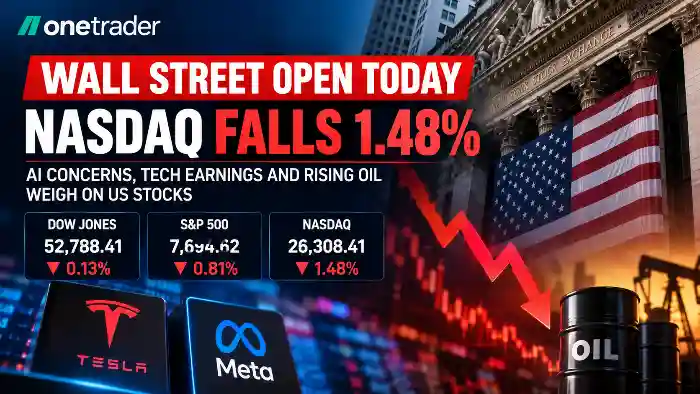
US stocks opened sharply lower on Thursday, October 22, 2026, as renewed concerns about artificial intelligence spending, mixed reactions to major technology earnings and rising crude oil prices weighed on Wall Street. The Nasdaq Composite led the declines, while the S&P 500 and Dow Jones Industrial Average also began the session in negative territory.
The weakness followed Wednesday’s advance, when earnings from SpaceX and Super Micro Computer had helped revive enthusiasm for AI-related stocks. However, financial updates from Tesla and Meta Platforms prompted investors to reassess the costs and potential returns associated with expanding artificial intelligence infrastructure.
Dow Jones, S&P 500 and Nasdaq Opening Levels
Wall Street’s three major benchmarks opened lower, with the technology-heavy Nasdaq recording the largest percentage decline.
| US index | Opening level | Opening change |
|---|---|---|
| Dow Jones Industrial Average | 52,788.41 | -0.13% |
| S&P 500 | 7,694.62 | -0.81% |
| Nasdaq Composite | 26,308.41 | -1.48% |
The Dow declined 67.7 points at the opening bell, while the S&P 500 fell approximately 62.6 points. The Nasdaq dropped about 394.5 points as selling pressure returned to technology and growth-oriented shares.
Also Read: Sensex Nifty Weekly Review: Indian Markets Fall Over 2% in Holiday-Shortened Week (Oct 19-23, 2026)
These figures represent the confirmed opening levels on October 22, rather than intraday or closing quotations.
Tesla and Meta Earnings Put AI Spending Under Scrutiny
Tesla and Meta Platforms were among the most closely watched companies following their earnings announcements on Wednesday, October 21.
Tesla came under pressure after reducing its annual capital expenditure forecast. The revision raised questions about the timing and scale of investments associated with its artificial intelligence, autonomous technology and robotics ambitions. Tesla shares were down approximately 5.3% in early premarket trading.
Meta also attracted attention after introducing new non-voting shares to support financing for its AI expansion. Although the company had delivered an encouraging earnings update, the financing announcement renewed scrutiny of the capital required for large-scale artificial intelligence development. Meta shares were down approximately 1.9% in the premarket snapshot reported by Reuters.
The different earnings developments highlighted a common issue facing major technology companies: the relationship between substantial AI investment commitments and the financial returns expected from those investments.
Semiconductor and Technology Stocks Face Selling Pressure
Selling pressure extended beyond Tesla and Meta into semiconductor manufacturers and other companies associated with the artificial intelligence industry.
Before the opening bell, Nvidia shares were down approximately 2.4%, while Amazon declined 1.6%. Intel fell 5.1%, and several other semiconductor companies, including AMD, Qualcomm, Marvell Technology, Broadcom and Micron Technology, recorded premarket declines ranging from approximately 2.9% to 5.3%.
SpaceX and Super Micro Computer also weakened in premarket trading, falling approximately 2.3% and 4.7%, respectively, after contributing to Wednesday’s market optimism.
Also Read: Top 10 Fresh Indian Market News Today: Q2 Results From CG Power, Jana SFB and More
These figures were recorded before regular trading began and should not be interpreted as the companies’ final performance for Thursday.

Rising Oil Prices Add to Market Pressure
Crude oil prices climbed on Thursday amid renewed concerns about supply disruptions in the Middle East. Brent crude rose more than 3% to approximately $112 per barrel during early trading, approaching a five-month high.
Reports of further Houthi attacks in Saudi Arabia intensified concerns about regional energy infrastructure and the possibility of wider disruptions to crude supplies.
Higher oil prices have implications for transportation, manufacturing and consumer costs. They can also complicate the inflation outlook at a time when investors are assessing the Federal Reserve’s monetary policy direction.
Also Read: Persistent Systems: Why Investors Should Watch Nagarro Integration
The rebound in crude prices added another source of uncertainty alongside the selling pressure on technology stocks.
US Jobless Claims Fall to 194,000
Fresh economic data showed that applications for US unemployment benefits declined during the week ended October 17.
Initial jobless claims fell by 6,000 to a seasonally adjusted 194,000, below economists’ expectations of 200,000. The previous week’s figure was revised to 200,000.
The four-week moving average declined by 1,000 to 197,750. Meanwhile, continuing unemployment claims increased by 25,000 to 1.728 million for the week ended October 10.
The figures indicated that layoffs remained relatively limited. However, continuing claims increased, highlighting the importance of distinguishing between the pace of job losses and the strength of new hiring.
The report also covered the survey period used to calculate the payroll component of October’s US employment report.
Federal Reserve Policy Remains in Focus
The latest labor market figures arrived against a backdrop of elevated energy prices and uncertainty surrounding inflation.
The Federal Reserve raised its benchmark interest rate by 25 basis points in September, bringing the target range to 3.75%–4.00%.
Also Read: Top 10 Fresh Indian Market News Today: Infosys, Shriram Finance and More
Economists cited by Reuters expected the central bank to leave interest rates unchanged at its next meeting, although those expectations remain subject to incoming economic information.
The combination of subdued layoffs and higher energy costs presents a complicated policy environment. Labor market resilience can support economic activity, while sustained increases in oil prices can create additional inflationary pressure.
Wall Street Opening Summary
Thursday’s opening session reflected renewed caution toward technology valuations and the financial implications of expanding artificial intelligence investment.
The Nasdaq’s 1.48% opening decline was substantially larger than the Dow’s 0.13% loss, demonstrating the greater pressure on technology-heavy benchmarks.
Tesla and Meta earnings, weakness across semiconductor stocks, rising crude oil prices and the latest unemployment claims figures were among the principal developments shaping market sentiment.
The verified opening data confirmed a negative start to Thursday’s session. Subsequent price movements and final closing levels were not established by these opening figures.
Disclaimer
This article is published by Onetrader for educational and informational purposes only. It does not constitute investment advice, financial recommendations, or an invitation to buy or sell securities. Stock prices, market indexes and economic information may change after publication. Readers should independently evaluate financial information before making investment decisions.
Onetrader is not registered with SEBI as an investment adviser or research analyst.




Keep learning with OneTrader
Explore structured lessons and practical guides to build your market knowledge.