🔥 In-Depth: Trump’s 100% Tariff Threat on China — Why U.S. Markets Crashed Today (and what happens next)
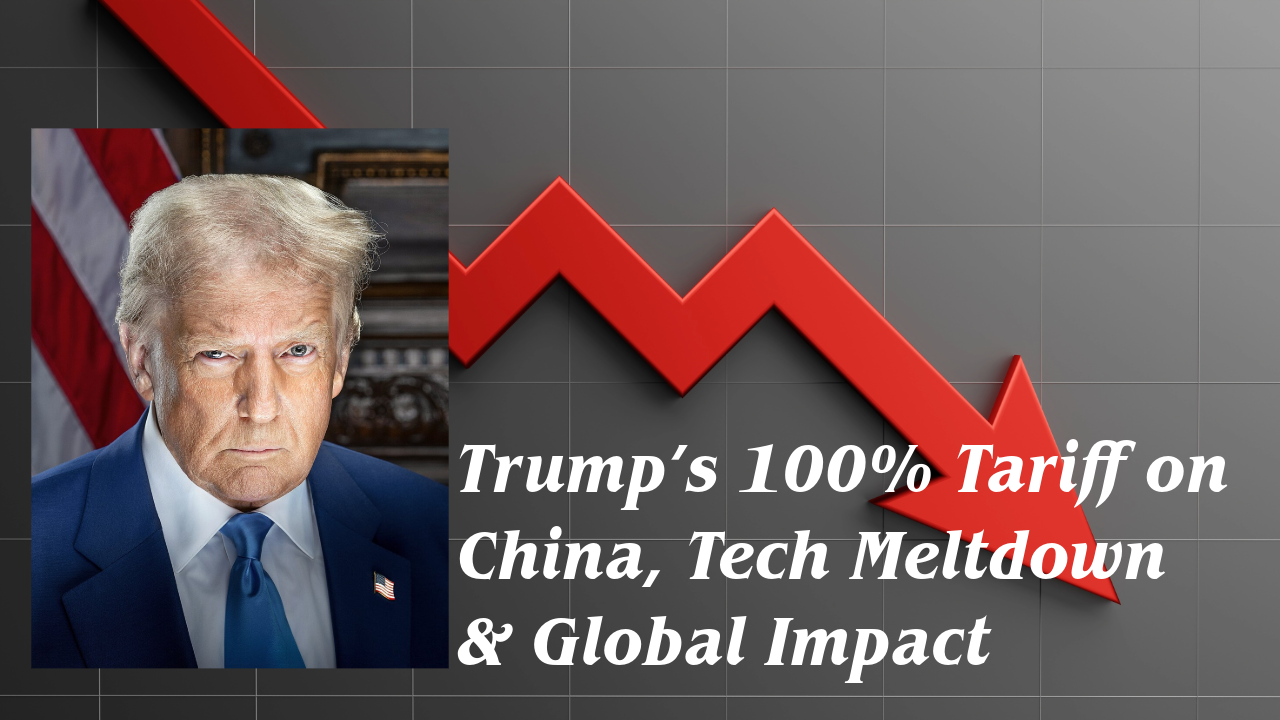
Short takeaway: President Trump’s surprise threat to impose a 100% tariff on Chinese imports (and new U.S. export limits on key software) — framed as a response to China’s tightened controls on rare earths — produced an immediate shock to risk assets. The S&P 500 and Nasdaq recorded their steepest daily falls in months; tech and semiconductor names were hit hardest as investors priced in higher costs, disrupted supply chains, and the prospect of a renewed, broad US–China trade war.
1) What actually happened (short timeline)
- China tightened export control rules on rare earths and related materials, expanding licensing requirements and limiting exports tied to defense and advanced-tech uses. That was announced by Beijing and widely reported.
- Within 24 hours the U.S. response escalated: President Trump announced the U.S. was considering a 100% tariff on Chinese imports (effective November 1 or sooner) and possible export controls on key U.S. software. The announcement was abrupt and framed as retaliation for China’s export controls.
- Markets reacted immediately: S&P 500 fell roughly 2.7%, Nasdaq fell ~3.6%, and the Dow dropped near 1.9% in a single session; semiconductor indices plunged more (Philadelphia Semicon ~6%+). Volatility spiked and safe havens (bonds, gold) saw flows.
2) Why this hit markets so hard — the core mechanics (clear, step-by-step)
A. Surprise + policy uncertainty
Markets hate surprises. A sudden announcement of sweeping tariffs and export controls forces traders to reprice risk immediately — algorithmic selling + stop-losses amplify moves within minutes. That shock creates liquidity squeezes and a cascade of selling.
B. China’s leverage: rare earths are strategic inputs
China controls a dominant share of the refining and processing of rare-earth elements (used in permanent magnets, EV motors, aerospace, electronics and some defense systems). If China restricts those exports, costs for many high-tech supply chains jump or suppliers become scarce — an inflation-and-supply-shock combo.
C. Hit to tech & semiconductors
Many top U.S. tech names depend on either Chinese manufacturing, Chinese demand, or chips made using supply chains that include Chinese inputs. Semiconductors are both supply-chain sensitive and valuation-heavy (highly priced future cash flows). When tariffs or export controls threaten margins or production, highly valued tech stocks are re-rated down fast. The Philadelphia Semiconductor Index plunged on the news.
Also Read: US Tech Stocks in 2026: Should Indian Investors Invest After the Recent Correction?
D. Inflation + margins
A 100% tariff is effectively a massive price shock for imported goods. Higher input costs—if passed to consumers—raise inflation expectations, which can push central banks to be more cautious and reduce real earnings multiples. Markets reprice future profits lower when policy risks to margins rise. (Past tariff waves have pushed prices higher in consumer categories.)
E. Global growth & trade channels
Trade restrictions reduce global trade volumes and business confidence. A hit to trade dampens corporate investment and GDP growth expectations worldwide — another reason global risk assets fall in sync. Reuters and other outlets found global markets moved down after the announcements.
3) How serious is a “100% tariff”? (legalities & realistic enforcement)
- Legal authority exists for presidential tariff action (Section 301, Section 232, or emergency powers like IEEPA can be used depending on the rationale). These authorities differ in scope, process, and political risk. Implementation of a sweeping 100% tariff would still face legal processes, potential WTO challenges, and likely large economic blowback.
- Political & economic feasibility: A 100% across-the-board tariff is extreme — it would sharply raise U.S. consumer prices, invite retaliation, and could trigger legislative pushback. Markets rationally price both the immediate announcement and the messy, uncertain path to any actual implementation.
4) Sector-level impact — winners & losers (what to watch)
Most vulnerable (short term)
- Semiconductors & chip equipment: disrupted supply chains and demand shocks. Philly Semicon index dropped sharply.
- Consumer electronics & hardware: higher production costs; inventory revaluations.
- Autos / EVs: rare-earth magnets are critical in many EV motors; restrictions raise input costs.
- Industrial capital goods & aerospace: reliance on specialty materials and integrated supply chains.
- Retailers heavily reliant on Chinese imports: margins squeezed or higher prices for consumers.
Potential beneficiaries / hedges
- Domestic alternative producers / miners (rare-earth miners outside China) may gain pricing power as supply diversification accelerates.
- Defense contractors (if U.S. onshores supply or increases defense spending).
- Safe havens: gold, U.S. Treasuries (but if risk of global slowdown rises, yields can move unpredictably).
5) Quantifying the economic effect (estimates & precedents)
- Past tariff phases under the Trump administration produced visible price effects in some categories — estimates put the household cost increase into the hundreds or low thousands USD depending on the scenario. One trade-policy analysis estimated sizable household cost increases from expanded tariffs. That’s a helpful benchmark for thinking about macro pass-through to consumers.
- Market cap / valuation shock: when expected margins fall and growth is repriced, highly valued sectors like tech (large cap) are the first and biggest losers — today’s index moves reflect a rapid reassessment of discounted future earnings.
6) Scenarios (best / base / worst) — and what each means for markets
Best case — “De-escalation”
- Negotiations reopen, tariffs trimmed or delayed, limited targeted controls only on narrow items. Markets recover within days to low weeks. Corporate guidance is updated and earnings season shows resilience.
Market implication: Quick rebound (V-shaped), limited long-term re-rating.
Base case — “Partial measures + higher costs” (most likely)
- Targeted tariffs and controls on strategic sectors (rare earths, certain electronics, software exports), with phased implementation and exemptions for some industries. Supply-chain reconfiguration begins; short-term pain, moderate long-term restructuring.
Market implication: Elevated volatility for weeks; rotation from highly valued tech into cyclicals/defensive names; higher commodity and input prices.
Worst case — “Full trade war”
- Broad 100% tariffs applied, reciprocal Chinese measures, global trade contraction, consumer price surge → risk of recession in trade-dependent economies.
Market implication: Deep correction, flight to quality, and potential multi-quarter economic slowdown.
7) Practical investor playbook (short-term & medium-term)
Immediately (next 1–10 trading days)
- Don’t panic-sell — markets often overshoot on the downside.
- Raise cash slightly if you are leveraged or short on liquidity.
- Trim high-beta / highly China-exposed positions (small caps, consumer importers, some tech hardware names).
- Prefer quality large-caps with low China dependency and strong balance sheets.
- Consider hedges: short-dated put protection on indices, long gold or inflation-protected securities (TIPS), or short volatility exposure with caution.
Medium term (1–6 months)
- Watch corporate guidance in earnings calls for margin pressure and supply-chain commentary. Add into weakness if fundamentals remain intact.
- Rotate into beneficiaries: domestic industrials, certain miners (non-China rare earth supply), defense suppliers, utilities/defensives if growth slows.
- Monitor policy developments (tariff legal rulings, exemptions, trade talks) and adjust exposures.
8) Key data & events to watch (daily checklist)
- Official statements from USTR / White House on tariff/legal details.
- China’s Ministry of Commerce updates on export licenses and enforcement of rare-earth rules.
- Earnings calls from large tech and semiconductor firms (guidance for supply, margins).
- Philadelphia Semiconductor Index / SOX, Nvidia / AMD / TSMC stock reactions.
- VIX, 10-yr Treasury yield, USD index, and gold prices for risk and safe-haven moves.
9) What governments & companies will likely do
- Companies: accelerate supply-chain diversification, stockpile critical inputs, negotiate exemptions, or re-source suppliers to-friendly jurisdictions.
- Governments: pursue emergency approvals to onshore strategic minerals (funding, tax incentives), expand strategic stockpiles, or fast-track domestic refining (we already see early moves by some U.S. miners/processing groups).
10) Bottom line — what to tell your readers / viewers
- The market drop today reflects policy shock + real economic risk — not just a headline. But not every investor should panic: short-term volatility is high; long-term outcomes depend on whether the rhetoric becomes sustained, broad policy, or is negotiated down.
- Actionable advice: review China-exposure in your portfolio, increase liquidity if needed, consider defensive hedges, and follow the events checklist above closely.