

Every year-end brings a fresh crop of “sectors to watch” lists, and most age badly because they lean on forecasts nobody can check. This revised guide keeps the five themes the page has always covered, namely artificial intelligence and cloud, clean energy and electric mobility, manufacturing, healthcare, and data centres, but anchors each of them to figures that can be traced to a government release, a regulator or a named research firm as of November 2026. Nothing here is a recommendation to buy or sell anything. The aim is to explain why these areas matter to the Indian economy and what to read before forming a view.
1. Artificial intelligence and cloud computing
The figure most often attached to artificial intelligence is PwC’s estimate that AI could add up to $15.7 trillion to global output by 2030, around 14 per cent of GDP. It is worth being clear about what that number is: it comes from PwC’s 2017 modelling, it is a scenario that assumes broad adoption and heavy complementary investment, and later analyses have stressed how uncertain such projections are. It is a useful illustration of ambition, not a forecast to plan around. A more concrete Indian marker is the IndiaAI Mission, which the government has described as approved with an outlay of over ₹10,372 crore, aimed at compute capacity, datasets and applications.
The practical questions for the sector are less glamorous than the headline: how much computing power is available at what cost, whether enterprises convert pilots into paying contracts, and how data-protection and AI regulation evolve. Cloud adoption matters because it is the demand that eventually shows up in the data-centre numbers discussed in the fifth section.

2. Clean energy and the electric vehicle ecosystem
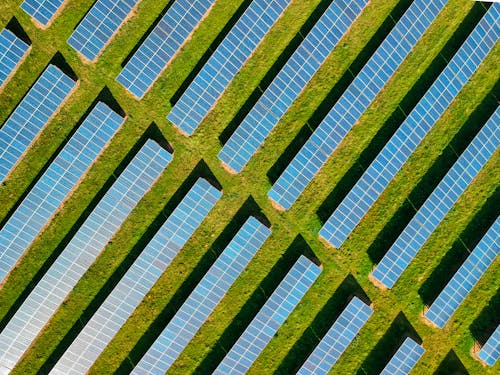
India’s power sector offers the most reliable data of the five. According to the Ministry of New and Renewable Energy, non-fossil installed capacity reached 300.50 GW on 31 July 2026, made up of 164.59 GW of solar, 58.14 GW of wind, 57.24 GW of hydro, 11.75 GW of bio-power and 8.78 GW of nuclear. That is more than 54 per cent of the country’s installed capacity of around 552 GW and over 60 per cent of the way to the target of 500 GW of non-fossil capacity by 2030 that India announced at COP26. The target is for non-fossil capacity, which includes nuclear and large hydro, not for renewables alone, as earlier versions of this page implied.
Also Read: AI Chip Stocks Fall: Why Nvidia, AMD and Broadcom Face a Tougher Market Despite Long-Term Growth
Capacity and generation tell different stories. The ministry’s figures for 2025-26 show non-fossil sources supplying 29.2 per cent of the 1,846 TWh generated, well below their share of capacity, because solar and wind run only part of the day and the grid still depends on coal for round-the-clock supply. Storage, transmission and grid balancing are therefore the bottlenecks to watch. For a deeper look at the listed-company side, see our overview of the power and renewable energy sector.
Electric mobility is growing from a small base. Vahan registration data compiled by industry bodies shows about 2.55 million electric vehicles sold in 2025-26, a rise of roughly 25 per cent over the previous year, which works out to between 8.3 and 8.6 per cent of all vehicle registrations depending on the dataset. More than nine in ten of those were two- and three-wheelers. Electric cars are still a small slice, at around 4.3 to 4.6 per cent of passenger vehicle sales in the year.

3. Manufacturing and the Make in India push
The manufacturing story is increasingly a story about electronics and semiconductors. Under the India Semiconductor Mission, the government says 12 manufacturing projects have been approved with an investment pipeline of about ₹1.64 lakh crore, covering a fabrication unit, compound-semiconductor facilities and assembly-and-test plants. Some of that capacity is only beginning to operate, so the real test is the pace at which approvals turn into production and orders. Production-linked incentive schemes, which pay manufacturers on incremental sales, sit alongside this and have been most visible in electronics.
Defence manufacturing is the other leg, supported by procurement from domestic suppliers and a growing export effort; our note on defence and aerospace manufacturing covers it. The risks are familiar: dependence on imported inputs, the cost competitiveness of Indian plants, global trade policy, and the fact that incentive schemes have end dates.
Also Read: India’s Water and Wastewater Treatment Industry: Growth, Future Opportunities and Key Stocks

4. Healthcare and life sciences
Earlier versions of this page quoted a market-size projection for 2025 that cannot be traced to an official source, so it has been dropped in favour of public data. The National Health Accounts put India’s total health expenditure at about 3.8 per cent of GDP, with government spending at 1.84 per cent of GDP in 2021-22, still below the 2.5 per cent goal set by the National Health Policy, 2017. The share of health costs paid out of pocket by households fell from about 62.6 per cent in 2014-15 to 39.4 per cent in 2021-22, according to the Economic Survey 2024-25, and the government’s share of total health spending rose to 48 per cent.
Public insurance is a large part of that shift. Ayushman Bharat PM-JAY offers a cover of ₹5 lakh per family for hospitalisation and was extended in 2024 to all citizens aged 70 and above. The Union Budget for 2026-27 allocates roughly ₹1.05 lakh crore to the Ministry of Health and Family Welfare. Hospitals, diagnostics, pharmaceuticals and health technology all draw on this expanding base of insured demand, but they face very different economics, from price controls on drugs to the capital intensity of hospital chains.

5. Digital infrastructure and data centres
Data-centre capacity is measured in megawatts of IT load, and different firms count it differently. CBRE puts India’s operational capacity at about 1.75 GW at the end of the first half of 2026, Cushman & Wakefield reports 1,789 MW across the top seven markets, and Savills estimates 1.8 GW of IT load. Mumbai alone accounts for 890 MW in the Cushman & Wakefield data. Estimates of capacity added in the first half range from about 130 MW to 258 MW for the same reason. On the outlook, Savills and KPMG both project capacity of more than 7 GW by 2030, driven by cloud providers, AI workloads and data-localisation rules.
Land, power supply and cooling are the constraints that decide who can build, and the economics differ between a colocation operator and a company that develops real estate for data centres. For a listed real-estate company with a data-centre arm, see our note on Anant Raj’s business model, and for the sector backdrop read data centre infrastructure in India.
Also Read: India’s Cold Chain and Refrigeration Industry: Growth, Future Opportunities and Key Stocks

Bonus: fintech and digital payments
Digital payments remain the clearest example of scale in India’s digital economy. NPCI data reported on 1 November 2026 shows that UPI processed 25.47 billion transactions worth ₹31.53 lakh crore in October 2026, up 23 per cent in volume and 16 per cent in value from a year earlier. That works out to about 822 million transactions a day. A rising volume does not by itself translate into profits for payment apps, because UPI carries no merchant discount rate for most transactions, so lending, wealth and insurance distribution are where fintech businesses look for revenue.
A snapshot of the data
| Theme | Verifiable data point | Source and date |
|---|---|---|
| AI and cloud | Up to $15.7 trillion added to global output by 2030 (scenario); IndiaAI Mission outlay over ₹10,372 crore | PwC 2017 study; Government of India statement |
| Clean energy | 300.50 GW non-fossil capacity, over 54% of about 552 GW; target 500 GW by 2030 | MNRE, 31 July 2026 |
| Electric vehicles | About 2.55 million sold in 2025-26, roughly 8.3% to 8.6% of registrations | IESA, JMK Research and EVreporter from Vahan data, FY2025-26 |
| Manufacturing | 12 semiconductor projects approved, pipeline about ₹1.64 lakh crore | India Semiconductor Mission, June 2026 |
| Healthcare | Out-of-pocket share of health spending 39.4%; government health spending 1.84% of GDP | National Health Accounts / Economic Survey, 2021-22 |
| Data centres | About 1.75 to 1.8 GW operational; more than 7 GW projected by 2030 | CBRE, Cushman & Wakefield, Savills, KPMG, 2026 |
| Digital payments | 25.47 billion UPI transactions worth ₹31.53 lakh crore in a month | NPCI, October 2026 |
How to use a list like this
A sector can be important to the economy and still be a poor investment at a given price, and the reverse is also true. Before acting on any theme, read the annual reports and regulatory filings of the companies involved, understand how they earn their revenue, and keep in mind that concentrated bets on a single theme carry concentrated risk. The figures above change every quarter, so treat the dates as part of the information.
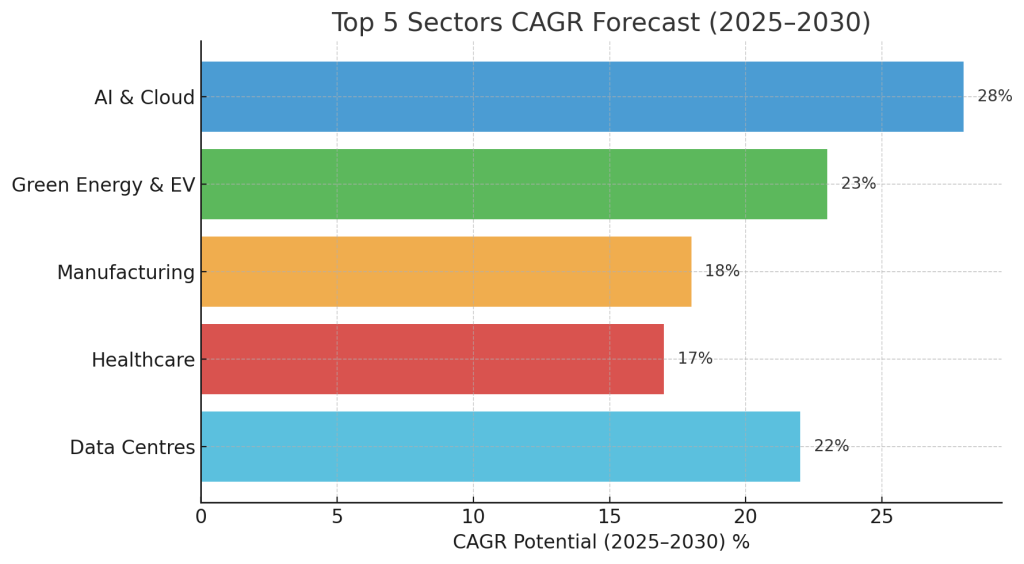
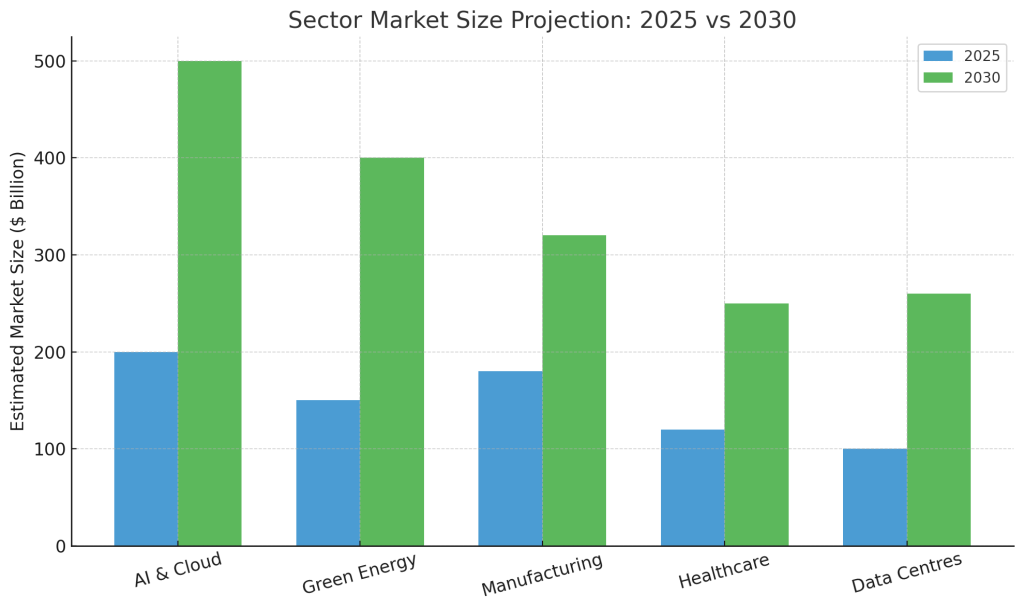
This article is for education and does not recommend any security, sector allocation or business. Data points are from the sources named and were last reviewed on 8 November 2026.
Also Read: AI Agents: The Future of How We Use Computers and the Internet






Keep learning with OneTrader
Explore structured lessons and practical guides to build your market knowledge.

Need a laugh after all that money talk?
Paisa LOL: India's funniest finance page, with memes, comics, jokes and long funny stories.