Introduction
Investing and trading are often described as activities that require intelligence, knowledge and analytical ability. But Daniel Kahneman’s Thinking, Fast and Slow shows that even intelligent and experienced people can make poor decisions because of the way the human mind naturally processes information. The book explores the psychological mechanisms behind judgment, decision-making, risk perception and human behavior, making it highly relevant to investors and traders.
Kahneman explains that the mind does not always analyze information slowly and logically. Instead, it frequently relies on quick judgments, mental shortcuts and emotional reactions. These shortcuts are useful in everyday life, but they can also create predictable mistakes when dealing with uncertainty. Financial markets provide the perfect environment for these mistakes because prices constantly change, information is incomplete and outcomes are uncertain.
For investors, understanding these psychological tendencies can be as important as learning valuation or fundamental analysis. A person may know that long-term investing is important and still panic during a market crash. A trader may have a well-tested strategy and still move a stop-loss because they do not want to accept a loss. Thinking, Fast and Slow helps explain why these behaviors happen.
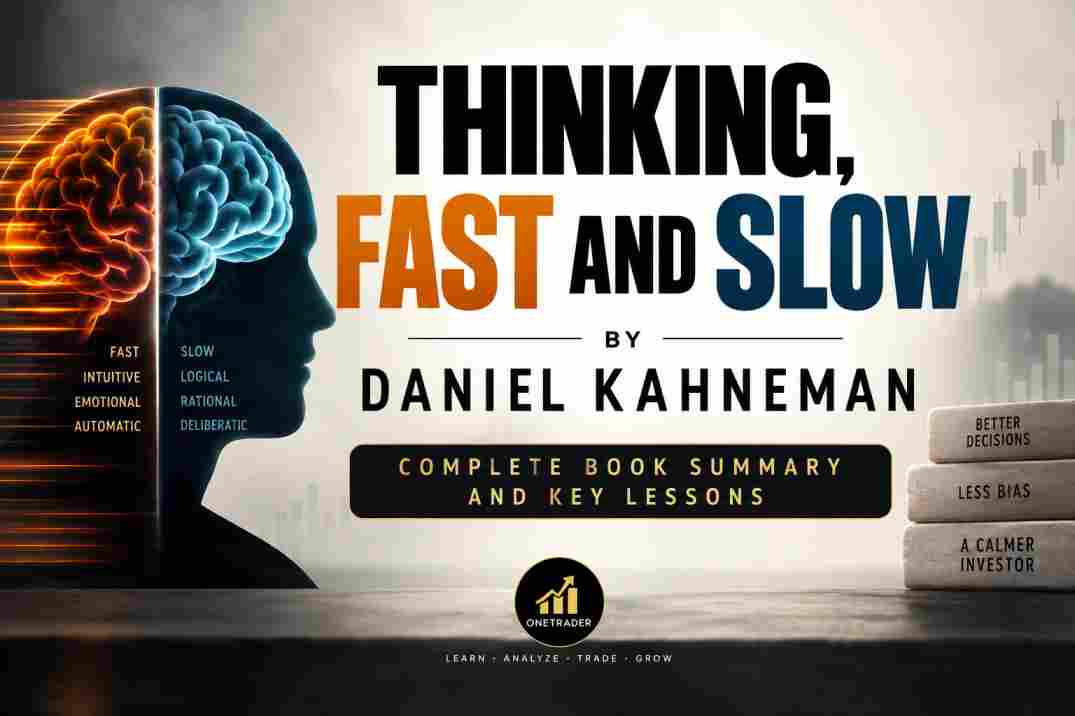
The Two Systems of Thinking
The central idea of the book is that human thinking can be understood through two systems.
Also Read: Credit Cards: The Smartest Financial Tool or the Fastest Way Into Debt?
System 1 operates quickly and automatically. It makes immediate judgments without requiring significant conscious effort. When you recognize a familiar company, read a simple sentence or instinctively react to a sudden event, System 1 is usually involved.
System 2 is slower, deliberate and analytical. It requires concentration and mental effort. When you calculate a company’s valuation, compare financial statements or carefully examine whether an investment thesis makes sense, you are using System 2.
Neither system is inherently good or bad. System 1 is essential because humans cannot consciously analyze everything they encounter. The problem arises when System 1 produces an answer that feels convincing even though the situation requires deeper analysis.
In the stock market, this can happen constantly. A stock rises sharply and immediately looks attractive. A stock falls 20% and suddenly appears dangerous. A familiar brand feels safer than an unfamiliar company. These reactions can be automatic rather than analytical.
Also Read: Demat Account AMC Charges Explained: What Investors Need to Know
Why Confidence Can Be Dangerous
One of the strongest themes in Kahneman’s work is that people can become confident without having sufficient evidence.
Investors often create explanations for why a stock is moving. If the stock rises after they buy it, they may conclude that their analysis was correct. If it falls, they may blame temporary market conditions. The human mind is extremely good at creating stories that make events appear understandable after they happen.
This can create excessive confidence.
An investor might correctly predict three trades in a row and begin believing that their strategy is exceptionally reliable. But three successful outcomes do not necessarily prove that the underlying method is superior. Randomness plays a significant role in financial markets.
Also Read: Biggest Stock Market Crashes in History and Lessons for Investors
The lesson is not to eliminate confidence. It is to recognize the difference between confidence in a process and certainty about an outcome.
The Availability Heuristic
The availability heuristic describes the tendency to judge the likelihood or importance of something based on how easily examples come to mind.
This has major implications for markets.
If investors constantly hear about a company’s success on television, social media and financial websites, they may assume the company is a better investment simply because information about it is everywhere. Likewise, after a major market crash, investors may become excessively worried about another crash because recent losses are easier to remember.
Also Read: Recency Bias in Trading – Why Recent Trends Fool Traders
Recent and emotionally powerful events can therefore influence our perception of probability.
For example, after hearing repeated stories about a particular sector producing multibagger returns, investors may assume similar companies will continue to generate exceptional returns. The opposite can happen after a market collapse when investors become excessively pessimistic about equities in general.
The availability of information does not necessarily mean the information is statistically important.
Anchoring and Investment Decisions
Anchoring occurs when people rely too heavily on an initial number or piece of information when making subsequent judgments.
Also Read: SBI AMC IPO 2026 – Draft Analysis, Expected Valuation, Business Model & Investment View | Onetrader
This is extremely common among investors.
Suppose an investor purchased a stock at ₹1,000. If the stock falls to ₹700, the investor may think, “I will sell when it comes back to ₹1,000.” But ₹1,000 is simply the investor’s purchase price. It does not automatically represent the company’s fair value.
The business does not know what price the investor paid.
The relevant question is whether the company is worth owning at ₹700 based on its current fundamentals and future prospects. If the investment thesis has deteriorated, waiting for the stock to return to the old price can be an expensive psychological mistake.
Also Read: Risks in ETFs Explained – Tracking Error, Liquidity & Market Risk
Anchoring can also work in the opposite direction. If a stock previously traded at ₹500 and now trades at ₹250, investors may automatically consider it cheap. But a falling price does not guarantee undervaluation.
Loss Aversion
One of Kahneman’s most important concepts is loss aversion.
People generally experience the psychological pain of losing money more strongly than the satisfaction of gaining an equivalent amount.
This explains many common investment behaviors.
An investor may hold a fundamentally weak stock because selling would force them to accept a loss. At the same time, they may sell a strong-performing company too quickly because they want to “lock in” the profit.
This creates a dangerous combination: allowing losses to continue while cutting successful investments too early.
In trading, loss aversion can be even more damaging. A trader who cannot emotionally accept a predefined loss may move the stop-loss farther away, hoping the position will eventually recover. A small planned loss can then become a much larger one.
Accepting that losses are part of investing and trading is therefore not simply a technical skill. It is a psychological skill.
Also Read: Stock Market Traps: How Retail Traders Get Fooled Every Day – Onetrader Guide
The Sunk Cost Trap
The human mind often struggles to abandon something after investing significant time, money or effort into it.
This is known as the sunk cost effect.
Imagine an investor spends months researching a company and eventually buys it. Six months later, the company’s fundamentals deteriorate significantly. Instead of reassessing the investment objectively, the investor may continue holding it because they have already invested so much effort into the original thesis.
But previous effort cannot be recovered.
Also Read: Sukanya Samriddhi Yojana (SSY) – Complete Guide, Interest Rate, Withdrawal Rules | Onetrader
The correct question is not, “How much time have I already spent on this stock?” It is, “If I had no position today, would I still want to own this business at the current price?”
That simple question can help investors separate current decisions from past commitments.
Confirmation Bias
People naturally prefer information that supports what they already believe.
An investor who becomes bullish on a company may start searching for positive news while ignoring negative developments. Every favorable announcement confirms the original thesis, while negative information is dismissed as temporary.
Also Read: Futures and Options (F&O) Complete Guide – Learn Trading from Basics to Advanced by Onetrader
This is confirmation bias.
Financial markets make confirmation bias especially easy because investors can find someone online supporting almost any opinion. If you believe a stock will rise, you can find bullish analysts, social media posts and charts supporting your view. If you believe it will fall, you can find bearish arguments just as easily.
A disciplined investor deliberately looks for information that could prove the original thesis wrong.
The goal of research should not be to defend a decision. It should be to test whether the decision remains valid.
Also Read: The Psychology of Spending: How Emotions Control Your Wallet (Day 2 – Money Mastery by OneTrader)
The Halo Effect
The halo effect occurs when one positive characteristic influences our overall perception of something.
In investing, a famous founder can create a halo around a company. A strong brand can make investors assume the entire business is excellent. A company with impressive historical growth can cause investors to assume its future will automatically remain strong.
But every investment needs independent analysis.
A respected management team can still make bad capital-allocation decisions. A powerful brand can face changing consumer preferences. A company with excellent historical returns can eventually encounter competition.
Also Read: 5 Hidden Signs Before a Stock Rally – Learn to Spot Big Moves Early
A good characteristic should be considered evidence, not proof.
The Planning Fallacy
Humans frequently underestimate how long difficult projects will take and how many problems they may encounter.
This is known as the planning fallacy.
Investors can experience something similar when estimating future business growth. They may assume that a company will successfully launch new products, expand into new markets, increase margins and maintain high growth for many years without significant setbacks.
Reality is usually more complicated.
Companies encounter competition, regulation, economic downturns, execution problems, changing customer behavior and unexpected costs. Investors therefore need to leave room for uncertainty rather than building an investment thesis around a perfect future.
Regression to the Mean
Another important concept is regression to the mean.
Exceptional results often do not continue indefinitely. A company experiencing unusually high growth may eventually see growth normalize. A stock that has dramatically outperformed may eventually experience more ordinary returns. A business experiencing temporarily weak performance may recover if its underlying economics remain sound.
This does not mean everything automatically returns to average. Structural changes can create genuinely different long-term outcomes.
The important lesson is to distinguish between temporary extremes and sustainable changes.
Investors should ask whether a company’s current performance is supported by durable competitive advantages or whether it is being influenced by temporary conditions.
Why Market Predictions Are Difficult
Kahneman’s ideas also challenge the human desire to predict the future.
Financial markets contain enormous amounts of uncertainty. Yet investors constantly search for precise forecasts about interest rates, stock prices, economic growth and market direction.
Predictions can be useful when they are based on evidence and expressed with appropriate uncertainty. The problem begins when forecasts are treated as facts.
A disciplined investor understands that even a well-researched thesis can be wrong.
This is why diversification, position sizing, valuation discipline and a margin of safety matter. They provide protection against the possibility that our assumptions are incorrect.
Thinking Fast and Slow in Trading
Trading provides an especially clear example of Kahneman’s ideas.
A trader sees a sudden breakout and feels an immediate urge to enter. That is System 1 reacting quickly. A disciplined trader can pause and ask whether the setup actually satisfies the trading plan. That deliberate evaluation involves System 2.
After entering, the stock moves against the position. System 1 may generate fear and encourage the trader to exit prematurely. Alternatively, loss aversion may encourage the trader to hold and hope.
The solution is not to eliminate emotions. That is unrealistic. The solution is to create a process that reduces the influence of emotional decisions.
A clearly defined entry, stop-loss, position size and exit strategy can reduce the number of decisions that need to be made under pressure.
Thinking Fast and Slow for Long-Term Investors
Long-term investors face a different set of psychological challenges.
Market crashes can trigger fear. Bull markets can create greed. A stock that has already risen significantly may feel impossible to buy, while a stock that has fallen sharply may feel attractive simply because it is cheaper than before.
Kahneman’s framework encourages investors to slow down when the decision involves uncertainty and meaningful financial consequences.
Instead of asking, “What is everyone doing?” an investor can ask, “What has changed in the business?”
Instead of asking, “How much has the stock fallen?” the investor can ask, “What is the current intrinsic value and what assumptions support it?”
Instead of asking, “What will happen next month?” the investor can ask, “What is my investment thesis and what evidence would invalidate it?”
These questions move the decision away from automatic reactions and toward deliberate thinking.
The Biggest Lesson From Thinking, Fast and Slow
The biggest lesson from Thinking, Fast and Slow is that knowing about psychological biases does not automatically make us immune to them.
Even experienced investors can become victims of overconfidence, anchoring, loss aversion, confirmation bias and availability bias. The objective is therefore not to become perfectly rational. Human beings are not designed that way.
The objective is to build systems that reduce the impact of predictable mistakes.
For an investor, that might mean using a written investment thesis, maintaining valuation discipline, diversifying appropriately and reviewing decisions objectively. For a trader, it could mean predefined risk, systematic entries and exits, position sizing and maintaining a trading journal.
The more important the decision, the more valuable it can be to slow down and deliberately examine the assumptions behind it.
Conclusion
Thinking, Fast and Slow is not specifically an investing book, but its lessons are deeply connected to investing and trading. Financial markets constantly challenge the human mind because they combine uncertainty, money, fear, greed, incomplete information and social pressure.
Kahneman’s work helps investors recognize that many mistakes do not come from a lack of intelligence. They come from predictable patterns in human thinking.
The goal is therefore not to eliminate intuition or emotion. It is to recognize when automatic thinking may be misleading us and deliberately switch to a more analytical approach.
For investors and traders, this can become a powerful advantage. A better understanding of your own mind can improve the quality of your decisions even when you cannot predict what the market will do next.
Financial Disclaimer
The content published on Onetrader is for educational and informational purposes only. It is not investment advice, financial advice, or a buy/sell recommendation. Onetrader is not SEBI registered. Stock market investments involve risk, and past performance does not guarantee future results. Readers should conduct their own research and consider their financial goals, risk tolerance and financial situation before making any investment decision.