Estimated reading time: 6 minutes
Thank you for reading this post, Please bookmark onetrader.in website for regular updates!
1. Swiggy Business Overview
Founded: 2014
Founders: Sriharsha Majety, Nandan Reddy, Rahul Jaimini
Headquarters: Bengaluru, India
Industry: Online food delivery & hyperlocal logistics
Core Business
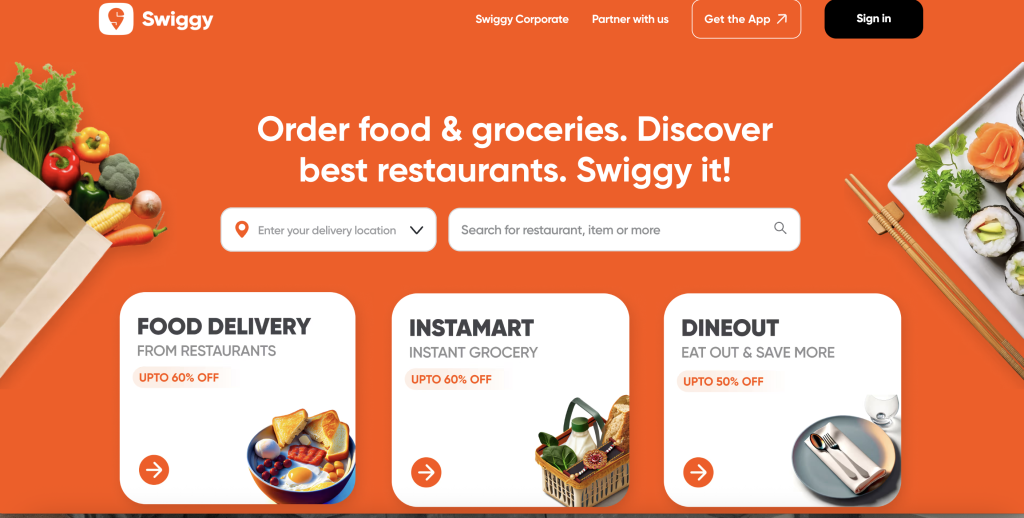
Swiggy primarily operates in food delivery, connecting customers with restaurants through its app and website. But over the years, it has expanded into multiple verticals:
- Food Delivery (Core Business)
- Customers order food from partner restaurants via the Swiggy app.
- Swiggy delivers using its network of delivery partners (riders).
- Revenue comes from delivery fees, commissions from restaurants, and subscription services (Swiggy One).
- Grocery & Essentials (Swiggy Instamart)
- Instant delivery of groceries, daily essentials, and snacks.
- Focus on 10–30 minute deliveries in select cities.
- Hyperlocal Logistics & Other Services
- Swiggy Genie: Pick-up & drop-off service for packages, parcels, or personal errands.
- Cloud kitchens: Swiggy supplies kitchens for restaurants to reduce delivery time and expand reach.
- Swiggy Super / Subscription Services
- Monthly subscription giving free deliveries and discounts.
- Helps increase customer loyalty and recurring revenue.
Revenue Model
- Commission from restaurants – 15–30% per order.
- Delivery fees – Charged to customers (varies by distance/order size).
- Subscription fees – Swiggy One/Instamart subscription.
- Advertising – Restaurants pay for better visibility on the platform.
Highlights of the quarter
Swiggy Platform
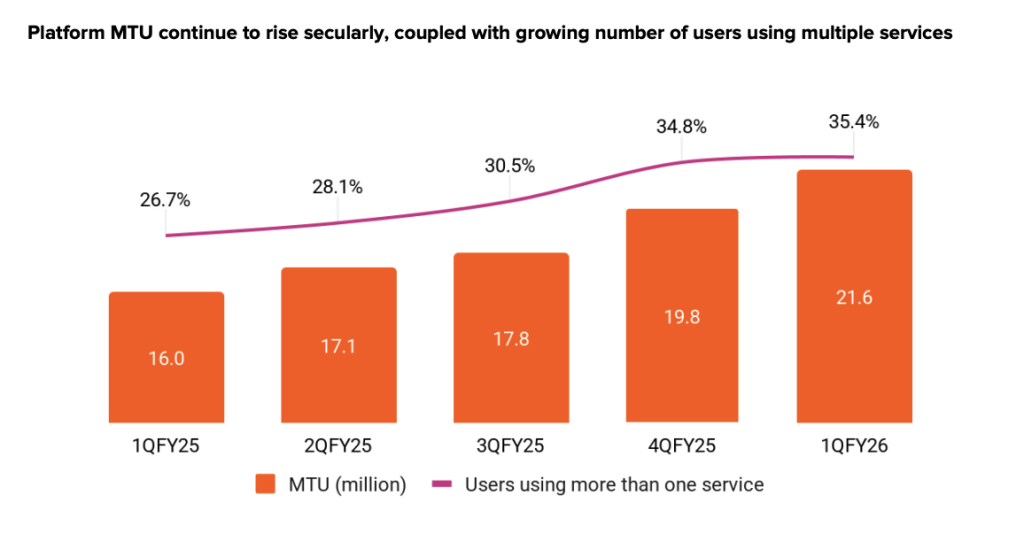
○ Platform Average Monthly Transacting Users (MTU) grew 35.2% YoY to 21.6 Mn (+9.0% QoQ)
○ Consolidated Adjusted Revenue grew 52.7% YoY to INR 5,308 Cr (+12.5% QoQ)
○ B2C Adjusted EBITDA Margin (% of B2C GOV) declined by 204bps YoY to -4.7% (+12bps QoQ)
○ Consolidated Adjusted EBITDA loss increased by INR 81 Cr QoQ to INR 813 Cr
● Food delivery
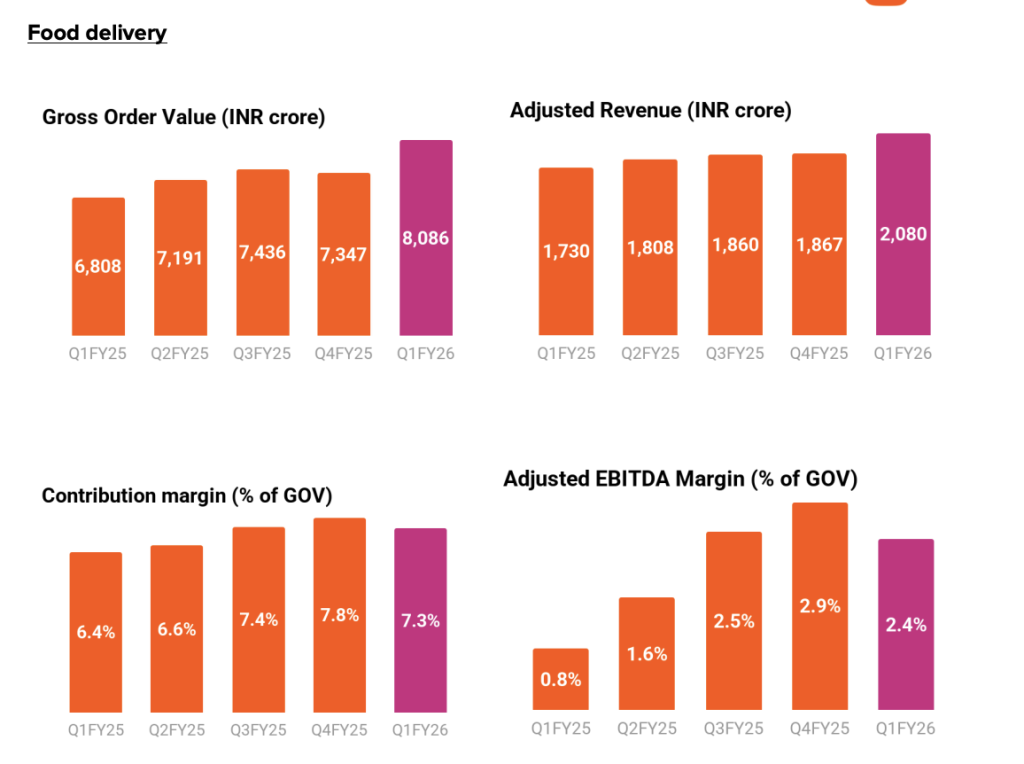
○ GOV grew 18.8% YoY to INR 8,086 Cr
○ Added 1.2 Mn Monthly Transacting Users to reach 16.3 Mn, Maximum numbers of MTUs added
in a single quarter over the last 2 years
○ Adjusted EBITDA declined by 9.6% QoQ to INR 192 Cr, Adjusted EBITDA Margin at 2.4% of GOV
(+152bps YoY, -52 bps QoQ)
● Quick-commerce
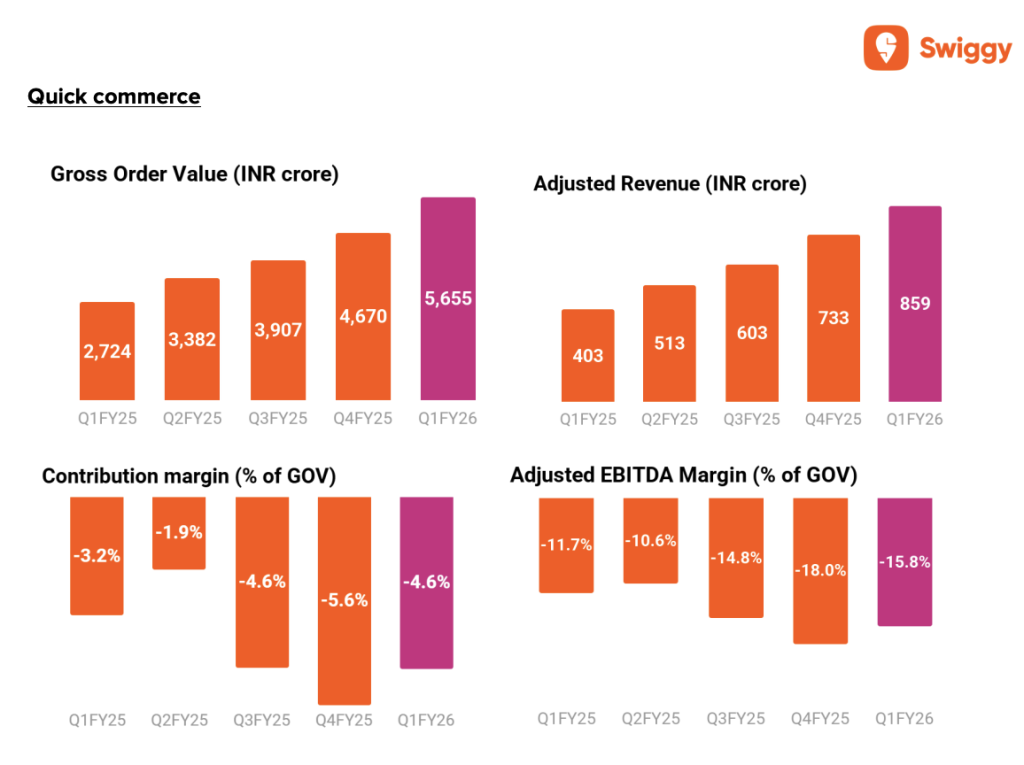
○ GOV growth accelerated to 107.6% YoY (+21.1% QoQ) to INR 5,655 Cr, with 1.2 Mn MTUs added
(+12% QoQ)
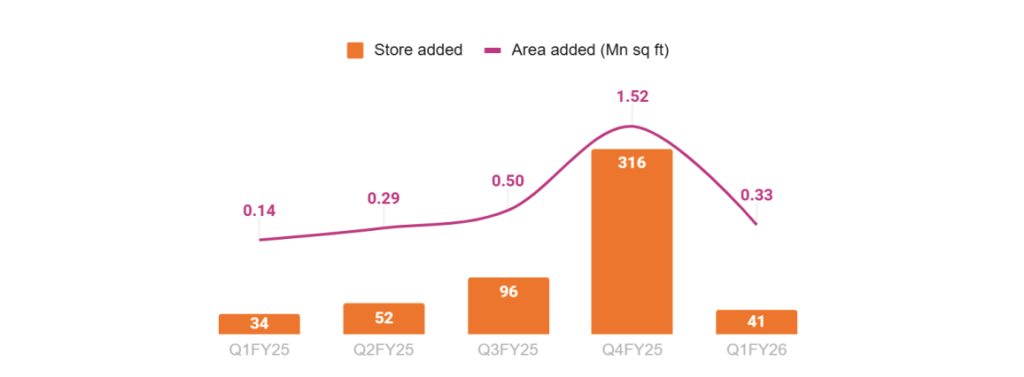
○ Added 41 darkstores, driving up active darkstore area to 4.3 Mn sq ft (+158.7% YoY, +8.2% QoQ),
growing average size of our darkstores further to over 4000 sq ft
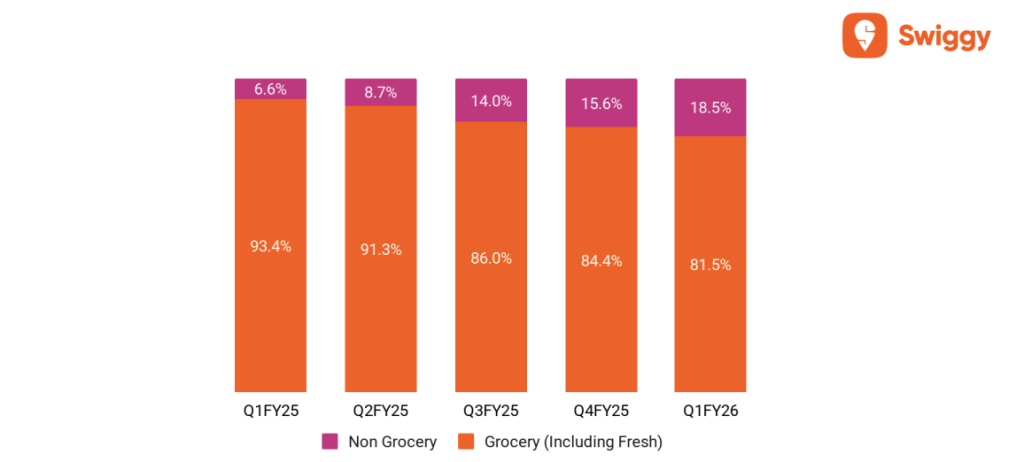
○ Average order value grew 25.6% YoY to INR 612 ahead of our guidance, led by continued
expansion of non-grocery selection and larger-basket buying behaviour across user cohorts
○ Contribution margin improved by 97 bps to -4.6% in Q1FY26 in line with our guided trajectory
○ Adjusted EBITDA margin improved by 213bps (QoQ) to -15.8%.
Swiggy’s competitive landscape
1. Direct Competitors
a) Zomato
- Market Share: ~58% in food delivery in India; Swiggy has ~42%.
- Strengths:
- Strong brand recognition and first-mover advantage in many cities.
- International presence (Middle East, UAE).
- Diversified offerings: food delivery, Zomato Pro subscription, cloud kitchens, and grocery delivery (via acquisitions).
- Weaknesses vs Swiggy:
- Delivery network is slightly smaller in some Tier-2/3 cities.
- Customer experience varies depending on local delivery partners.
b) Zepto (Quick Commerce)
- Focus: Ultra-fast grocery delivery (10–20 minutes).
- Strengths:
- Extremely fast delivery using localized dark stores.
- Focused on millennial and Gen Z urban users.
- Challenges for Swiggy:
- Swiggy Instamart is slower (15–30 minutes) and slightly more expensive.
- High competition for small-ticket grocery orders.
c) Blinkit (by Zomato)
- Another major player in instant grocery delivery.
- Competes directly with Swiggy Instamart in metros and Tier-1 cities.
2. Indirect Competitors
- Regional/local food apps: FreshMenu, Box8, etc., mostly in metros.
- Supermarkets & online grocery: BigBasket, Amazon Fresh, Flipkart Supermart.
- Cloud kitchens & restaurant aggregators: Some restaurants operate their own delivery to bypass aggregators.
3. Key Competitive Factors
- Delivery Speed & Coverage
- Swiggy leverages a large delivery partner network, but Zepto and Blinkit offer faster grocery delivery.
- Tier-2 and Tier-3 city penetration is a growth area for Swiggy.
- Pricing & Discounts
- Heavy discounting is common across all platforms.
- Swiggy uses subscription plans (Swiggy One) to retain customers.
- Technology & Personalization
- Swiggy invests in AI for route optimization, personalized recommendations, and dynamic pricing.
- Zomato has a strong review and rating system, which helps in customer trust and retention.
- Brand Loyalty & Customer Retention
- Swiggy’s Swiggy One subscription builds recurring revenue and loyalty.
- Zomato uses loyalty programs like Zomato Pro and Gold.
- Profitability & Cost Management
- Food delivery is a low-margin business, and every player struggles to break even.
- Swiggy has higher operational costs due to wider delivery coverage and Instamart expansion.
4. SWOT Perspective vs Competitors
| Factor | Swiggy | Zomato | Zepto / Blinkit |
|---|---|---|---|
| Market Share (Food) | 42% | 58% | – |
| Market Share (Quick Commerce) | 26% | Blinkit 35% | Zepto 30% |
| Delivery Speed | Good | Good | Excellent for groceries |
| Pricing / Discounts | Moderate | Moderate | Aggressive in groceries |
| Tech / AI | Strong | Moderate | Moderate |
| Customer Loyalty | Swiggy One | Zomato Pro | Minimal |
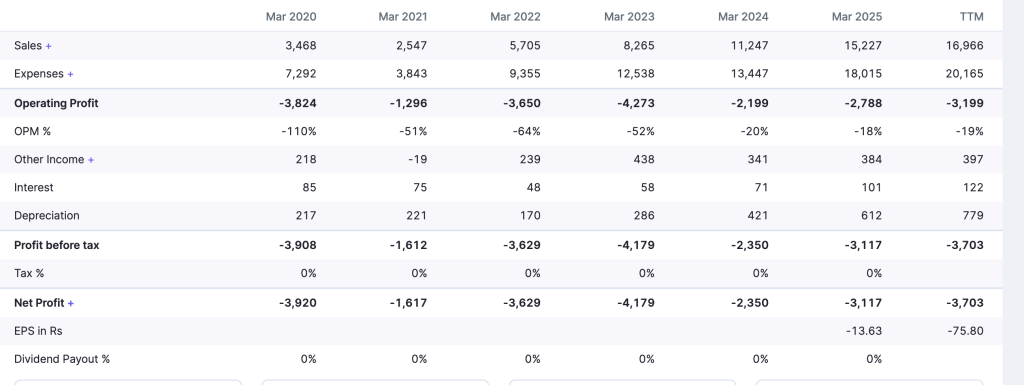
Source: Screener.in
🧾 Key Financial Challenges
1. High Operating Costs
- Marketing Expenses: Elevated due to increased competition and customer acquisition efforts
- Employee Costs: Significant rise due to workforce expansion and operational scaling
2. Instamart’s Profitability Struggles
- Despite rapid growth, Instamart’s high operational costs and low margins have led to substantial losses, impacting overall profitability
3. GST Impact
- The recent imposition of an 18% GST on delivery fees has increased operational costs by approximately ₹180–200 crore annually. Companies like Swiggy are considering passing this burden onto delivery partners or customers, potentially affecting margins and order volumes
4. Market Volatility
- Swiggy’s stock has declined by 27% year-to-date, reflecting investor concerns over sustained losses despite revenue growth
🔍 Strategic Outlook
- Profitability Focus: Swiggy aims to achieve contribution breakeven in the quick commerce segment within the next 3–5 quarters
- Cost Management: Emphasis on balancing growth with sustainable cost management, especially in the quick commerce space
- Market Positioning: Continued investment in supply chain and infrastructure to support rapid delivery models and enhance customer experience
📊 Analyst Ratings & Price Targets
1. Motilal Oswal
- Rating: Buy
- Target Price: ₹560
- Upside Potential: ~32%
- Rationale: Positive macroeconomic factors, reduced competition, and improving profitability in the food delivery sector. The brokerage firm also noted signs of a turnaround in Swiggy’s quick commerce segment, Instamart.
2. TipRanks
- Average Price Target: ₹443.40
- High Estimate: ₹500
- Low Estimate: ₹382
- Upside Potential: ~3.44%
- Analyst Consensus: Strong Buy (based on 5 analysts)
3. TradingView
- Average Price Target: ₹462.67
- High Estimate: ₹740
- Low Estimate: ₹285
- Analyst Consensus: Buy (based on 25 analysts)
4. Trendlyne
- Average Price Target: ₹533.33
- Upside Potential: ~22.66% from the last price of ₹434.80
- Analyst Consensus: Outperform (based on 7 analysts)
5. Alpha Spread
- Average Price Target: ₹452.42
- High Estimate: ₹777
- Low Estimate: ₹287.85
- Upside Potential: ~4% from the average target
- Analyst Consensus: Buy (based on 24 analysts)
6. Yahoo Finance
- Average Price Target: ₹447.67
- High Estimate: ₹740
- Low Estimate: ₹285
- Analyst Consensus: Outperform (based on 24 analysts)

Technical analysis
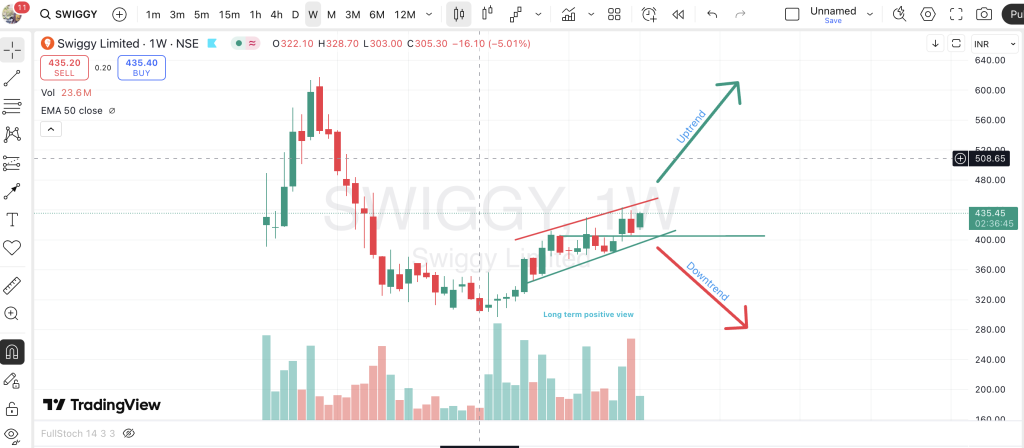
More check in the video:
Disclaimer
This content is for informational purposes only and not financial advice. Investing in stocks involves risk—always do your own research or consult a financial advisor. Some links may be affiliate links, which may earn me a small commission at no extra cost to you.