🧾 SBI Cards & Payment Services Ltd — Business Model, Management View & Future Roadmap (2025-2030)
(By Onetrader Guide)
🔹 Company Snapshot
- Name: SBI Cards & Payment Services Ltd (SBICARD)
- Founded: May 1998 (as private company), became public limited etc.
- Business: Leading pure-play credit-card issuer in India.
- Scale & Market: Market cap ~ ₹88,000 crore as of Oct 2025.
- Key offering: Credit cards (retail, co-branded), payment services, transaction fees, interest income.
- Registered NBFC – ML (non-deposit taking) with RBI registration.
🔹 Why SBICARD matters
India is going through a massive digital payments + unsecured credit growth wave. SBICARD stands at the intersection of consumer credit, payment infrastructure and brand of India’s largest bank (State Bank of India) — giving it structural advantage.
For investors: this is not just “credit-cards in India” — it’s “credit-cards + digital adoption + rising middle class + co-brand partnerships + data analytics for risk & growth”.
🔹 Business Model — How SBICARD Makes Money
Let’s break it down into core engines:
Also Read: Raymond: From Suits to High-Precision Engineering — The Transformation Is Just Beginning
1. Interest Income on Outstanding Balances
When cardholders carry balances (revolve loans) SBICARD earns interest — often high yield for unsecured credit.
2. Transaction & Merchant Fees
For every card transaction, SBICARD earns merchant discount or interchange fees and service charges.
3. Annual & Joining Fees, Value-Added Services
Premium cards, co-branded cards, annual fees etc contribute additional revenue.
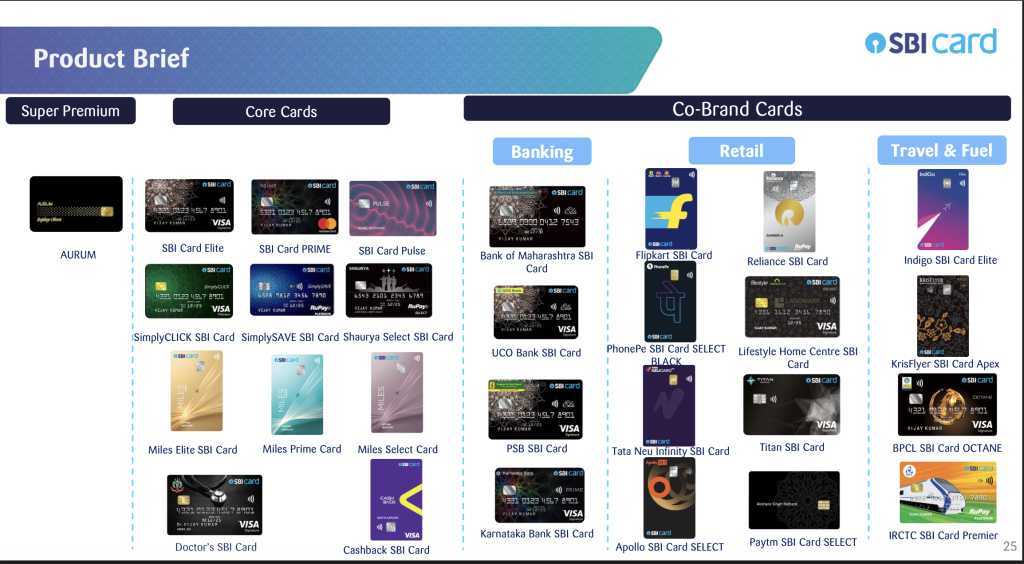
4. Co-Brand Partnerships & Ecosystem
Co-branded with airlines, retail chains, banks, digital platforms — expands reach and card usage.
Also Read: DMCC Speciality Chemicals: The 100-Year Chemical Company Building a New Specialty Business
5. Operating Leverage & Scale Benefits
As volume of cards, spending, transactions increases, incremental cost per card comes down (marketing, risk, servicing) → margin expansion. Also digitization (AI/ML) helps reduce acquisition & servicing cost.
Underlying logic:
- More cardholders + higher spends → more interest + transactional income
- Deep brand/backing (SBI) + digital infrastructure + co-brand tie-ups → competitive moat
- Higher data + analytics = better underwriting, risk management → lower credit costs
🎙️ Management Vision & Commentary
Some of the public signals:
- From SBICARD “About Us”: “The aim … offer Indian consumers access to a wide range of world-class, value-added payment products and services.”
- Digital transformation: SBICARD “reimagines … credit-card sourcing business processes … made it lean, digital and AI/ML driven … platform enables new customers to get an instant card in 5 minutes.”
- From third-party analysis: SBICARD “strong management, large card base and spending, linkage with SBI … but headwinds exist in unsecured lending.”
Onetrader interpretation:
Management is clearly focused on two parallel tracks:
Also Read: Avalon Technologies: The EMS Company Quietly Building India’s Next Manufacturing Engine
- Scaling card base + spends (growth engine)
- Digitizing risk/acquisition/servicing (efficiency + margin)
But they also recognise credit-risk headwinds, particularly in unsecured portfolios — which is why tech + analytics push is critical.
🔹 Recent Signals & Financial Health
- According to SimplyWallSt: revenue growth per annum estimated ~33–38%.
- Recent news: SBICARD reported profit drop for Q1 FY26 due to higher write-offs and delinquencies.
- Another quarter: profit down ~6.4% in Q1 FY26; provisions rose ~22.8%.
Observations:
- Growth in spends and card base remains strong → positive.
- But credit losses/write-offs rising → risk to margins and earnings.
- Digital + analytics transformation underway → long-term margin potential.
🔹 Future Scope — 2025-2030 Roadmap
Here’s where SBICARD’s future lies and what to watch for:
A. Credit-Card Penetration + Digital Payments Growth
- India’s card penetration is still low compared to developed markets → big runway.
- UPI + digital payments ecosystem growth means more card acceptance, more spends → more fees + interest.
B. Co-Brand & Ecosystem Partnerships
- More tie-ups with banks, fintech, e-commerce platforms → card issuance + card spends growth.
- Premium card segment growth (wealthy consumers) → higher annual fees + spends.
C. Analytics, AI/ML, Risk Management
- As acquisition costs rise, digital sourcing (e.g., 5-minute instant cards) will be key for cost efficiency.
- Better risk models = lower delinquencies, better portfolios → better margins.
D. Internationalisation / New Products
- Though primarily India-focused, expansion into adjunct products (BNPL, digital wallets, credit line for fintech) could add new revenue streams.
- Value-added services tied to cards (insurances, subscriptions).
E. Margin Expansion & Scale Leverage
- With scale, fixed costs per card fall.
- Also, portfolio maturity leads to lower defaults if underwriting remains tight.
- Onetrader estimate: if card base continues 12-15%+ growth and risk control improves, medium-term ROE & ROA can improve significantly.
Onetrader target scenario:
- Card base + spends growth : ~12-18% p.a.
- Margins & ROE improvement by 2028-30 if credit costs moderate
- Revenue CAGR (fee + interest) perhaps ~15-20% in favourable conditions
⚠️ Risks & What Could Go Wrong
- Credit risk / asset quality: Unsecured lending (credit cards) has high risk — rising NPAs or write-offs can hit earnings hard. Recent results show this.
- Competition & pricing pressure: More fintechs, banks issuing cards, may drive down fees or higher customer acquisition cost.
- Regulatory risk: RBI/Payment regulators may regulate card fees, interest rates or co-brand partnerships.
- Economic slowdown: Card spends & consumer credit growth could slow in macro weakness → lower growth.
- Digital disruption: If cards become less relevant (though unlikely in short term) or if digital payments bypass cards, SBICARD could face disruption.
🎯 Onetrader Verdict — Positioning & Investment View
SBICARD is a high-quality growth & scale play in India’s payment + credit ecosystem. It offers structural growth if you accept some credit-risk and wait for digitisation benefits to kick in.
Also Read: IREDA: The Green Financing Powerhouse Funding India’s Renewable Energy Boom
Positioning:
- For long term (5-10 years): good exposure to digital payments + credit growth, especially if you trust management’s risk discipline.
- For medium term (2-4 years): watch credit costs and regulatory developments before aggressive addition.
- Portfolio role: A core growth allocation with higher risk than staples; not defensive.