Every investor wants the same thing: better returns from mutual funds.
But the biggest mistake beginners make is searching for “the best mutual fund” and simply choosing the fund that delivered the highest return in the previous year.
That is not how successful mutual fund investing works.
A fund that gave 40% last year may not give 40% next year. A fund that performed poorly during one market cycle may actually have a strong long-term strategy. The real skill is not finding yesterday’s winner. It is learning how to identify a fund that has a reasonable chance of creating wealth over the long term.
Also Read: Will SIFs Prove to Be Better Than Mutual Funds? Early Performance Offers an Interesting Clue
So, how should an ordinary investor select a mutual fund?
Let’s understand it step by step.
First Understand Your Goal
Before selecting a mutual fund, don’t start with the fund name. Start with your goal.
Are you investing for a house? Retirement? Children’s education? Wealth creation? Or a goal that is only three years away?
Also Read: SIP Calculator: How to Calculate Your SIP Returns and Investment Amount
The time available for the investment makes a huge difference.
If your goal is only a few years away, taking very high equity risk may not be appropriate. If you are investing for 10, 15 or 20 years, you may have more flexibility to tolerate short-term market volatility.
Therefore, the first rule is simple:
Goal first. Fund second.
Also Read: SIP vs Lump Sum – Which Is Better for Long-Term Investors?
Also Read: Top 5 Water Management Stocks in India: Financials, Growth & Future Potential
Step 1: Decide How Much Risk You Can Take
Not every investor can tolerate the same level of volatility.
Large-cap-oriented funds may behave differently from mid-cap and small-cap funds. Equity funds can experience significant temporary declines during market corrections.
Imagine investing ₹5 lakh and seeing the value temporarily fall to ₹3.75 lakh during a major correction.
Also Read: What Is a Large-Cap Fund and Why Is It Preferable?
The question is not whether the fund will eventually recover. The question is:
Will you remain invested without panicking?
If the answer is no, your portfolio may be taking more risk than you can emotionally handle.
A good mutual fund is not simply the one with the highest possible return. It is the one whose risk you can tolerate while remaining invested.
Also Read: Mutual Fund Taxation in India 2026 – New STCG & LTCG Rules Explained | Onetrader
Step 2: Choose the Right Category
Before comparing individual funds, decide which category makes sense for your objective.
Equity funds can include large-cap, mid-cap, small-cap, flexi-cap, multi-cap and other strategies. There are also hybrid, debt and other categories designed for different objectives.
A beginner should understand what the category invests in before looking at individual fund performance.
For example, comparing a small-cap fund with a large-cap fund purely on returns doesn’t make much sense because their risk profiles and portfolios can be very different.
Also Read: Mutual Fund Myths vs Facts – Complete Guide for Beginners (2026) | by Onetrader
Compare funds within the same category first.
Also Read: What Is a Large-Cap Fund and Why Is It Preferable?
Step 3: Don’t Select a Fund Based on One-Year Returns
This is probably the most important rule.
Suppose Fund A generated 35% in one year while Fund B generated 24%.
Also Read: SIP vs Lumpsum – Which is Better for You in 2026? | by Onetrader
Many investors immediately choose Fund A.
But what if Fund A generated 35% because it had a large allocation to a sector that happened to perform exceptionally well that year?
What if the same fund underperformed for the next three years?
Instead of looking only at one-year returns, examine performance across different periods and market conditions.
Also Read: Types of Mutual Funds Explained (Equity, Debt, Hybrid & More) | by Onetrader
Look at:
- 3-year performance
- 5-year performance
- Longer-term performance where available
- Performance during market corrections
- Performance relative to its benchmark
The objective is to identify consistency, not one lucky year.
Step 4: Compare the Fund With Its Benchmark
A mutual fund should not be judged in isolation.
Suppose a fund generated 15% while its benchmark generated 18%.
Also Read: How Does a Mutual Fund Work? Explained Step-by-Step | by Onetrader
At first glance, 15% may look excellent.
But the fund actually underperformed its benchmark by 3 percentage points.
Now consider another fund that generated 16% while its benchmark generated 13%.
The second fund may have demonstrated stronger relative performance.
Also Read: What is a Mutual Fund? Simple Explanation with Example | by Onetrader
This is why investors should always ask:
“How did the fund perform compared with its benchmark?”
For actively managed funds, this becomes especially important.
Also Read: BlueStone Jewellery The Missed Gem?
Also Read: Mutual Funds Series: Complete Guide from Basics to Advanced | by Onetrader
Step 5: Check Consistency
A strong mutual fund does not necessarily need to be the number-one performer every year.
Instead, look for a fund that has demonstrated reasonable consistency across different market environments.
For example, Fund A might rank first one year, 15th the next year and 20th the following year.
Fund B might rank around the top quarter of its category consistently.
Which one would you prefer for a long-term portfolio?
The answer may not always be Fund A.
Consistency can be more valuable than occasional spectacular performance.
Step 6: Look at the Fund Manager and Investment Strategy
In an actively managed mutual fund, the fund manager plays an important role.
Understand the fund’s investment philosophy.
Does the fund focus on growth companies? Value? Quality businesses? A combination?
Also check how the fund behaved during previous market corrections.
You don’t need to predict exactly what the fund manager will do next. But you should understand how the fund is managed.
For index funds, the focus is different. Instead of evaluating a fund manager’s stock-picking ability, investors should pay more attention to the underlying index, expense ratio and tracking difference.
Step 7: Check the Expense Ratio
Costs matter.
Two funds may have similar portfolios and similar performance, but the fund with lower ongoing expenses can have an advantage over a long investment period, all else being equal.
This is particularly relevant when comparing index funds because passive funds generally compete heavily on costs.
However, don’t choose a fund solely because it has the lowest expense ratio.
A cheap fund is not automatically a good fund.
Cost should be one part of your analysis, not the entire analysis.
Also Read: Skyways Air Services IPO 2026 — India’s No. 1 Air Freight Forwarder Goes Public
Step 8: Check Portfolio Quality
Look at what the fund actually owns.
Don’t blindly invest because the fund’s name sounds attractive.
Check the portfolio’s major holdings and sector allocation.
Ask yourself:
Are the holdings diversified?
Is the fund heavily concentrated in one sector?
Are a few companies making up a very large percentage of the portfolio?
Does the portfolio match the fund’s stated strategy?
You don’t need to analyse every company in the portfolio like a professional analyst. But you should have a basic understanding of where your money is going.
Step 9: Understand AUM
AUM means Assets Under Management.
It tells you how much money the mutual fund manages.
A very large AUM is not automatically good, and a small AUM is not automatically bad.
However, extremely small funds may have different operational and liquidity considerations, while very large funds in certain categories may face challenges deploying substantial amounts of capital efficiently.
So AUM should be considered as one factor rather than a fund-selection rule by itself.
Step 10: Look at Risk, Not Just Return
Suppose two funds both generated approximately 15% over a long period.
But Fund A experienced much larger fluctuations while Fund B delivered similar returns with relatively lower volatility.
The second fund may be more attractive to an investor who prioritises a smoother journey.
This is why investors should look beyond return percentages and consider risk measures and drawdowns.
Remember:
Higher return usually comes with higher risk.
Don’t chase returns without understanding the risk that produced them.
Also Read: Gaja Alternative Asset Management IPO 2026
Step 11: Check the Fund During Market Crashes
This is where the real character of a fund can become visible.
During a bull market, almost everything can look brilliant.
The difficult question is:
How did the fund behave when the market fell?
Look at previous major market corrections and compare the fund’s decline with its benchmark and category.
A fund that falls significantly less than its peers during difficult periods may deserve closer attention.
Of course, past behaviour does not guarantee future performance.
Step 12: Direct or Regular?
Once you have selected the right fund, you may also need to decide between direct and regular plans.
Direct plans generally have lower expenses because they don’t include distributor commissions.
Regular plans involve distribution through intermediaries and may be useful for investors who want assistance.
If you are comfortable selecting and managing your investments yourself, a direct plan may be more cost-efficient.
But remember:
Direct does not mean higher returns automatically.
It mainly means a different cost structure.
Step 13: SIP or Lump Sum?
The choice between SIP and lump-sum investing depends on your circumstances, cash flow and market conditions.
A SIP allows you to invest a fixed amount regularly and can help create investing discipline.
For someone receiving a monthly salary, a SIP can be a convenient way to invest consistently.
A lump sum involves investing a larger amount at once and therefore has greater exposure to the market’s current valuation and subsequent movements.
The important point is not to believe that SIP guarantees profits. It does not.
It is simply a systematic way of investing.
Step 14: Don’t Keep Changing Funds
One of the biggest mistakes investors make is constantly switching funds.
A fund underperforms for six months and the investor exits.
Another fund starts performing well and the investor enters.
Then the cycle repeats.
This can result in buying yesterday’s winner and selling yesterday’s loser.
Instead, establish clear reasons for selecting a fund in the first place.
If the fund continues to follow its strategy and its long-term fundamentals remain reasonable, short-term underperformance alone may not be a reason to exit.
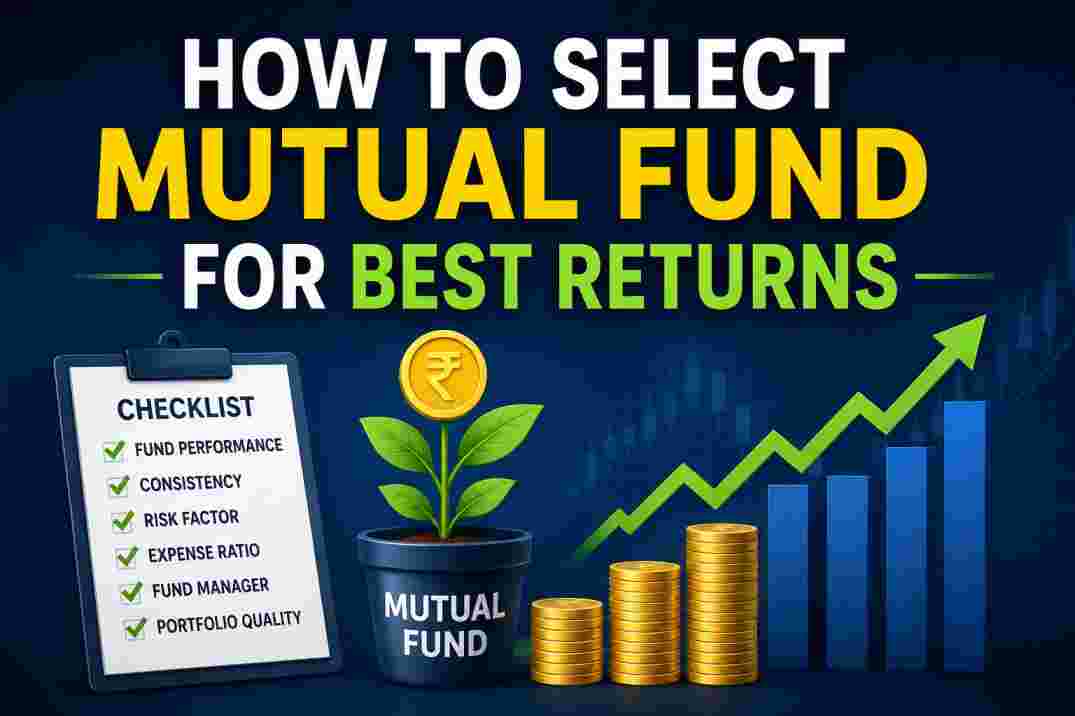
A Simple Onetrader Mutual Fund Checklist
Before investing, ask yourself these questions:
1. What is my goal?
2. What is my investment time horizon?
3. What level of risk can I tolerate?
4. Is this the right fund category for me?
5. How has the fund performed over multiple periods?
6. How does it compare with its benchmark?
7. Is the performance reasonably consistent?
8. What are the costs?
9. What does the portfolio actually hold?
10. How did it behave during market corrections?
If you can answer these questions clearly, you’re already doing much better than an investor who simply searches for “highest-return mutual fund.”
The Biggest Mistakes to Avoid
Don’t choose a fund solely because it gave the highest return last year.
Don’t invest because a friend recommended it.
Don’t choose a fund just because its NAV is low.
A lower NAV does not mean a fund is cheaper.
Don’t assume a ₹10 NAV fund is better than a ₹500 NAV fund.
Don’t invest in too many funds simply for diversification. Owning 15 or 20 similar equity funds can create unnecessary overlap.
And most importantly, don’t expect mutual funds to make you rich overnight.
Wealth creation requires time.
Final Onetrader Conclusion
Selecting a mutual fund is not about finding the fund with the biggest return today.
It is about finding a fund that fits your goal, risk tolerance, time horizon and investment strategy, and then giving the investment enough time to work.
Look at long-term performance, consistency, benchmark performance, costs, portfolio quality and risk.
Don’t chase yesterday’s winner.
Choose the right category. Choose carefully. Invest consistently. Stay patient.
Because in investing, the biggest advantage is often not finding the perfect fund.
It is staying invested in a sensible strategy for a long enough period to allow compounding to work.
Onetrader Thought:
“Don’t ask which mutual fund gave the highest return. Ask which fund can you hold with confidence for the next 10 years.”
Onetrader Disclaimer: This content is for educational and awareness purposes only. We are not SEBI registered. Nothing shared here is investment, trading, or financial advice. Mutual fund investments are subject to market risks. Please do your own research or consult a qualified financial advisor before making any financial decision.