
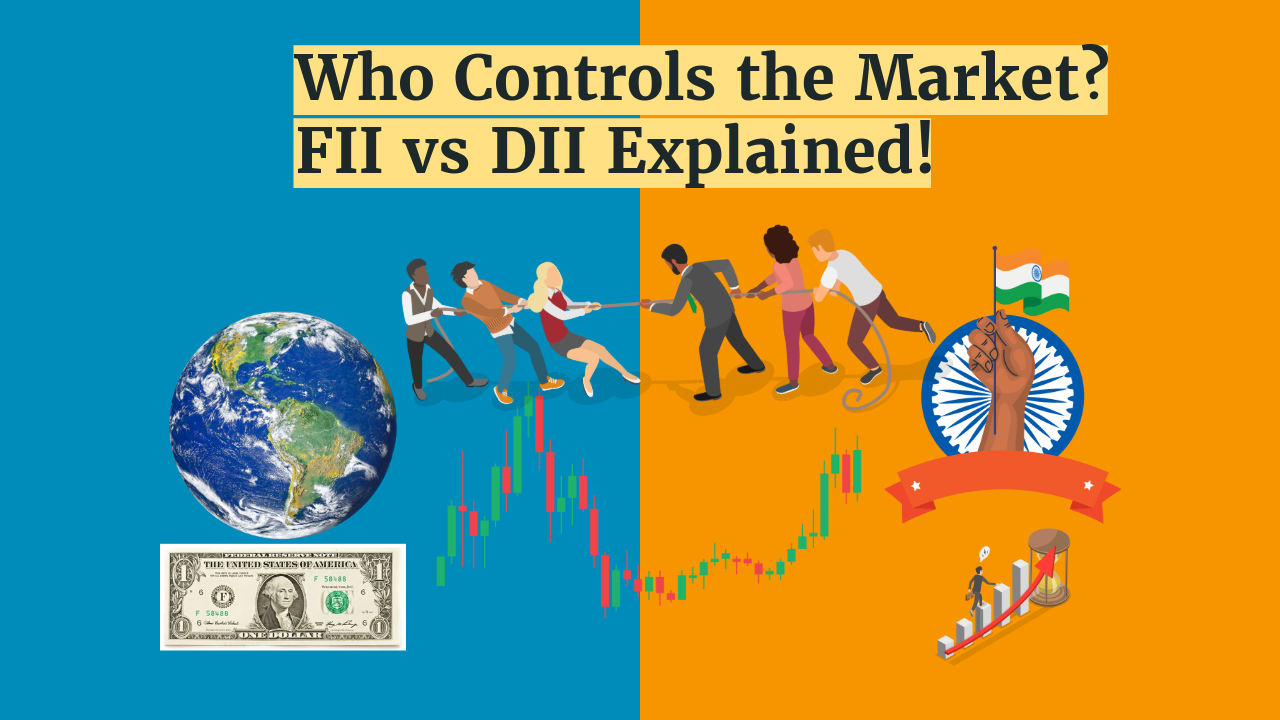
🌍 How FII & DII Flows Impact the Stock Market
(Onetrader Guide — by Onetrader)
Every evening, you see headlines like —
📈 “FIIs buy ₹3,200 crore worth of stocks; DIIs sell ₹2,100 crore”
or
📉 “Foreign Investors pull out ₹5,000 crore from Indian equities.”
But what does it actually mean?
And how do these FII & DII flows decide the next day’s market direction?
Let’s break it down 👇
Also Read: How to Buy Your First Stock in India: A Beginner’s Step-by-Step Guide
🏦 What Are FII and DII?
🔹 FII – Foreign Institutional Investors
These are large global investment entities that invest money in Indian markets from abroad.
Examples: BlackRock, Vanguard, Morgan Stanley, Goldman Sachs, JP Morgan, etc.
They trade through registered accounts and bring foreign capital into India’s stock market.
🔹 DII – Domestic Institutional Investors
These are large Indian institutions that invest locally.
Examples: LIC, SBI Mutual Fund, HDFC AMC, ICICI Prudential MF, insurance companies, pension funds, etc.
They represent Indian household savings and long-term domestic wealth.
Also Read: Intraday vs Delivery Trading: What Is the Difference?
💰 What Are “Flows” in the Market?
When you see “FIIs bought ₹5,000 crore,” it means the net cash inflow — total buy value minus total sell value — from foreign investors.
- Positive FII flow: More buying → bullish sentiment
- Negative FII flow: More selling → bearish pressure
The same logic applies to DII flows.
👉 These flows are daily liquidity movements, showing where big money is going.
🔁 FII vs DII Tug of War
FIIs and DIIs often move in opposite directions:
Also Read: Best Stock Market Apps in India: Features, Charges and How to Choose
| Scenario | FII Activity | DII Activity | Market Impact |
|---|---|---|---|
| Bullish phase | FIIs buy | DIIs partially sell (book profit) | Market rallies strongly |
| Correction phase | FIIs sell | DIIs buy (support market) | Market stabilizes |
| Panic phase | FIIs heavy selling | DIIs limited buying | Market falls sharply |
💡 Example (2023–2024):
- FIIs sold ₹1.5 lakh crore during mid-2023 correction.
- DIIs absorbed ₹1.2 lakh crore, preventing a crash.
That’s why even when FIIs sell, Nifty often doesn’t collapse completely — domestic funds balance the market.
📊 Why FII Flows Matter More (Short Term)
FIIs control a large portion of daily liquidity — especially in index futures & large caps.
They influence:
- Nifty & Bank Nifty movement
- USD-INR exchange rate
- Market sentiment (global → India)
When FIIs Buy:
- Rupee strengthens
- Nifty, Bank Nifty, and large caps rally
- Risk appetite increases
When FIIs Sell:
- Rupee weakens
- Market becomes volatile or declines
- Midcaps correct first
🧠 Why DII Flows Are Powerful (Long Term)
DIIs bring stability — their money comes from SIPs, mutual funds, and insurance flows.
Even if FIIs sell ₹10,000 crore in panic, DIIs often buy gradually using steady inflows.
That’s why India’s market remains resilient despite global sell-offs — because DIIs keep investing every month through retail SIPs.
Also Read: Best US Stock Trading Platforms for Indians: Fees, Features and How to Choose
💡 Fact:
As of 2025, monthly SIP inflows crossed ₹21,000 crore — most of this becomes DII inflow into equities.
🌍 Factors Influencing FII & DII Decisions
| Factor | Effect on FII/DII |
|---|---|
| US Interest Rates | When Fed hikes rates, FIIs pull money out of emerging markets like India. |
| Rupee vs Dollar | Rupee depreciation often triggers FII selling. |
| Corporate Earnings | Strong results attract DII buying. |
| Government Policies | Reforms, disinvestments, or PLI schemes attract both FII & DII interest. |
| Global Risk Sentiment | War, oil prices, inflation — all influence short-term flows. |
📈 How Traders Use FII/DII Data
Smart traders analyze FII/DII data daily — available on NSE website under “Participant Wise Open Interest.”
Here’s how they interpret it:
🔹 If FIIs are buying in Index Futures:
→ Expect bullish sentiment next day.
Also Read: How to Find Your Demat Account Number Online – DP ID, Client ID & BO ID
🔹 If FIIs are selling heavily in Index Futures:
→ Expect pressure or range-bound trade.
🔹 If DIIs are buying when FIIs are selling:
→ Expect market stability or bottom formation.
🧩 Example: FII-DII Flow Impact (2025)
March 2025:
FIIs turned net buyers after 4 months of selling — ₹18,000 crore inflow.
→ Nifty rallied from 21,000 to 22,600 within 4 weeks.
August 2025:
FIIs booked profits — ₹12,000 crore net selling.
→ Nifty corrected 3% while DIIs cushioned the fall by buying ₹9,000 crore.
Also Read: How to Transfer Shares From One Demat Account to Another – Complete Guide
That’s how flows literally shape daily candles you see on charts.
🏁 Final Thoughts
FII and DII flows are the bloodstream of the stock market.
FIIs bring global momentum.
DIIs provide local stability.
When both buy together — markets roar. 🐂
When both sell — be cautious. 🐻
So next time you check the news, don’t ignore those flow numbers —
they reveal who’s controlling the market that day.
Also Read: Demat Account Charges in India: AMC, Brokerage, DP Charges and Other Fees
❓ Frequently Asked Questions (FAQs)
1️⃣ What is the difference between FII and DII?
FII (Foreign Institutional Investor) refers to investors or institutions from outside India who invest in the Indian stock market.
DII (Domestic Institutional Investor) refers to Indian-based institutions like mutual funds, insurance companies, and pension funds investing locally.
FIIs bring foreign capital, while DIIs represent domestic savings.
2️⃣ Why do FII and DII flows matter for the market?
Because these flows represent big money movements that decide short-term and medium-term trends.
- When FIIs buy aggressively → markets usually rise.
- When FIIs sell → markets often correct.
- DIIs help balance volatility when FIIs exit.
3️⃣ How can I track daily FII and DII data?
You can check the NSE official website → “Participant Wise Open Interest” or visit moneycontrol.com / nseindia.com every evening after 6:00 PM for daily flow data.
These show whether FIIs and DIIs were net buyers or sellers.
4️⃣ Do FII and DII influence Nifty and Bank Nifty?
Yes — especially FIIs.
They trade heavily in index futures and large caps, which directly impact Nifty 50 and Bank Nifty levels.
DII activity helps support dips when FIIs sell.
Also Read: How to Close a Demat Account Online in India
5️⃣ What does it mean when both FII and DII are buying?
That’s the best-case bullish scenario.
When both are net buyers, liquidity floods the market → index rallies and overall sentiment turns positive.
6️⃣ What happens if both FII and DII are selling?
It’s a warning signal ⚠️ — both sets of big players exiting means the market could enter correction mode.
Traders should avoid aggressive buying during such phases.
7️⃣ Can retail investors use FII-DII data for trading?
Yes, smartly!
Use it to confirm your trend bias —
✅ FII buying supports bullish setups
✅ FII selling supports cautious or bearish positions
But always combine with price action and volume, not blindly follow flow numbers.
8️⃣ What are the top months for FII inflows in India?
Historically, October–December (Q3) and March–April (financial year-end rotation) often see stronger inflows.
However, global factors like interest rates, Fed policy, and USD-INR can shift trends anytime.
Also Read: How to Sell Shares in India
9️⃣ How do FIIs affect the Indian Rupee?
When FIIs buy Indian equities, they bring USD → convert to INR → rupee strengthens.
When FIIs sell, they withdraw INR → convert to USD → rupee weakens.
That’s why FII flow and rupee trend often move in opposite directions.
🔟 Can FII and DII both make mistakes?
Absolutely.
Even institutional investors go wrong — they just have deeper pockets and longer horizons.
Retail traders should focus on aligning with the dominant side (more consistent flow) rather than predicting turns.
💡 Pro Tip (for readers):
Track FII/DII flow data weekly instead of daily to see the trend, not just noise.
Daily numbers can mislead — but multi-week trends reveal real direction.
Also Read: What Are Futures and Options?