
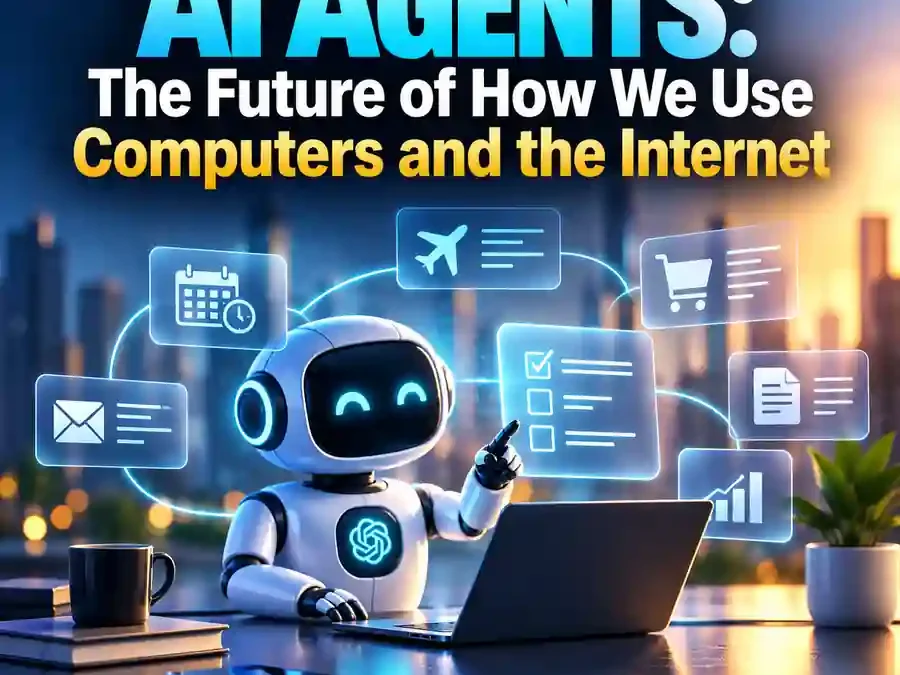
Artificial intelligence is entering a new stage that could fundamentally change how people use computers, smartphones and the internet. For decades, digital technology has depended on users performing individual actions, such as opening websites, searching for information, switching between applications, entering details and completing tasks manually. Generative AI introduced a different experience by allowing people to ask questions, create content and analyze information through natural-language conversations. Now, AI agents are taking that development further by moving beyond providing answers toward performing actions on behalf of users. This emerging technology could eventually transform computers from tools that wait for instructions into intelligent systems capable of planning, coordinating and completing increasingly complex digital tasks.
The significance of AI agents goes beyond another improvement in chatbot technology. The larger opportunity is to change how humans interact with software itself. Instead of learning how to operate multiple applications, people could increasingly describe what they want to accomplish and allow an AI system to organize the necessary steps. From managing appointments and researching purchases to handling administrative work and coordinating business processes, AI agents could reduce the amount of repetitive interaction required to complete everyday tasks. Although the technology remains imperfect and still requires careful supervision, its development represents a potential turning point in the evolution of personal computing.
What Are AI Agents and How Are They Different From Traditional AI?
An AI agent is a software system designed to pursue a goal by interpreting instructions, planning actions, using available tools and evaluating the results. Traditional chatbots generally respond to questions, while AI agents can potentially interact with applications, retrieve information, update records and perform sequences of actions. The distinction is important because generating a useful answer and successfully completing a real-world task are different capabilities. A chatbot might explain how to organize a meeting, whereas an appropriately connected AI agent could examine calendar availability, suggest suitable times, prepare invitations and request approval before sending them.
AI agents typically combine several technologies, including large language models, memory, external tools and software systems that coordinate their actions. The language model helps interpret the user’s objective, while tools provide access to information or permitted functions. An agent may break a larger request into smaller tasks, complete them in sequence and adjust its approach when something changes. For example, an agent helping to plan a journey might compare transportation options, identify suitable accommodation and organize an itinerary around the user’s preferences. However, these capabilities depend on the agent’s actual integrations, permissions and reliability. An AI system cannot automatically access every website, account or application simply because it understands a request.
Also Read: Why India’s Middle Class Is the Next Big Growth Engine
Why AI Agents Could Change the Way We Use Computers
The modern computer is built around applications. People open a browser to search the internet, use email software to communicate, access spreadsheets to analyze information and switch between services to complete work. This application-centered approach has become familiar, but it also creates friction because users must understand which software to use and how different systems fit together. AI agents introduce the possibility of organizing computing around objectives rather than individual applications.
Imagine someone preparing for a business trip. Today, that process may involve checking a calendar, searching for flights, comparing hotels, examining transportation options and creating reminders. An AI agent with appropriate access could potentially coordinate much of this work through a single request. Instead of requiring the user to navigate every service independently, the system could gather relevant information, compare alternatives and prepare a plan for approval. The person would remain responsible for important decisions, but much of the repetitive digital work could be reduced.
This shift could also influence the design of future operating systems. Rather than treating AI as an additional feature inside a computer, software developers may increasingly build systems that allow authorized AI agents to interact with files, applications and services. Traditional graphical interfaces would remain important, particularly when users need precision or direct control, but natural-language interaction could become a more prominent way to accomplish tasks.
How AI Agents Could Transform Everyday Life
The strongest long-term opportunity for AI agents may come from ordinary activities that currently require multiple digital steps. Managing household schedules, comparing products, organizing documents, preparing travel plans and coordinating personal reminders all involve gathering information and making small decisions. An AI agent could potentially combine these activities into connected workflows, reducing the need to repeatedly switch between websites and applications.
Also Read: Robotics & Industrial Automation in India: The Next Big Manufacturing Opportunity
Online shopping provides an example. Instead of manually examining dozens of product pages, a user could ask an AI agent to identify products that satisfy particular requirements, compare their features and explain the differences. With appropriate permissions, future systems could also help track prices, monitor deliveries and manage returns. Financial and purchasing actions would still require clear authorization and safeguards, but the research and administrative work surrounding those decisions could become substantially easier.
Education and accessibility may also benefit. Students could use agents to organize study material, create revision schedules and identify topics requiring further attention. People with disabilities could potentially use voice-controlled agents to navigate software, complete forms or interact with digital services that would otherwise require complex manual input. These applications highlight an important possibility: AI agents could make technology more accessible by reducing the technical knowledge needed to perform everyday tasks.
From AI Assistants to Autonomous Digital Workflows
One of the most significant developments in agentic AI is the movement from individual requests toward connected workflows. A traditional assistant might summarize a document or draft an email, but a more capable agent could potentially coordinate several related tasks. In a business environment, for example, an authorized agent might retrieve information from different systems, prepare a report, identify missing details and notify the relevant team members. The value would come from connecting multiple actions rather than completing each one separately.
More advanced systems may also use multiple specialized agents working together. One agent could retrieve information, another could analyze it and a third could prepare a final output. This approach may help divide complicated work into manageable components, although coordinating several agents can introduce additional errors, costs and security challenges. Multiple agents do not automatically produce better results; their work must be checked for accuracy and consistency.

Also Read: Data Centre Infrastructure in India: Growth Opportunities
The future of AI automation may therefore involve a combination of intelligent agents, traditional software and human oversight. Predictable activities can continue using conventional automation, while AI agents may be useful when tasks involve changing information, interpretation or flexible planning. The most effective systems will likely combine these approaches rather than attempting to replace every existing software process with artificial intelligence.
The Role of AI Agents in Future Smartphones and Wearables
AI agents could become particularly important as computing expands beyond traditional screens. Smartphones, smart glasses, earbuds, watches and connected vehicles already provide different ways to access digital services. As AI capabilities improve, agents could potentially coordinate these devices and deliver assistance through whichever interface is most appropriate at a particular moment.
For example, someone wearing AI glasses might ask for directions while walking through an unfamiliar city. An agent could retrieve relevant navigation information and deliver instructions through audio or a wearable display. Later, the same user could continue planning their journey on a smartphone without restarting the entire interaction. This kind of continuity would depend on shared context, secure account connections and reliable communication between devices.
The long-term opportunity is a more connected personal computing environment in which AI helps users move between devices and services. Instead of every device operating as a largely separate interface, an authorized agent could coordinate information across an individual’s digital ecosystem. This connects directly with the future of AI wearables, where technology may become less dependent on constant interaction with smartphone screens.
Also Read: Defence & Aerospace Manufacturing: India’s Next Major Industrial Growth Story
Why Technology Companies Are Investing in Agentic AI
The development of AI agents has major implications for the technology industry because agents could influence how people discover and use software. Companies such as Microsoft, Google, Amazon and Salesforce are developing agent-related capabilities across productivity software, cloud infrastructure and enterprise applications. Their interest reflects a broader opportunity to make AI part of everyday digital workflows rather than limiting it to standalone conversations.
For software companies, agentic AI could change the value of traditional applications. Businesses may increasingly expect software to perform tasks through intelligent automation rather than simply provide interfaces for employees to operate. This could create demand for agent-ready applications, secure integrations, workflow-management systems and tools that allow organizations to supervise AI activity.
The opportunity also extends to semiconductor companies, cloud infrastructure providers and cybersecurity businesses. More sophisticated agents may require substantial computing resources, especially when they repeatedly analyze information, use tools and coordinate complex workflows. Companies supplying AI processors, data-center infrastructure and cloud services could benefit from growing demand, although the economics will depend on adoption, competition and improvements in computing efficiency. At the same time, cybersecurity providers may find new opportunities in protecting organizations from unauthorized agent activity and sensitive-data exposure.
Security, Privacy and Human Control Will Shape Adoption
Despite their potential, AI agents introduce risks that are different from those associated with ordinary chatbots. A chatbot that produces an incorrect answer may misinform a user, but an agent with permission to modify files, send messages or interact with business systems could cause more direct consequences. Errors involving purchases, financial records, confidential information or account permissions could be particularly serious.
Also Read: Semiconductor & Electronics Manufacturing: India’s Next Big Industrial Opportunity
One important concern is prompt injection, where malicious instructions hidden inside websites, documents or other external information attempt to manipulate an AI agent. Another is excessive access, where an agent receives more permissions than it needs to complete a task. Because agents may operate across several connected systems, security failures could affect multiple applications rather than a single interaction.
Responsible deployment will require clear permission boundaries, activity records, meaningful human oversight and reliable ways to stop an agent when necessary. Sensitive or irreversible actions should have appropriate approval controls rather than relying solely on the AI model to decide whether permission is needed. Privacy will be equally important because personal agents may handle calendars, messages, documents and other sensitive information. Long-term adoption will depend not only on what AI agents can accomplish but also on whether users can understand, supervise and trust their actions.
Will AI Agents Replace Traditional Apps and Websites?
AI agents could reduce the need to manually navigate some applications, but a complete replacement of apps and websites is unlikely in the foreseeable future. Many digital activities benefit from direct visual interaction, including creative design, gaming, detailed financial analysis and complex document editing. Users may also prefer to examine information themselves before making important decisions.
Instead, the relationship between people and applications could gradually change. Websites and software platforms may increasingly serve both human users and authorized AI agents. A person might ask an agent to collect information from several services while continuing to use a traditional interface to review the results or make final choices. Businesses may also need to redesign parts of their software so agents can interact with services reliably and securely.
Also Read: India’s Power & Renewable Energy Sector: Growth, Demand, Future Scope and Key Stocks
This evolution could affect internet business models. Search engines, online marketplaces, software providers and digital advertising companies have historically relied heavily on direct user interaction. If agents begin handling more research and routine navigation, companies may need new ways to make their products discoverable and useful through AI-mediated experiences. However, the commercial outcome remains uncertain because technical standards, consumer preferences and platform rules are still evolving.
The Future of AI Agents Over the Next Decade
The development of AI agents is likely to happen gradually rather than through a sudden replacement of existing technology. Early adoption may remain concentrated in tasks where the benefits are measurable and errors can be reviewed easily. As models improve and software integrations become more reliable, agents could take responsibility for increasingly complicated workflows while still operating within defined limits.
One of the most important changes may be the transition from AI as a tool for producing information to AI as a system for helping achieve objectives. People could spend less time navigating software and more time defining what they want to accomplish, reviewing alternatives and making decisions. Businesses could use agents to reduce repetitive administrative work, while consumers could benefit from more personalized and accessible digital services.
However, greater autonomy will not automatically mean greater reliability. Agents must become better at recognizing uncertainty, handling unexpected situations and knowing when to request human intervention. Their economic value will also depend on whether the time and resources saved justify the cost of operating them. These practical considerations will determine how quickly agentic AI moves from experimental demonstrations into widespread everyday use.
Also Read: AI and Power Demand: Could Utilities Become the Next AI Winners?
The long-term significance of AI agents lies in their potential to reshape the relationship between humans and computers. The personal computer made digital tools widely available, the internet connected those tools to information and services, and smartphones made computing accessible almost everywhere. AI agents could represent another important stage by allowing people to interact with digital systems through goals and natural-language instructions rather than relying entirely on manual navigation.
The future may not involve computers operating independently of humans. A more realistic and useful possibility is a world where intelligent software handles repetitive digital work while people retain control over important decisions. If AI agents become sufficiently reliable, secure and affordable, they could change not only how we use individual applications but also how the internet itself is experienced. That makes agentic AI one of the most important long-term technology developments to understand as personal computing enters its next generation.
Disclaimer: The content on Onetrader is for educational/informational purposes only. Not SEBI registered advisors.
Also Read: AI and Data Centres: Stocks That Could Benefit From the Infrastructure Boom







Keep learning with OneTrader
Explore structured lessons and practical guides to build your market knowledge.