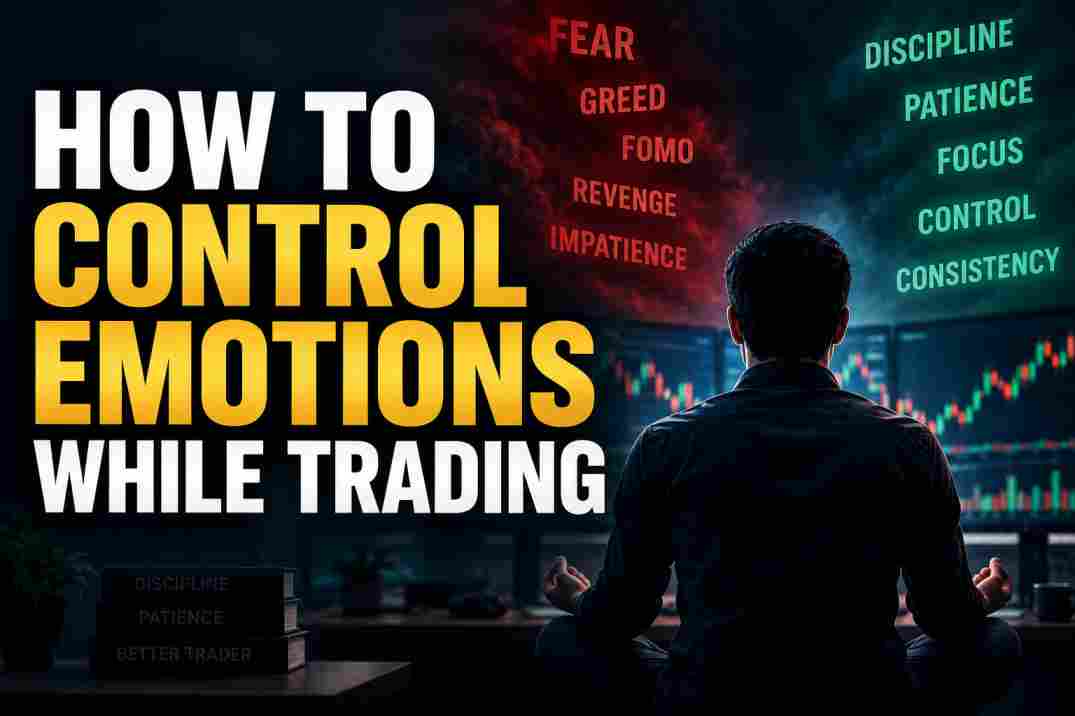
Trading is often described as a game of charts, patterns, indicators and probabilities. But there is another factor that can have an even greater influence on results: emotion. A trader may have a well-tested strategy and still lose money because fear, greed, impatience or frustration changes the way that strategy is executed. Learning how to control emotions while trading is therefore not about becoming emotionless. It is about learning how to make decisions without allowing temporary emotions to override a well-defined process.
Why Emotions Become So Powerful in Trading
Money creates a unique psychological environment. When a position moves in your favor, the brain naturally wants more. When it moves against you, the desire to avoid pain becomes stronger. This can create a cycle where traders enter because of excitement, hold because of hope, exit because of fear and then re-enter because of FOMO.
The problem becomes worse when traders attach their self-worth to individual trades. A winning trade can make someone feel highly confident, while a losing trade can make them feel that they need to prove themselves. The market, however, does not reward confidence or punish insecurity. It simply responds to changing information, supply and demand, and market conditions.
Fear Can Destroy Good Trading Decisions
Fear is one of the most common emotions experienced by traders. A trader may identify a valid setup but hesitate to enter because of a previous loss. Another trader may enter correctly but exit too early after seeing a temporary decline. During a market correction, fear can become even stronger as negative headlines and falling prices reinforce each other.
Also Read: Why Most Traders Lose Money in the Stock Market
The important point is that fear itself is not necessarily bad. Fear can remind you that risk exists. The problem begins when fear changes your predetermined plan. A disciplined trader uses risk limits and position sizing so that normal market fluctuations do not become psychologically overwhelming.
Greed Can Make Traders Take Unnecessary Risk
Greed usually appears when things are going well. After several profitable trades, traders can start believing that they have discovered an easy formula for making money. They may increase their position size, take lower-quality setups or hold a profitable trade far beyond their original plan.
Greed can also appear when traders chase stocks after a sharp move. Seeing a stock rise rapidly creates the fear that the opportunity will disappear. Instead of waiting for a suitable setup, the trader enters simply because the price is moving. A strong market can make this behavior look successful temporarily, but the same habit can become expensive when conditions change.
How to Control Emotions Before Entering a Trade
Emotional control starts before the trade, not after it. A trader should know the reason for entering, the price or condition that invalidates the idea, the amount of capital at risk and the intended exit approach before taking the position.
Also Read: Gambler’s Fallacy in Trading – Why Traders Think Markets Must Reverse
This preparation reduces the number of decisions that need to be made under pressure. If you decide everything only after entering the trade, every price movement can create a new emotional debate. A written trading plan creates structure when emotions become loud.
Position sizing is equally important. If a potential loss is large enough to create anxiety, the position may simply be too large. Reducing position size can make it easier to follow the strategy without constantly watching every tick.
Stop-Loss Discipline and Emotional Control
Many traders believe controlling emotions means becoming mentally stronger. In reality, good risk management can reduce the emotional pressure in the first place. A predetermined stop-loss defines the point where the original trade idea is considered invalid.
The challenge is accepting that a stop-loss is not a prediction that the market will definitely move against you. It is simply a risk-management mechanism. Some trades will reach the stop-loss and later recover. That does not automatically mean the stop-loss was wrong. What matters is whether the risk was controlled according to the trading plan.
Also Read: The 1.8 Crore Solapur Trading Tragedy: A Warning to Every Retail Trader
How to Deal With Losses Without Revenge Trading
After a loss, the strongest temptation can be to immediately recover the money. This is where revenge trading begins. A trader may increase position size or take a setup that would normally be rejected because the emotional objective has changed from following the strategy to recovering the previous loss.
A better approach is to treat each trade as one event in a much larger series. A single loss does not determine whether a strategy works. If emotions become intense after a significant loss, stepping away from the market can be more productive than immediately searching for another trade.
Build a Process Instead of Depending on Willpower
Trying to control emotions through willpower alone is difficult. A better solution is to build a system that reduces opportunities for emotional decisions. Use predefined entry conditions, fixed risk parameters, appropriate position sizing and a trading journal.
The journal should record not only entry and exit prices but also the reason for the trade and the emotional state during the decision. After reviewing multiple trades, recurring behaviors become easier to identify. You may discover that most mistakes happen after consecutive losses, during fast-moving markets or when trading without confirmation.
Also Read: Recency Bias in Trading – Why Recent Trends Fool Traders
The Professional Approach to Trading Emotions
Professional trading does not mean having no emotions. Experienced traders can still feel fear, excitement and frustration. The difference is that those emotions do not automatically determine their actions.
The objective is to become comfortable with uncertainty. You will not know whether the next trade will win. You will not know exactly where the market will move tomorrow. What you can control is your risk, your position size, your preparation and whether you follow your rules.
The best traders therefore focus less on predicting every market movement and more on executing their process consistently.
Conclusion
Controlling emotions while trading is not about eliminating fear, greed or excitement. It is about preventing those emotions from taking control of your decisions. A trader who understands risk, uses appropriate position sizing, follows predefined rules and reviews their behavior regularly has a much stronger foundation for consistency.
Also Read: Anchoring Bias in Trading – Why Traders Get Stuck to One Price (2025)
The market will always create emotional situations. Your job is not to control the market. Your job is to control your response to the market.
Trade the plan, not the emotion.
Frequently Asked Questions
How can I control my emotions while trading?
Create a clear trading plan, use appropriate position sizing, define risk before entering and maintain a trading journal. These processes can reduce impulsive decisions.
Why do I become emotional after a loss?
Losses trigger psychological discomfort and can create a strong desire to recover the money. Recognizing this pattern can help prevent revenge trading.
Also Read: Overconfidence Trap in Trading – Why Early Wins Create Huge Losses
Does a stop-loss help control trading emotions?
Yes. A predefined stop-loss can establish the maximum acceptable risk and reduce the temptation to make decisions based purely on fear during the trade.
Should I stop trading after a losing trade?
Not necessarily. One normal losing trade does not mean your strategy has failed. However, if you notice that frustration is affecting your decisions, taking a break can be sensible.
Disclaimer
This article is for educational and informational purposes only and should not be considered investment or trading advice. Trading and investing involve market risks, and losses are possible. Readers should conduct their own research and consider their financial circumstances and risk tolerance before making financial decisions.
Also Read: Loss Aversion in Stock Market – Why Traders Avoid Small Losses