
India’s Water Economy, Scarcity, Treatment, Recycling and Investment Opportunities Through 2035
Water is one of the most important resources on Earth, yet it is rarely discussed as an investment theme in the same way as artificial intelligence, defence, semiconductors, renewable energy or electric vehicles. That could change significantly over the next decade. The reason is simple: every major economic activity needs water. Cities need it, agriculture needs it, factories need it, power plants need it, semiconductor fabs need it, pharmaceutical companies need it, data centres need it and households need it.
The interesting part is that the future water opportunity is not simply about selling drinking water. The much larger opportunity is developing the infrastructure required to source, transport, purify, treat, recycle, monitor and efficiently distribute water.
India is moving toward a period in which water management could become a strategic infrastructure requirement rather than simply a public-service issue. Older water pipelines need replacement, cities need additional supply, wastewater needs treatment, industries need water recycling, groundwater needs management and new infrastructure such as data centres and semiconductor facilities will create additional demand for high-quality water.
This makes water a fascinating long-term sector for investors and businesses.
Also Read: India’s Power & Renewable Energy Sector: Growth, Demand, Future Scope and Key Stocks
India’s water and wastewater management market was estimated at about ₹192.44 billion in 2024 and is projected by one market study to reach ₹353.50 billion by 2030, representing roughly 10.7% CAGR. Another 2026 market study estimates India’s water and wastewater treatment technology market at about $2.73 billion in 2025, reaching $4.73 billion by 2031 at approximately 9.6% CAGR. Different studies use different definitions, so these figures should not be treated as directly interchangeable, but they point toward the same structural conclusion: India’s water-treatment economy is expected to expand materially over the coming years.
Also read: Drone & Anti-Drone – The Futuristic Industry (2025 – 2035)
What Exactly Is the Water Sector?
When investors hear “water sector”, they often think only about water-treatment companies. In reality, the industry is much broader.
The water economy begins with water sourcing. This includes reservoirs, rivers, groundwater, desalination and other sources. The next stage is transportation through pipelines, pumping stations and distribution networks. Water then needs to be treated before it reaches households or industrial users. After consumption, wastewater has to be collected and treated. Increasingly, that treated wastewater can be recycled and used again.
Also Read: AI and Power Demand: Could Utilities Become the Next AI Winners?
This creates a circular ecosystem: source → treatment → distribution → consumption → wastewater collection → treatment → recycling → reuse.
Around this core ecosystem sits another layer of businesses. Pumps, pipes, valves, meters, membranes, water-treatment chemicals, sensors, automation systems, engineering companies, construction companies and long-term operation-and-maintenance providers all participate in the water economy.
That is why an investor studying this theme should not look for only one “water stock”. The better approach is to understand the entire value chain.
Why Water Could Become One of the Biggest Infrastructure Themes
The fundamental investment thesis is scarcity.
Also Read: AI and Data Centres: Stocks That Could Benefit From the Infrastructure Boom
India has a large population and rapidly increasing urbanisation, while freshwater resources are finite. NITI Aayog has previously highlighted the possibility of severe water stress, including a projected domestic water demand-supply gap of around 50 billion cubic metres by 2030 under the cited estimates.
Moody’s has also warned that worsening water stress could affect India’s economic growth, agriculture and water-intensive industries. It estimated India’s per-capita water availability could fall to around 1,367 cubic metres by 2031, below the commonly used 1,700-cubic-metre water-stress threshold.
The important investment point is that scarcity creates a requirement for infrastructure.
When a city does not have enough freshwater, it has several choices. It can develop new sources, improve distribution efficiency, reduce leakage, construct treatment plants, recycle wastewater, develop desalination or combine several of these solutions.
Also Read: AI Adoption Is Spreading: Which Industries Could Benefit Most?
Every one of those solutions requires capital.
This is why the water sector can develop into a long-duration infrastructure cycle.
Also Read: The Total Money Makeover Book Summary & 7 Baby Steps Explained
The Most Important Change: Water Is Moving From Supply to Management
For decades, India’s water challenge was largely about building infrastructure and providing access. The next phase is more complicated.
Also Read: Indian Defence Stocks in 2026: Growth Opportunity or Valuation Risk?
The question is increasingly becoming: How do we manage every drop efficiently?
A city can build a water-treatment plant, but if the distribution network leaks heavily, a large amount of treated water can still be lost. An industrial facility can obtain freshwater, but if it cannot recycle its wastewater efficiently, its operating costs and environmental footprint can rise.
The next generation of water infrastructure therefore involves sensors, smart meters, SCADA systems, automation, leak detection, artificial intelligence, predictive maintenance and real-time water-quality monitoring.
This is where the water sector starts connecting with another theme we already covered: AI and Cloud.
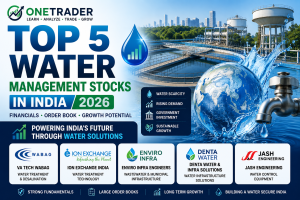
Also Read: Top 5 Water Management Stocks in India: Financials, Growth & Future Potential
AI can analyse consumption patterns, identify unusual pipeline behaviour, detect potential leaks and optimise pumping schedules. Cloud platforms can aggregate data from thousands of sensors. Smart meters can provide real-time consumption information. Predictive analytics can help utilities identify equipment failures before they become expensive breakdowns.
The future water company may therefore look less like a traditional construction company and more like a combination of engineering, technology and infrastructure.
India’s Government Spending Is Creating a Structural Catalyst
One of the most important developments for the Indian water sector came in March 2026.
The Union Cabinet extended and restructured Jal Jeevan Mission 2.0 through December 2028. The total outlay was increased to ₹8.69 lakh crore, with central assistance of ₹3.59 lakh crore. The programme is also shifting from simply creating infrastructure toward service delivery, sustainability and institutional reforms.
Also Read: Renewable Energy & Clean Tech Stocks in India: Complete List
This distinction is extremely important.
The first phase focused heavily on creating household tap-water infrastructure. The next phase puts greater emphasis on whether those systems remain functional, sustainable and capable of delivering reliable water services.
The government is also introducing a digital framework called Sujalam Bharat, under which villages and water-supply systems can be digitally mapped. That creates an additional opportunity for monitoring, data management and technology-enabled water administration.
This means the water opportunity is no longer simply “build pipes”.
Also Read: Is India’s Real Estate Boom Back? What Investors Need to Know
It is becoming build + operate + monitor + maintain + digitise.
Also Read: Meditation for Traders: Simple Techniques to Reduce Stress & Improve Focus
Urban India Could Become an Even Bigger Opportunity
India’s cities are growing rapidly, and urbanisation creates a very different water challenge.
A growing city requires additional reservoirs, pipelines, pumping stations, treatment plants and sewage infrastructure. But the wastewater problem grows at the same time.
Also Read: Infrastructure Investment Trusts (InvITs) in India – Complete Beginner Guide | Onetrader
AMRUT 2.0 is already supporting thousands of water, sewerage and water-body projects. The Ministry of Housing and Urban Affairs’ March 2026 progress report showed 8,739 approved projects with approved project costs of about ₹1.95 lakh crore. Water-supply projects accounted for more than ₹1.19 lakh crore of approved project cost, while sewerage and septage projects accounted for more than ₹68,000 crore.
This gives investors an important insight: the opportunity is not concentrated in drinking-water infrastructure alone.
Sewerage, wastewater treatment and water reuse could become equally important.
In fact, recent government projects increasingly demonstrate this transition. AMRUT 2.0 projects include sewage-treatment plants, underground sewerage networks, 24×7 water supply, water-body rejuvenation and reuse of treated wastewater.
Also Read: Top Space-Tech Stocks in India – A Hidden Multibagger Opportunity (2025-2045)
Wastewater Could Become the New Water Source
One of the most interesting future themes is wastewater recycling.
Historically, wastewater was treated mainly as something that needed to be disposed of safely. The future model is different: wastewater can become a resource.
A city can treat sewage and reuse the resulting water for industrial cooling, construction, landscaping, agriculture or other non-potable applications. Industries can increasingly recycle process water internally rather than continuously drawing fresh water.
This creates a circular water economy.
Also Read: Green Energy & EV Ecosystem – The Future of Power (2025–2035)
The National Mission for Clean Ganga has also been promoting the concept of treating wastewater as a resource and increasing the safe reuse of treated wastewater for industrial and other non-potable applications.
This could become one of the strongest long-term themes in the sector because recycling solves two problems simultaneously: it reduces freshwater demand and reduces wastewater discharge.
Also Read: Infrastructure Investment Trusts (InvITs) in India
Industrial Water Could Be an Even Bigger Business
The water industry is not only about governments.
Also Read: Drone & Anti-Drone – The Futuristic Industry (2025 – 2035)
Industries such as pharmaceuticals, chemicals, textiles, food processing, metals, mining, semiconductor manufacturing and power generation require enormous quantities of water and increasingly need sophisticated treatment systems.
For these companies, water is not simply a utility. It can be a production constraint.
A factory that cannot obtain adequate water may not be able to operate at full capacity. A semiconductor plant needs extremely high-purity water. Pharmaceutical manufacturing requires controlled water quality. Chemical companies may need advanced wastewater treatment and zero-liquid-discharge systems.
This creates opportunities for companies that can provide specialised treatment rather than basic municipal infrastructure.
Also Read: AI & Cloud – The Complete Future Playbook
Technologies such as reverse osmosis, ultrafiltration, nanofiltration, membrane bioreactors, desalination, water recycling and zero-liquid-discharge systems could therefore see increasing demand.
The 2026 India water-treatment market study specifically points toward urbanisation, stricter discharge standards, sustainability programmes and zero-liquid-discharge requirements as important growth drivers.
The Data Centre Connection Nobody Talks About
There is another interesting connection between our AI and Water themes.
AI requires data centres. Data centres require electricity. Many data centres also require significant cooling infrastructure, and some cooling technologies consume water.
Also Read: AMD vs NVIDIA: The AI War That Will Define the Next Decade
As India builds more AI infrastructure, cloud facilities and hyperscale data centres, water availability could become part of the infrastructure-selection decision.
This creates an unusual future opportunity: AI growth can indirectly increase demand for water-management technology.
Data-centre operators may increasingly look for recycled water, closed-loop cooling, advanced cooling technologies and water-efficiency monitoring.
That means the water theme could benefit from sectors that at first appear completely unrelated.
Also Read: Top 5 Sectors to Watch in 2025: Future Investment & Business Opportunities
Also Read: Benjamin Graham: The Father of Value Investing & Intelligent Investing
Desalination Could Become More Important
For coastal cities and water-stressed regions, desalination is another long-term solution.
Desalination converts seawater into usable freshwater, primarily through membrane-based technologies such as reverse osmosis.
The challenge has historically been energy consumption and cost. However, falling renewable-energy costs, improved membranes and better energy-recovery systems could gradually improve desalination economics.
Also Read: Future of AMCs in India: Growth, Scope & Best AMC Stocks
India’s large coastline gives it a strategic advantage in this area, although desalination will not replace freshwater sources everywhere.
The most attractive opportunity may be the combination of renewable energy + desalination + water recycling.
Pipes, Pumps and Valves: The Boring Businesses Could Become Interesting
One mistake investors often make is focusing only on high-technology water-treatment companies.
Water infrastructure ultimately depends on physical hardware.
Also Read: BSE 200 Stocks Down 25%+ From Highs: Complete List, Analysis & Investor Guide
Pipes need to be manufactured. Pumps need to move water. Valves need to control flow. Meters need to measure consumption. Motors need to power pumping systems.
This creates an ecosystem extending beyond pure water-treatment companies.
Companies involved in pumps, pipes, valves and infrastructure engineering can therefore receive indirect benefits from a long-term water-capex cycle.
The important difference is that these companies may have diversified businesses, so water might represent only one part of their overall revenue.
Also Read: 🔝 Top Railway Stocks by Order Book
Also Read:Overconfidence Trap in Trading – Why Early Wins Create Huge Losses
The Listed Indian Water Investment Universe
India does not have a huge number of pure-play listed water companies, which makes this sector interesting but also risky.
VA Tech Wabag is one of the most direct listed exposures to water treatment. Its business covers municipal and industrial water treatment, wastewater treatment, desalination and related infrastructure. The company therefore provides relatively direct exposure to the long-term treatment and reuse theme.
Ion Exchange India is another important name because it operates across water treatment, purification, recycling and water-management solutions. Its exposure extends into industrial customers and specialised water-treatment technologies.
Also Read: What is GST? Impact on Indian Economy and Stock Market (2025 Guide)
EMS Limited is more closely connected with municipal water and wastewater infrastructure, including sewage-treatment and water-supply projects. Its investment case is therefore linked significantly to government and municipal capex.
Enviro Infra Engineers is another company to study within the wastewater and sewage-treatment infrastructure ecosystem. Its opportunity is linked to municipal water infrastructure and treatment projects.
Beyond these more direct names, investors can investigate companies involved in pumps, pipes, engineering and infrastructure. The exposure becomes less pure but can provide diversification.
The key lesson is that a water company and a company that benefits from water spending are not necessarily the same thing.
Also Read: Nifty, Bank Nifty & Sector Indices – Current Valuation vs Historical Averages (2025)
How an Investor Should Analyse Water Stocks
Water stocks should not be purchased simply because water scarcity is increasing.
The first thing to examine is the company’s order book. A large order book can provide revenue visibility, but the quality of that order book matters more than the headline number.
The second factor is execution. Government infrastructure projects can take years to complete, and delays can affect revenue recognition and cash flows.
The third factor is working capital. This is particularly important for EPC-oriented businesses. A company may report strong accounting profits while cash remains stuck in receivables.
The fourth factor is recurring revenue. Companies that operate treatment plants under long-term operation-and-maintenance contracts can potentially create more predictable cash flows than companies dependent entirely on new EPC orders.
The fifth factor is return on capital. Water infrastructure is capital intensive, so investors should examine ROCE, ROE, asset turnover and cash conversion rather than focusing only on revenue growth.
Finally, valuation matters. A good water company can still become a bad investment if purchased at an excessive valuation.
Also Read: Are We Still Thinking — Or Just Consuming? | OneTrader Thought Series
Where the Biggest Future Opportunity Could Be
The water industry is likely to evolve through several stages.
The first stage is basic infrastructure: pipelines, pumps, reservoirs and treatment plants.
The second stage is wastewater treatment and sewage management.
The third stage is recycling and reuse.
The fourth stage is industrial water management, including zero-liquid discharge and high-purity water.
The fifth stage is digital water infrastructure.
The sixth stage is the circular water economy, where wastewater is treated as a resource rather than waste.
The companies that can move from stage one toward stages four, five and six could potentially develop stronger long-term competitive advantages.
Water + AI + Renewable Energy Could Create a New Mega Theme
This is where the sector becomes particularly interesting.
Imagine a future industrial facility powered partly by renewable energy. Its water system continuously measures consumption through sensors. AI predicts demand. Wastewater is treated and recycled. Pumps operate according to electricity prices and production requirements. Water quality is monitored automatically. The system reports its environmental performance to regulators and investors.
That is no longer a traditional water-treatment plant.
It is a smart water system.
This convergence of water, AI, cloud computing, renewable energy and industrial automation could create a completely new category of infrastructure businesses.
The 2030–2035 Water Economy
Between 2030 and 2035, water management could become increasingly decentralised.
Instead of depending entirely on huge centralised infrastructure, cities may use smaller treatment and recycling systems distributed across neighbourhoods and industrial zones.
Factories may recycle a much larger proportion of their water internally.
Large buildings could integrate rainwater harvesting, wastewater recycling and smart metering.
Agriculture could increasingly use precision irrigation and sensors to reduce unnecessary water consumption.
Utilities could use AI to identify leaks before they become major losses.
Desalination could expand in selected coastal regions.
And treated wastewater could become a commercially valuable resource.
This is why the water industry should be viewed as an infrastructure transformation rather than simply a shortage story.
The Biggest Risks
The biggest risk is government dependency. Many Indian water companies depend heavily on public-sector contracts, so delays in tendering, approvals or payments can affect financial performance.
Another risk is working capital. Large infrastructure projects can generate significant receivables.
Competition is another concern because large engineering companies can compete aggressively for government projects.
There is also execution risk. A company can announce a large order book, but converting that order book into revenue and free cash flow is what ultimately matters.
Finally, valuation risk should never be ignored. Water is a powerful long-term theme, but investors can overpay for the theme before the earnings actually arrive.
The Onetrader Investment Framework
For investors, the water theme should be approached as a 10-year infrastructure theme rather than a one-year stock-market trade.
Instead of asking, “Which water stock will double?”, a better question is: “Which companies are positioned to benefit from India’s increasing expenditure on water supply, wastewater treatment, recycling, industrial water management and smart infrastructure?”
Then divide the ecosystem into categories.
Pure water-treatment companies provide direct exposure. Wastewater companies provide exposure to the sanitation and recycling cycle. Pump and pipe manufacturers benefit from physical infrastructure spending. EPC companies benefit from project execution. Technology providers benefit from the digitisation of water networks.
This framework helps investors avoid putting the entire thesis on one company.
Also Read: NSE/BSE competitor NCDEX ?
The Big Picture
Water could become one of the most important infrastructure themes of the next decade precisely because it is unavoidable.
AI can change. Technology companies can disappear. Consumer preferences can shift. But every city, factory, farm, hospital, data centre and household will continue to require water.
The challenge is that India’s future water problem is not simply about finding more water. It is about using existing water more efficiently.
That means treating wastewater, recycling industrial water, reducing leakage, improving distribution, monitoring quality, developing smart infrastructure and creating a circular water economy.
The March 2026 restructuring of Jal Jeevan Mission 2.0, the scale of AMRUT 2.0 projects and the growing requirement for industrial water treatment all point toward a long-term infrastructure opportunity.
For investors, the water theme may therefore represent something different from the high-growth technology themes we have already discussed.
It is potentially a slow-moving but structurally persistent opportunity.
The most interesting companies may not be the ones making the loudest promises. They may be the businesses quietly building treatment plants, supplying pumps and membranes, managing wastewater, recycling industrial water and operating infrastructure for decades.
Final Thought
The next great water company may not sell water.
It may sell the technology that allows a city to use the same water multiple times.
And that is the real investment story behind India’s emerging Water Economy.