
Estimated reading time: 5 minutes
Thank you for reading this post, Please bookmark onetrader.in website for regular updates!
Support & Resistance Trading Strategy – Complete Beginner Guide (Onetrader)
Support and Resistance is the foundation of trading.
If you understand this concept deeply, 50% of trading confusion disappears automatically.
Every advanced strategy — breakout, pullback, order blocks, smart money, VWAP, demand–supply — all of them are built on Support & Resistance.
This article is written in simple language, especially for Indian retail traders, so you can apply it confidently in stocks, indices, intraday, or swing trading.
What is Support & Resistance?
Support
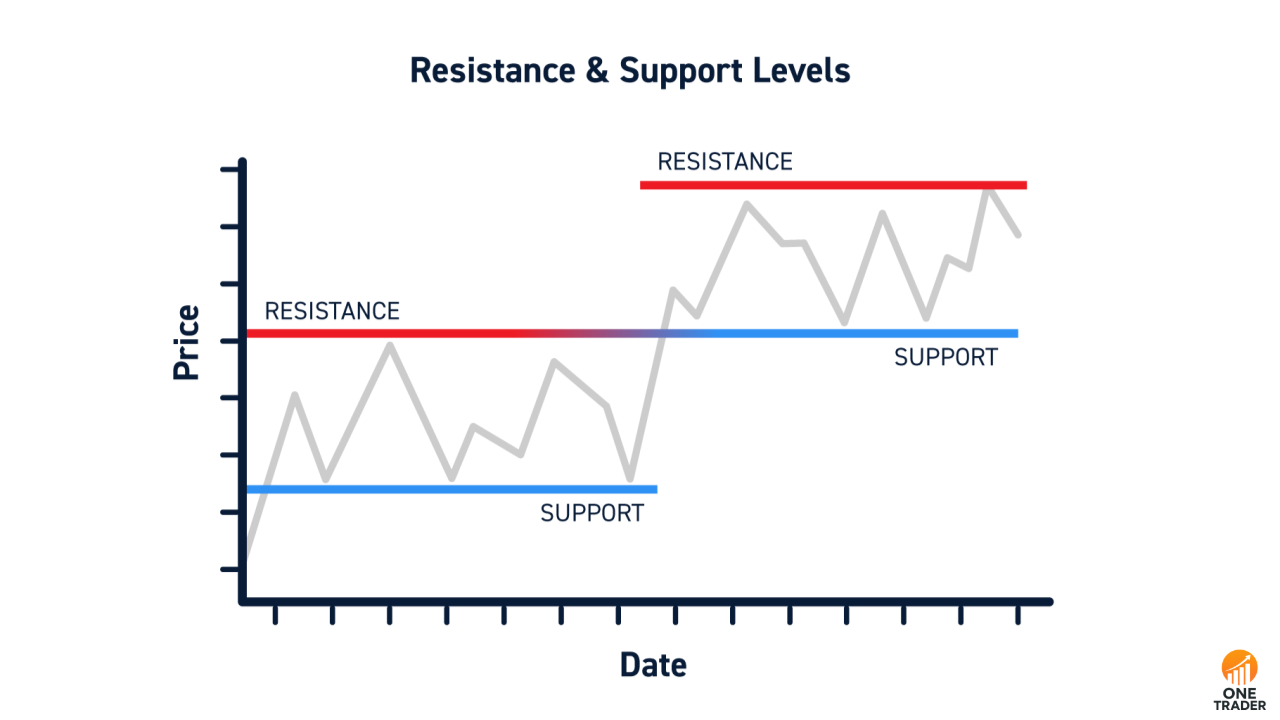
Support is a price zone where buying pressure is strong enough to stop the fall of price.
In simple words:
Support is an area where buyers believe the price is “cheap”.
When price comes near support:
- Buyers enter
- Sellers slow down
- Price often bounces upward
Resistance
Resistance is a price zone where selling pressure is strong enough to stop the rise of price.
In simple words:
Resistance is an area where sellers believe the price is “expensive”.
When price reaches resistance:
- Sellers dominate
- Buyers hesitate
- Price often falls downward
Why Support & Resistance Works in the Market
Support & Resistance works not because of indicators, but because of human psychology and institutional behavior.
1. Big Players Operate at Levels
Institutions, FIIs, and smart money cannot enter randomly.
They place large orders near:
- Previous supports
- Previous resistances
- Psychological levels
That’s why price reacts repeatedly at these zones.
2. Memory of the Market
Markets have memory.
- Traders remember where price reversed earlier
- Pending orders remain at those levels
- Fear and greed repeat at the same prices
So price respects these zones again and again.
3. Retail Psychology
Retail traders:
- Buy late near resistance
- Panic sell near support
Smart traders do the opposite.
Support & Resistance is a ZONE, Not a Line
This is where most beginners make mistakes.
❌ Drawing one thin line
❌ Expecting exact reversal from that line
Correct Approach
✅ Draw zones
✅ Allow price to move slightly above or below
✅ Focus on reaction, not perfection
Think of support and resistance as areas of interest, not exact prices.
How to Identify Strong Support & Resistance Levels
Rule 1: Higher Timeframe First
Always start from:
- Daily chart
- Then 15-minute or 5-minute
Levels from higher timeframe are more powerful.
Rule 2: Minimum 2–3 Touches
A level becomes strong only when:
- Price reacts at least 2 or 3 times
- Clear rejection is visible
One touch = weak
Multiple touches = strong
Rule 3: Clear Rejections
Good levels show:
- Long wicks
- Sharp reversals
- Strong candles
Avoid levels where price just passed silently.
Rule 4: Avoid Middle Zones
Do not draw levels:
- In the middle of random price movement
- Where price never reacted clearly
Trade edges, not the middle.
How to Trade Support & Resistance (Practical Logic)
Buying Near Support
Conditions:
- Price approaches a strong support zone
- Selling pressure slows down
- Rejection candles appear
Entry:
- After confirmation candle near support
Stoploss:
- Below the support zone
Target:
- Next resistance zone
Selling Near Resistance
Conditions:
- Price approaches a strong resistance zone
- Buying momentum weakens
- Rejection or bearish candles form
Entry:
- After confirmation near resistance
Stoploss:
- Above resistance zone
Target:
- Next support zone
Important Truth: Support & Resistance Can Break
Support & Resistance is not magic.
When:
- Big news comes
- Trend is extremely strong
- Institutions change direction
Support can break
Resistance can break
Smart Trader Rule
When a level breaks, don’t argue with the market.
Exit and wait for the next setup.
Support Turning into Resistance (and Vice Versa)
One of the most powerful concepts.
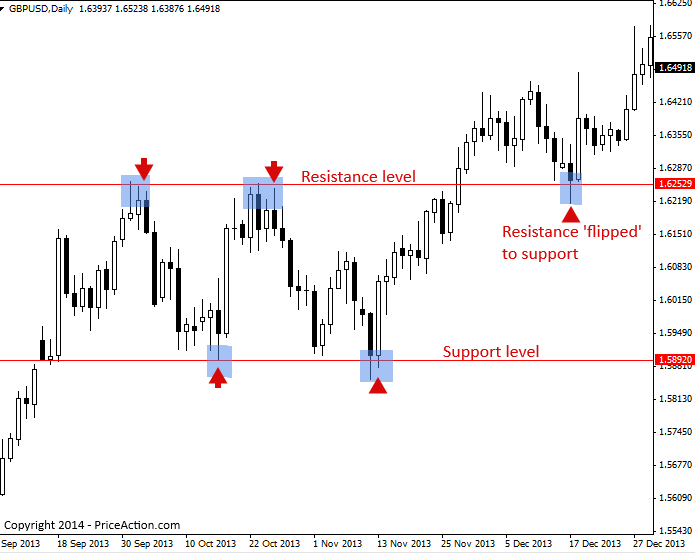
- Broken support often becomes resistance
- Broken resistance often becomes support
This happens because:
- Old buyers become sellers
- Old sellers become buyers
This concept alone can be a separate advanced strategy.
Where NOT to Use Support & Resistance
Avoid trading this strategy when:
- Major news events are scheduled
- Market is extremely trending without pullbacks
- Volume is very low
- You are trading blindly without confirmation
Support & Resistance works best in:
- Normal market conditions
- Structured price movement
Common Beginner Mistakes
❌ Drawing too many levels
❌ Buying every support touch
❌ Selling every resistance touch
❌ Ignoring trend direction
❌ Trading without stoploss
❌ Overtrading same level again and again
Remember:
One good trade is better than ten random trades.
Risk Management Rules (Non-Negotiable)
This strategy works only with discipline.
- Risk maximum 1% per trade
- Fixed stoploss before entry
- Risk–Reward minimum 1:2
- If level breaks → exit immediately
No stoploss = no strategy.
Who Should Use Support & Resistance Strategy?
Suitable For:
- Beginners in trading
- Intraday traders
- Swing traders
- Stock and index traders
Not Suitable For:
- People searching for guaranteed profits
- Traders who hate stoploss
- Over-leveraged traders
Final Truth from Onetrader
Support & Resistance is not a single strategy.
It is the language of the market.
If you master this:
- Breakouts make sense
- Pullbacks make sense
- Smart money concepts become easier
- Indicators become secondary
This is why Onetrader always starts with foundations.
What’s Next?
👉 Strategy #2 – Trend Line Trading
We’ll build on this foundation and go one step deeper.
Stay disciplined.
Stay logical.
Trade like a professional.
— Onetrader Guide