Estimated reading time: 3 minutes
Thank you for reading this post, Please bookmark onetrader.in website for regular updates!
📖 Chapter 3 (Part 2): Revenue vs Profit – What’s the Difference & Why It Matters
🔹 Introduction
Most beginners confuse revenue and profit, but for investors, understanding the difference is crucial.
A company can show huge revenue but still be in loss, and another can have small revenue but high profit.
So let’s break this down in the simplest way possible 👇
🔹 What is Revenue?
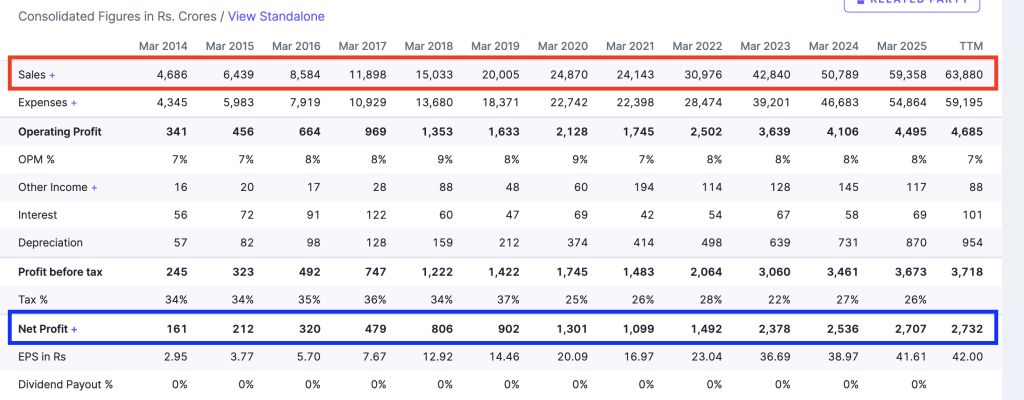
Revenue is the total money a company earns from selling its products or services before deducting any costs.
Also Read: What Is Market Capitalization? Beginner’s Guide to Market Cap in Stocks
It’s also called Sales or Top Line because it appears at the top of the Profit & Loss statement.
✅ Simple Definition:
Revenue = Quantity Sold × Price per Unit
Example:
If a company sells 1,000 laptops at ₹40,000 each,
👉 Revenue = 1,000 × ₹40,000 = ₹4 crore
Also Read: Stock Valuation Explained | How to Find Undervalued Stocks for Beginners
That’s the total income before any expenses.
🔹 What is Profit?
Profit is the money left after subtracting all expenses (like salaries, rent, raw materials, taxes) from revenue.
It’s also called Net Income or Bottom Line because it appears at the bottom of the financial statement.
✅ Simple Definition:
Also Read: Key Financial Ratios Explained – How to Analyse a Company Like a Pro
Profit = Revenue – Total Expenses
Example:
From the same ₹4 crore revenue, if total expenses are ₹3 crore,
👉 Profit = ₹4 crore – ₹3 crore = ₹1 crore
That ₹1 crore is what actually belongs to shareholders.
🔹 Types of Profit
| Type | Formula | Meaning |
|---|---|---|
| Gross Profit | Revenue – Cost of Goods Sold (COGS) | Basic profit before admin expenses |
| Operating Profit | Gross Profit – Operating Expenses | Profit from core business |
| Net Profit | Total Revenue – All Expenses | Final profit after taxes and interest |
🔹 Real-Life Example: DMart vs Zomato
| Company | Revenue (FY24) | Net Profit (FY24) | Observation |
|---|---|---|---|
| DMart | ₹42,000 Cr | ₹2,400 Cr | High profit, stable business |
| Zomato | ₹7,000 Cr | ₹–350 Cr | Good revenue, still loss-making |
✅ Lesson:
High revenue doesn’t mean success — profitability matters more for investors.
Also Read: Free Cash Flow (FCF) Explained – The Real Indicator of Company Strength
🔹 Why This Difference Matters to Investors
- Profit Reflects True Strength
Revenue shows sales, but profit shows efficiency and sustainability. - Stock Price Follows Profit Growth
In the long run, companies with consistent profit growth give higher returns. - Management Quality
Strong managers know how to control costs and convert sales into profit. - Valuation Impact
Many ratios (like P/E, ROE, ROCE) depend on profits, not revenue.
🔹 Simple Analogy
Think of a tea stall 🍵
- Revenue = total sales (number of cups × price)
- Profit = what’s left after milk, sugar, rent, and gas costs
A stall can sell 500 cups daily (high revenue) but still earn less profit if milk prices go up.
🔹 Interesting / Lesser-Known Facts
- Amazon made revenue for years before becoming profitable — investors trusted the long-term business model.
- Many “unicorn startups” in India (like Swiggy, Paytm) have high revenues but negative profits.
- Profit margin is a key signal — it shows how much of every rupee earned is kept as profit.
🔹 Q&A Section
Q1: Why do companies show high revenue but no profit?
A: Because expenses (like marketing or expansion costs) are high.
Q2: Which is more important — revenue or profit?
A: Both matter. Revenue shows growth potential, profit shows financial health.
Also Read: Cash Flow Statement Explained – How Companies Manage Their Money
Q3: Can a company survive without profit?
A: Only for a short period. Long-term survival depends on profitability.
Q4: Should investors prefer profit growth or revenue growth?
A: Ideally both — but consistent profit growth is the real wealth creator.
🔹 Key Takeaways
- Revenue = Total income, Profit = Income after expenses
- A company can have high revenue but still lose money
- Profit reflects efficiency, stability, and management quality
- Always check profit growth trend before investing
- In the long term, profit drives stock prices, not just sales