Estimated reading time: 9 minutes
Thank you for reading this post, Please bookmark onetrader.in website for regular updates!
📝 Introduction:
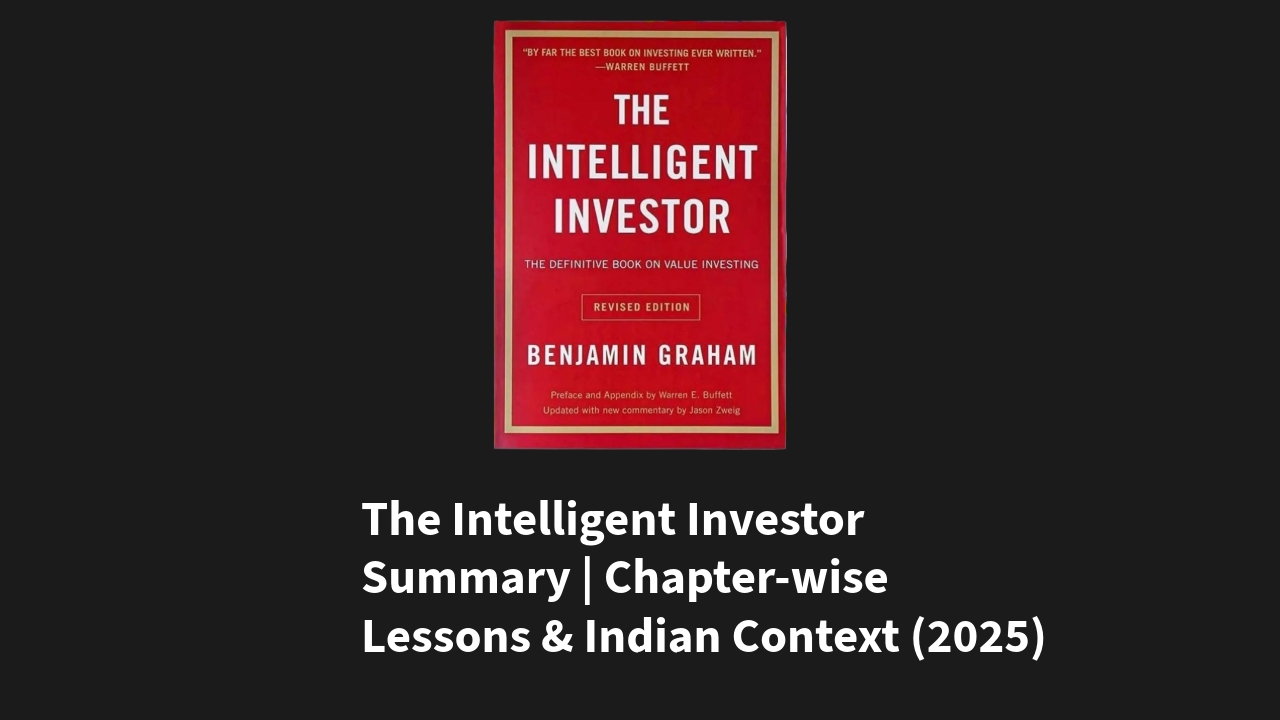
Few books have stood the test of time in investing like The Intelligent Investor by Benjamin Graham. First published in 1949, it remains the ultimate guide to value investing. Warren Buffett famously called it:
“By far the best book on investing ever written.”
Graham’s philosophy is simple but profound: protect your capital first, and aim for steady, reasonable returns rather than chasing risky profits.
Why this book matters in India today
- India is a fast-growing market with millions of new investors entering through apps like Zerodha, Groww, and Upstox.
- Many first-time investors confuse speculation with investing — chasing IPOs, meme stocks, or intraday trading.
- Graham’s timeless wisdom teaches Indians how to build wealth patiently in quality businesses, not gamble with hot stocks.
Core Ideas of the Book
- Investing vs Speculation → The clear difference.
- Mr. Market → The metaphor of market emotions.
- Margin of Safety → The golden rule.
- Defensive vs Enterprising Investors → Two types of approaches.
- Investor Psychology → How emotions kill returns.
Graham does not promise quick riches. Instead, he provides a framework to become a truly “intelligent” investor:
Also Read: Poor Charlie’s Almanack Part 2 – Charlie Munger’s Mental Models for Investing
- Discipline over excitement
- Patience over activity
- Safety over greed
This is especially relevant in India, where investors often:
- Buy penny stocks hoping for a lottery win.
- Fall for WhatsApp “stock tips.”
- Panic sell during corrections.
By following Graham, Indian investors can avoid these traps and build wealth steadily through value investing.
📖 Chapter 1: Investing vs Speculation
🔑 Main Idea:
Graham begins by distinguishing Investing from Speculation. Mixing the two is the biggest mistake most investors make.
- Investing:
- Buying an asset at a reasonable price, backed by fundamentals.
- Expecting returns from dividends + growth of business.
- Requires analysis, safety, and patience.
- Speculation:
- Gambling on price movements.
- No deep study of the business.
- Driven by luck, trends, or tips.
🏦 Indian Context Examples:
- Investing Example
- Buying Infosys in 2000 after analyzing IT sector growth, strong balance sheet, global client base.
- Holding for 20+ years → multi-bagger returns.
- Speculation Example
- Buying a penny stock like Yes Bank in 2018–19 just because price fell, without analyzing NPAs.
- Investors who speculated lost 90% wealth.
- IPO Mania in India
- Many retail investors apply for IPOs hoping to sell on listing day. This is speculation, not investing.
- Example: Paytm IPO (2021). Hype-driven speculation led to 60% fall post-listing.
📉 Why Speculation is Dangerous:
- Creates overconfidence when lucky once.
- Leads to big losses when market turns.
- Distracts from real wealth creation (long-term compounding).
🧠 Graham’s Warning:
Speculation is not “wrong,” but it must be:
Also Read: Poor Charlie’s Almanack Book Summary (Part 1)
- Done with very small portion of portfolio.
- Kept completely separate from serious investing.
📊 Investor Story: Mr. A vs Mr. B
- Mr. A (Investor): Invests in HDFC Bank in 2010, holds till 2020. → 6x returns.
- Mr. B (Speculator): Trades in/out of small caps during the same period. → ends with losses after brokerage + taxes.
Same decade. Different approaches. Different results.
📖 Chapter 2: Defensive vs Enterprising Investors
🔑 Main Idea:
Graham says there are two types of intelligent investors:
- Defensive Investor (Passive)
- Prioritizes safety over returns.
- Doesn’t want to spend much time researching.
- Strategy: Invest in index funds, bonds, or blue-chip stocks.
- Goal: Avoid losses, earn moderate but steady returns.
- Enterprising Investor (Active)
- Willing to put in time and effort to research.
- Hunts for undervalued stocks.
- Strategy: Active portfolio management, deep study of balance sheets.
- Goal: Achieve higher-than-average returns.
🏦 Indian Examples:
- Defensive Investor
- Someone doing SIPs in Nifty 50 Index Fund or holding Infosys, HDFC Bank, Asian Paints.
- Doesn’t check portfolio daily, but earns 12–15% CAGR long-term.
- Enterprising Investor
- Someone who identified Bajaj Finance or Avenue Supermarts (D-Mart) early, studied fundamentals, and held long.
- Achieved 20–25% CAGR.
🧠 Graham’s Insight:
Both types can succeed, but mixing the two leads to disaster.
- A defensive investor chasing hot stocks without research = losses.
- An enterprising investor buying index funds expecting high returns = disappointment.
📉 Mistake Indians Make:
Many Indian retail investors think they are enterprising (trading daily), but in reality, they don’t do proper research. They rely on tips → speculation, not intelligent investing.
Also Read: Thinking, Fast and Slow Book Summary & Investor Psychology Guide
📖 Chapter 3: The “Mr. Market” Metaphor
🔑 Main Idea:
One of Graham’s most famous lessons is the story of Mr. Market.
- Imagine you have a business partner called Mr. Market.
- Every day, he offers to buy your share or sell his share at a price.
- Some days he is euphoric and offers a very high price.
- Some days he is depressed and offers a very low price.
Your job as an investor is NOT to follow his mood swings, but to take advantage of them.
🏦 Indian Context Examples:
- COVID Crash (March 2020)
- Mr. Market was depressed. Nifty fell 40%.
- Stocks like Titan, HDFC Bank, Bajaj Finance traded at cheap prices.
- Intelligent investors bought, and by 2021 → doubled wealth.
- 2021 Bull Run
- Mr. Market was euphoric. Many IPOs launched at crazy valuations (Paytm, Zomato, Nykaa).
- Retail investors chased hype.
- Within 1 year, prices crashed 40–70%.
- ITC Example
- For years, Mr. Market undervalued ITC (2015–2020), calling it “boring.”
- Investors who ignored market mood and focused on strong fundamentals are now enjoying multibagger returns.
📊 Investor Story: Mr. A vs Mr. B
- Mr. A (Intelligent): Treats Mr. Market like a servant. Buys only when prices are cheap, ignores noise.
- Mr. B (Emotional): Treats Mr. Market like a teacher. Buys at highs, sells at lows. Loses money.
🧠 Lesson for Indians:
- Don’t get carried away by market emotions.
- Stock prices fluctuate daily, but business value changes slowly.
- Intelligent investors benefit from volatility instead of fearing it.
📖 Chapter 4: Value Investing & Intrinsic Value
🔑 Main Idea:
At the heart of Graham’s philosophy is Value Investing → buying stocks at prices lower than their intrinsic value (true worth).
- Intrinsic Value = Real worth of a company, based on earnings, dividends, growth potential, and assets.
- Stock price ≠ intrinsic value. Prices fluctuate daily, but intrinsic value changes slowly.
🏦 Indian Context Examples:
- ITC (2015–2020)
- Stock stayed around ₹200 for 5 years.
- Investors mocked it as “boring.”
- But intrinsic value (cash flows, FMCG growth) was far higher.
- In 2021–23, ITC doubled as the market recognized value.
- Infosys (2000–2003)
- After dot-com bubble, stock crashed 70%.
- But fundamentals were strong.
- Intrinsic value > market price.
- Long-term investors made huge gains.
- PSU Banks vs HDFC Bank
- PSU banks often looked “cheap” in PE terms.
- But intrinsic value was weak (bad loans, poor management).
- HDFC Bank, though “expensive,” was a better value pick.
🧠 Graham’s Advice:
- Don’t chase hot stocks just because prices are rising.
- Don’t buy “cheap” junk stocks without solid fundamentals.
- True investing = analyzing businesses, not stock tickers.
📖 Chapter 5: The Margin of Safety
🔑 Main Idea:
This is Graham’s most important principle.
Also Read: The Dhandho Investor Book Summary & Low Risk Investing Strategy | Onetrader
👉 Always leave a margin of safety between the price you pay and the stock’s intrinsic value.
- If a stock’s intrinsic value = ₹100, don’t buy at ₹100.
- Wait until it’s available at ₹70–80.
- That “buffer” protects you from errors, market downturns, or unexpected risks.
🏦 Indian Context Examples:
- HDFC Bank
- Always traded at premium valuations.
- But during 2008 crash & 2020 COVID crash, price fell 30–40%.
- Smart investors bought during those times → huge long-term gains.
- Yes Bank (2017–2019)
- Looked “cheap” at ₹200 when compared to book value.
- But intrinsic value was collapsing due to NPAs.
- No margin of safety → investors lost 90%.
- Bajaj Finance
- At its peak, valuations looked expensive.
- During market corrections (2013, 2018, 2020), stock offered entry with margin of safety.
- Those who bought then → 5–10x returns.
🧠 Why It Works:
- Even the best analysis has errors.
- Unexpected risks (like COVID, new regulations) can hit businesses.
- Margin of Safety = insurance policy.
📊 Investor Story: Mr. A vs Mr. B
- Mr. A (with Margin of Safety): Buys Titan at 25% discount during market correction. Even if analysis was slightly wrong, still earns profit.
- Mr. B (No Margin): Buys Titan at peak valuations. Small mistake = big losses.
📖 Chapter 6: Investor Psychology & Risk
🔑 Main Idea:
The biggest enemy of an investor is not the market—it’s their own emotions. Fear and greed make investors do the exact opposite of what they should:
- Buy at highs (greed).
- Sell at lows (fear).
🏦 Indian Context Examples:
- 2008 Global Crisis
- Nifty crashed 60%.
- Most investors sold in panic.
- Those who held quality stocks (HDFC Bank, Infosys) → tripled wealth in next 5 years.
- COVID 2020 Crash
- Nifty fell 40% in March 2020.
- Coffee Can–style investors bought Titan, Asian Paints, Bajaj Finance at cheap prices.
- By 2021, these stocks doubled.
- IPO Mania (2021)
- Investors rushed into Paytm, Nykaa, Zomato at sky-high prices.
- Emotions (FOMO) led to losses of 40–70%.
🧠 Graham’s Advice:
- Control your emotions.
- Don’t panic during crashes.
- Don’t chase hype during bubbles.
📖 Chapter 7: Timeless Lessons
🔑 Main Idea:
Graham ends the book with timeless principles for intelligent investing:
- Don’t Chase Hot Stocks
- Market fads come and go. Stick to fundamentals.
- Indian Example: Small-cap rallies (2017, 2021) crashed later.
- Dividends Matter
- Stable dividend-paying companies (ITC, Infosys, Hindustan Unilever) show financial strength.
- Diversify Wisely
- Don’t put all money in one stock or sector.
- But don’t over-diversify into 40+ stocks either.
- 10–15 quality businesses = enough.
- Protect Capital First
- Don’t aim for maximum profits. Aim to avoid losses.
- Wealth builds by compounding safe returns.
- Long-Term Thinking
- Investing is a marathon, not a sprint.
- 10–20 years of holding quality stocks changes lives.
🏁 Conclusion:
The Intelligent Investor is not a book about getting rich quick. It’s about avoiding mistakes, protecting capital, and building wealth slowly but surely.
Also Read: Common Stocks and Uncommon Profits Book Summary & Multibagger Strategy | Onetrader
Biggest Lessons for Indian Investors:
- Don’t confuse investing with speculation.
- Decide: Defensive (index funds) or Enterprising (value stocks).
- Treat the market like Mr. Market—use volatility to your advantage.
- Buy below intrinsic value, with Margin of Safety.
- Control emotions—fear & greed destroy wealth.
- Stick to timeless principles: dividends, diversification, long-term mindset.
👉 In India’s fast-growing economy, Graham’s wisdom is more relevant than ever. From Asian Paints to HDFC Bank, from Titan to Infosys—those who apply value investing + patience have seen life-changing wealth.
“The secret to investing is not intelligence, but temperament.” — Benjamin Graham
🙋 FAQs:
Q1: Is The Intelligent Investor good for beginners in India?
Yes. Defensive investors can simply buy index funds or blue-chip stocks. It teaches principles that protect beginners from costly mistakes.
Also Read: The Little Book of Common Sense Investing – Why Index Funds Win | Onetrader
Q2: Is Value Investing still relevant in 2025?
Absolutely. Indian markets reward patience. HDFC Bank, Asian Paints, and Titan are proof that long-term value compounds.
Q3: What is the most important lesson from the book?
The concept of Margin of Safety—always buy with a buffer below intrinsic value.
Q4: Can I use this book for trading?
No. Graham warns against speculation. Trading = gambling. This book is for wealth-building.
Q5: How many stocks should I hold?
10–15 quality businesses across sectors are enough for most investors.
Also Read: The Total Money Makeover Book Summary & 7 Baby Steps Explained | Onetrader
Q6: Did Warren Buffett follow this book?
Yes. Buffett was Graham’s student at Columbia University. He credits this book as his foundation in investing.
✅ Final Word:
The Intelligent Investor is not about chasing the hottest stock—it’s about building lifelong wealth. Graham’s wisdom applies perfectly to Indian investors today:
- Buy quality.
- Hold long.
- Protect your capital.
- Ignore noise.
👉 Ultimate Lesson: “In the short run, the market is a voting machine; in the long run, it is a weighing machine.”
Also Read: The Automatic Millionaire Book Summary & Money Automation System | Onetrader