
Estimated reading time: 10 minutes
Thank you for reading this post, Please bookmark onetrader.in website for regular updates!
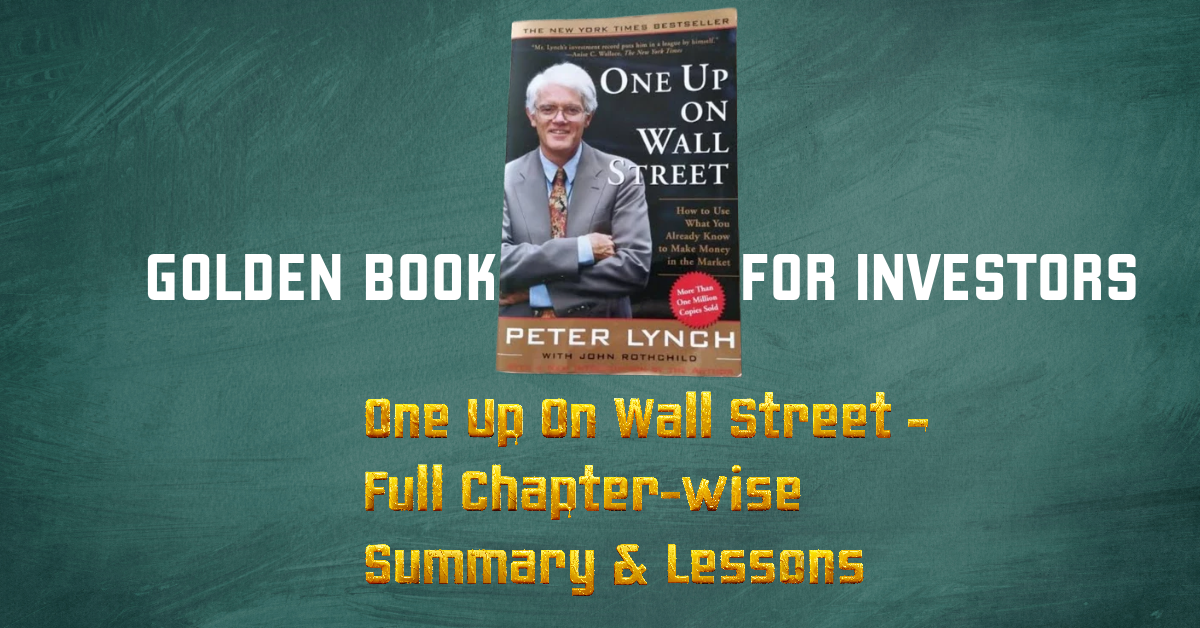
📘 One Up On Wall Street – Full Chapter-wise Summary & Lessons
📝 Introduction:
When most people think about successful investors, they imagine Wall Street professionals, hedge fund managers, or full-time traders with fancy degrees and algorithms. But legendary investor Peter Lynch — the man who turned the Fidelity Magellan Fund from $18 million to $14 billion between 1977 and 1990 — believed otherwise.
His core philosophy? 👇
“You don’t need to be a genius to beat the market. You just need an edge. And most individual investors already have it.”
Lynch’s book One Up On Wall Street is not about complex formulas or insider secrets. It’s about how ordinary investors can outperform professionals by:
- Observing trends in daily life
- Understanding companies behind the products they use
- Buying and holding quality stocks before Wall Street notices them
📈 His famous principle:
“Invest in what you know.”
If you notice a new retail chain always full of customers, a brand your friends can’t stop talking about, or a product your family uses every day — that’s a potential investment lead. Lynch calls these “tenbaggers” — stocks that grow 10x or more over time.
🇮🇳 Why This Book Matters for Indian Investors:
India is the perfect playground for Peter Lynch’s strategy because:
- We have rapid consumption growth and brand adoption.
- Everyday life offers early clues to future multibaggers.
- Many legendary Indian stocks were obvious before they exploded.
Examples:
- Titan: Most Indian families trust Tanishq jewelry — that’s “investing in what you know.”
- Avenue Supermarts (D-Mart): Always crowded stores → massive long-term growth.
- Asian Paints: A brand found in nearly every Indian home → consistent compounding.
This book shows how you don’t need to predict the future — just observe the present carefully.
📖 Chapter 1: The Power of Individual Investors:
🔑 Main Idea
Peter Lynch’s central message: You have an advantage over professionals.
Most retail investors think institutions are unbeatable — they have analysts, tools, data. But institutions also have limitations:
- Bureaucracy → slow decision-making.
- Regulations → can’t invest in small/mid caps early.
- Short-term performance pressure.
You, as an individual investor:
- Can invest small amounts and enter early.
- Can hold for 5–10 years without pressure.
- Can act quickly based on observations.
🏦 Indian Examples:
- Page Industries (Jockey):
- Before it became a ₹60,000+ crore company, people were already choosing Jockey over local brands.
- A retail investor who noticed this early could have made 50x returns.
- Avenue Supermarts (D-Mart):
- People saw stores packed with customers long before it listed.
- Early investors multiplied their money 7–8x in less than a decade.
- Pidilite (Fevicol):
- A product used in every home and construction site.
- Boring, everyday product → long-term wealth generator.
🧠 Lynch’s Philosophy:
- You don’t need to beat the market every quarter.
- You don’t need a CFA or MBA.
- All you need is awareness, curiosity, and patience.
He famously said:
“If you invest in a company just because you understand it, you already know more than 90% of Wall Street.”
📖 Chapter 2: Types of Stocks and How They Behave (~600 words)
🔑 Main Idea:
Peter Lynch categorizes stocks into six main types. This classification helps investors understand what they’re buying and set realistic expectations. The mistake most investors make is expecting a slow grower to behave like a multibagger or a cyclical stock to act like a steady compounder.
Let’s break down each category 👇
1. Slow Growers 🐢:
- Mature companies growing slower than the economy (5–8% annually).
- Usually pay high dividends.
- Safe but limited upside.
📊 Indian Examples:
- ITC (pre-2022): Strong dividend payer, slow earnings growth.
- Coal India: PSU monopoly with stable but slow growth.
✅ Best for: Conservative investors seeking income, not big returns.
2. Stalwarts 🏢:
- Large, established companies growing ~10–12% per year.
- Not multibaggers but can double in 4–6 years.
📊 Indian Examples:
- Infosys, HCL Tech: IT giants with stable growth.
- HDFC Bank: Consistent compounding with low volatility.
✅ Best for: Long-term investors who want steady, low-risk returns.
3. Fast Growers 🚀:
- Small to mid-sized companies growing >20% annually.
- These are the potential multibaggers Lynch calls “tenbaggers.”
📊 Indian Examples:
- Avenue Supermarts (D-Mart): Revenue CAGR >25% for a decade.
- Bajaj Finance: Explosive growth in retail lending.
✅ Best for: Investors who can handle volatility and hold 5–10 years.
4. Cyclicals 🔄:
- Businesses that rise and fall with the economy or commodity cycles.
- Timing is crucial here — wrong entry can mean years of underperformance.
📊 Indian Examples:
- Tata Steel, JSW Steel: Boom during global demand upcycles, fall during recessions.
- Auto Sector (Tata Motors, Maruti): Demand tied to economic growth.
✅ Best for: Experienced investors with understanding of business cycles.
5. Turnarounds 🔄📈:
- Companies in trouble but with potential for recovery.
- Risky but can give huge returns if revival succeeds.
📊 Indian Examples:
- SBI: Post-2018 NPA clean-up, strong comeback.
- Tata Motors: Huge turnaround with EV strategy.
✅ Best for: Risk-takers who study deeply and enter early.
6. Asset Plays 🏦:
- Companies whose hidden assets are undervalued by the market.
- Example: land, patents, cash reserves.
📊 Indian Examples:
- Bharat Electronics (BEL): Cash-rich, undervalued for years.
- Nesco: Massive land bank in Mumbai undervalued by stock price.
✅ Best for: Deep value investors with patience.
🧠 Lynch’s Advice:
- Know which category your stock belongs to.
- Don’t expect a slow grower to become a 10-bagger.
- Diversify across types for balance.
📖 Chapter 3: How to Pick the Right Stocks:
🔑 Main Idea:
Peter Lynch says the best stock ideas are right in front of you — in your home, shopping mall, or office. You just need to notice them before institutions do.
“Know what you own, and know why you own it.”
🧠 Step-by-Step Stock-Picking Framework
1. Start With What You Know:
Lynch’s most famous principle.
- If your family is obsessed with a new brand…
- If every mall you visit is full of one retail chain…
- If your friends can’t stop talking about a product…
👉 That’s your research starting point.
📊 Indian Examples:
- Titan (Tanishq): Jewelry store footfall is visible before stock skyrockets.
- Zomato / Swiggy: Rising food delivery trend → early signals of future dominance.
2. Do the Basic Homework:
Lynch warns: “Buying without research is like playing poker without looking at the cards.”
Check fundamentals:
- Revenue growth (consistency matters)
- Profit margins
- Debt levels
- Competitive advantage (brand, moat)
- Management quality
📊 Example: Before investing in Avenue Supermarts, check:
- Same-store sales growth
- Debt-to-equity ratio
- Expansion plans
- Customer retention
3. Look for the Edge:
The best opportunities are where you know more than the market.
- You see demand on the ground before analysts notice.
- You understand consumer behavior before data confirms it.
📊 Example:
- Nykaa: Women’s increasing online beauty purchases were visible before its IPO.
- IRCTC: Monopoly in online railway ticketing → predictable revenue streams.
4. Think Long Term (5–10 Years):
Lynch warns against selling too early. True wealth comes from holding “tenbaggers.”
📊 Example:
- ₹1 lakh in Bajaj Finance in 2010 → ₹60+ lakh by 2024.
- ₹1 lakh in Titan in 2005 → ₹1 crore+ by 2024.
5. Beware of Red Flags 🚨:
Avoid companies with:
- Rising debt and no profitability.
- Overhyped IPOs with no clear business model.
- Constant management changes.
- Fraud/scandals (check corporate governance).
📊 Example: Yes Bank – looked cheap but had major NPA issues. No edge, no moat.
🧠 Lynch’s Golden Rule
“The best stock to buy may be the one you already own — if the story is still intact.”
Don’t sell just because price doubled. If fundamentals are strong and story continues, hold.
📖 Chapter 4: The Tenbagger Mindset – How to Find 10x Stocks:
🔑 Main Idea:
A “tenbagger” is a stock that multiplies 10x or more over time. Lynch’s career was built on spotting these before the crowd — and he insists ordinary investors can do it too.
📊 Example:
- Titan: ~₹2 in 2003 → ₹3,000+ in 2025 (1500x returns).
- Bajaj Finance: ₹60 in 2010 → ₹7,500+ in 2025 (125x).
- Avenue Supermarts (D-Mart): IPO ₹300 (2017) → ₹4,000+ (2025) (13x).
So, how do you find them before they explode? Lynch shares a checklist 👇
🧠 The Tenbagger Checklist:
- Small Size, Big Potential:
- Tenbaggers are usually small or mid-sized companies, not large giants.
- A ₹5,000 crore company can grow 10x easier than a ₹5 lakh crore one.
- Strong Earnings Growth:
- Look for consistent >20% revenue and profit growth.
- Avoid “turnaround” stories unless you understand them deeply.
- A Simple Business Model:
- Lynch loved boring, easy-to-understand companies (paints, shoes, food).
- Complexity = confusion = risk.
- Expanding Market Opportunity:
- Companies expanding into new geographies or product lines have more runway.
- Owner-Led Management:
- Promoters with skin in the game often create huge wealth.
📊 Indian Example:
- Page Industries (Jockey): Simple business → massive market → promoter focus → 100x returns.
📖 Chapter 5: Mistakes Most Investors Make:
Peter Lynch says most investors fail not because they lack intelligence — but because they repeat the same costly mistakes.
Here are the top ones 👇
1. Selling Winners Too Early:
- Investors sell as soon as a stock doubles.
- But tenbaggers need time — 5–10 years.
- If the story is intact, don’t book profits too early.
📊 Example:
- Many investors sold Titan after 2x or 3x — missing 100x potential.
2. Holding Losers Too Long:
- Investors hope bad stocks will “come back.”
- Lynch says: “Sell the losers and keep the winners.”
📊 Example:
- Holding Yes Bank or Reliance Power for years despite declining fundamentals is wealth destruction.
3. Following the Crowd:
- Herd mentality = late entry.
- By the time a stock is on the news, big gains are gone.
📊 Example:
- Zomato and Paytm IPO frenzy — early investors made money, retail crowd bought the peak.
4. Ignoring the Story:
- If fundamentals change, exit.
- Blind loyalty is as dangerous as panic selling.
📊 Example:
- Idea Cellular lost its edge after Jio’s entry. Story changed — exit was smarter.
✅ Lynch’s Golden Rule:
“You only need a few big winners in your lifetime to change your financial future. Don’t sell them too soon.”
📖 Chapter 6: Timeless Lessons:
Peter Lynch ends the book with a few timeless truths every investor must remember:
- Be Patient – Most great stocks need 5–10 years to show their magic.
- Ignore Short-Term Noise – Daily price moves mean nothing.
- Diversify, But Not Too Much – 10–15 good stocks are enough.
- Keep It Simple – If you can’t explain the business in one sentence, don’t invest.
- Do Your Own Research – Don’t rely on media or tips.
📊 Example:
- All-time Indian multibaggers — Asian Paints, Titan, HDFC Bank, Bajaj Finance — followed these rules.
🏁 Conclusion:
One Up On Wall Street is one of the most practical investment books ever written. Lynch’s message is empowering: you don’t need Wall Street to get rich — you just need common sense and patience.
His “invest in what you know” philosophy fits perfectly in the Indian market. Opportunities are everywhere — in the shops you visit, the brands you use, the products your friends love. Most people ignore these signals. The intelligent investor acts on them before the institutions catch on.
Key Takeaways:
- Use your consumer edge.
- Understand the business, not just the stock price.
- Hold great companies long enough to unlock exponential gains.
- Don’t panic or follow the herd.
👉 Remember: One good “tenbagger” can change your financial life. And you’re more likely to find it in your daily routine than on a TV channel.
🙋 FAQs
Q1: Is this book good for beginners?
Yes. It’s easy to read and teaches real-world stock-picking strategies anyone can use.
Q2: What is a tenbagger?
A stock that grows 10x or more. Lynch shows how to spot them early through everyday observations and business fundamentals.
Q3: How long should I hold a stock?
Ideally 5–10 years. Most multibaggers take time to deliver.
Q4: Can I apply Lynch’s ideas in India?
Absolutely. Brands like Titan, D-Mart, Bajaj Finance, and Asian Paints all became multibaggers following the same principles.
Q5: How many stocks should I own?
10–15 well-researched companies are enough. Focus on quality, not quantity.
✅ Final Word:
Peter Lynch’s One Up On Wall Street shows that the stock market is not a casino — it’s a place where ordinary people with patience and observation can build extraordinary wealth.
If you start noticing investment opportunities in your daily life, do your homework, and hold long enough — you’re already miles ahead of most “experts.”
👉 “Behind every great stock is a great company. Find it, understand it, and hold it.” — Peter Lynch