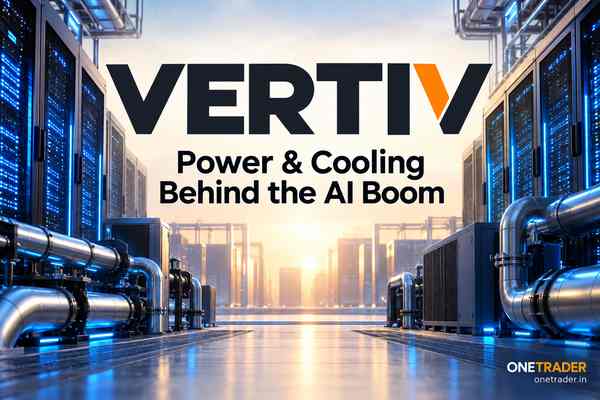
Artificial intelligence is usually discussed through the companies designing chips, developing models, or operating cloud platforms. However, every AI server depends on a physical foundation that receives less attention: reliable electricity, effective cooling, and infrastructure that keeps expensive computing equipment running. Vertiv operates in this essential layer of the technology industry, supplying power, thermal management, and integrated infrastructure for data centers and other critical environments.
For readers studying US technology businesses, Vertiv offers a different perspective on the AI investment cycle. Its opportunity comes from solving the engineering problems created when customers install increasingly powerful computing systems. Understanding the Vertiv business model therefore means looking beyond AI enthusiasm and examining how the company helps turn computing capacity into usable infrastructure.
The Business Vertiv Built
Vertiv, listed on the New York Stock Exchange under the ticker VRT, serves data centers, communication networks, and commercial and industrial environments. Its portfolio brings together power equipment, cooling technologies, racks, monitoring, and related services. Customers span hyperscale and cloud operators, colocation facilities, telecommunications businesses, and organizations operating their own critical IT infrastructure.
The commercial logic is straightforward. A customer buying servers also needs infrastructure capable of supporting them reliably. Power interruptions, overheating, or poorly coordinated equipment can prevent the customer from using that computing investment effectively. Vertiv addresses these requirements through individual products and integrated solutions, allowing it to participate in several parts of a facility’s infrastructure rather than a single equipment purchase.
Also Read: Eaton Business Model: Powering Data Centers, Industry and Aerospace
Power Infrastructure Is Part of the Computing System
Vertiv’s power portfolio includes uninterruptible power supplies and power-distribution equipment. These systems support the delivery and continuity of electricity to critical equipment, while its broader infrastructure offering connects power with cooling and monitoring. The company’s position is therefore closely tied to the operating requirements of the facilities it serves.
The business implication is that greater computing capacity can create additional infrastructure requirements. Installing more processors is only useful when the surrounding electrical system can support them. For Vertiv, the potential opportunity includes both equipment for new facilities and infrastructure changes at existing sites. However, the amount it earns from an individual project depends on the customer’s design, purchasing decisions, and the scope awarded to the company.
Liquid Cooling Is Expanding the Opportunity
Cooling becomes more demanding as computing equipment concentrates more heat within a rack. Vertiv supplies technologies for hybrid air-and-liquid environments as well as fully liquid-cooled facilities. Its offering includes coolant distribution units, chillers, rear-door heat exchangers, heat-rejection systems, and services supporting installation and operation.
This creates an opportunity across different stages of data-center development. Some operators are building facilities around liquid cooling, while others are preparing existing air-cooled sites for future upgrades or introducing liquid cooling into selected areas. Vertiv’s engineering opportunity lies in making these systems work together within the constraints of each facility. The transition requires planning around the existing infrastructure, so the value extends beyond supplying a cooling component.
Also Read: Dell Technologies: From PC Giant to AI Infrastructure Powerhouse
Integrated Solutions Can Deepen Customer Relationships
Vertiv also offers modular solutions that combine power, cooling, racks, and monitoring. Its solutions team supports customers from initial requirements through project execution, including deployments at the edge, where computing infrastructure operates closer to the users or equipment it serves.

From a business perspective, integration could increase the scope of work Vertiv captures from a customer. A coordinated solution may also simplify deployment when buyers face limited space, demanding schedules, or technical constraints. This is an analytical implication rather than a guaranteed advantage: customers must still judge whether Vertiv’s combined offering provides better economics and execution than purchasing components separately.
Manufacturing Capacity Matters Alongside Technology
Developing suitable products is only one part of serving a growing infrastructure market. Suppliers also need manufacturing capacity, testing capabilities, and the ability to deliver equipment when customers require it. In July 2026, Vertiv announced an expansion at its Tognana technology campus in Italy to support demand for advanced cooling infrastructure. The campus combines research, product development, manufacturing, testing, and customer engagement.
That combination matters because cooling equipment must perform within a complete operating system. Customer testing and engineering collaboration can help identify deployment requirements before equipment reaches the site. The expansion illustrates how Vertiv is investing in the practical capacity behind its growth ambitions, although additional capacity must ultimately translate into productive deliveries and profitable sales.
Also Read: Nebius Stock: The AI Cloud Company Building the Infrastructure Behind the AI Boom
Recent Results Provide Supporting Evidence
Vertiv reported second-quarter 2026 net sales of $3.274 billion, an increase of 24% compared with the same quarter a year earlier. Organic growth contributed 18%, acquisitions contributed 5%, and favorable currency movements added 1%. Separating those components helps readers distinguish expansion within the existing business from growth added through acquisitions or exchange rates.
These figures support the business story, but one quarter cannot establish its durability. A fuller assessment requires watching whether sales growth continues, whether delivery execution remains strong, and whether the company converts that activity into sustainable earnings and cash generation.
What Could Make the Growth Story Difficult
The main analytical risk is the relationship between infrastructure demand and customer spending. Large projects can face delays, design changes, or tighter budgets. Even when long-term computing demand remains attractive, equipment orders and deliveries may move unevenly between periods. Investors should therefore avoid treating industry expansion as a promise of uninterrupted company growth.
Technology changes create another challenge. Vertiv must keep its products suited to evolving computing architectures while managing manufacturing investment and execution. Its breadth could help it serve more customer requirements, but breadth also brings operational complexity. Finally, a strong business opportunity does not automatically establish an attractive stock valuation; that requires a separate assessment of price and financial expectations.
Also Read: Broadcom: The AI Infrastructure Company Building the Custom Silicon Behind the Next Cloud
Vertiv’s business shows why the AI economy depends on more than processors. Power delivery, cooling, and infrastructure integration determine whether computing systems can operate effectively. The company’s long-term opportunity rests on serving those requirements reliably as customer deployments evolve.
Financial Disclaimer: This article is for educational and informational purposes only. It is not investment advice or a recommendation to buy or sell any security. Onetrader is not SEBI registered. Investors should conduct their own research and consider their financial objectives and risk tolerance before investing.
More from OurPaisa
Calculators and everyday tools, plus a community to discuss investing, markets and personal finance.