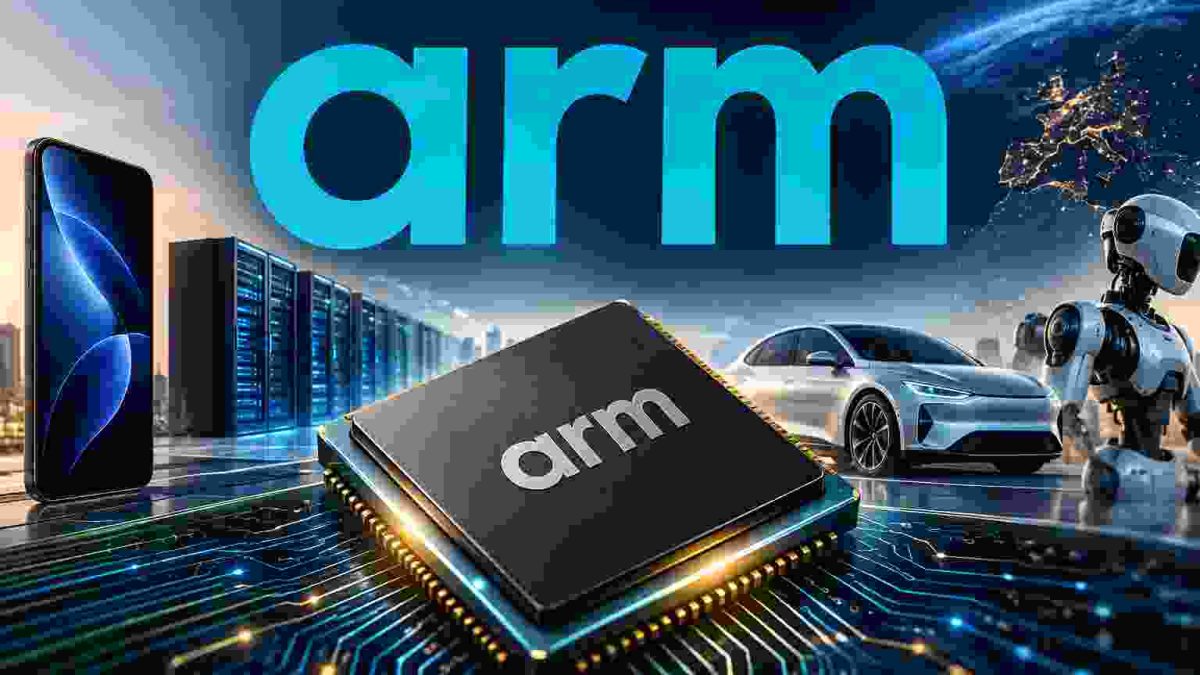
When investors think about the semiconductor industry, names such as NVIDIA, AMD and Intel usually come to mind first. Arm Holdings represents a very different part of the technology value chain. The company does not traditionally manufacture chips at scale or operate semiconductor fabrication plants. Instead, Arm develops the processor architectures and intellectual property that other companies use to design their own chips. That model has allowed Arm technology to become deeply embedded across modern computing, with more than 350 billion Arm-based chips shipped to date and processors based on its architecture powering more than 99% of smartphones. But Arm is now attempting to expand that influence far beyond smartphones.
The Business Behind the Arm Architecture
Arm’s core business has historically been built around intellectual-property licensing and royalties. Semiconductor companies, device manufacturers and other technology businesses license Arm’s processor designs and related technologies to create their own chips. Customers pay licensing fees to gain access to Arm’s technology, and once chips using that technology are manufactured and shipped, Arm generally receives a royalty based on the chip’s economics or a fixed amount per unit. This creates an interesting business model because Arm can participate in the growth of semiconductor volumes without having to manufacture every chip itself.
The model also creates a powerful ecosystem effect. Once chip designers build products around Arm architecture, software developers, operating systems and tools become increasingly aligned with that ecosystem. Arm says more than 22 million software developers are part of its ecosystem, while its architecture is used across smartphones, automotive systems, cloud infrastructure, IoT devices and other forms of computing. This broad deployment gives Arm exposure to multiple technology markets rather than depending entirely on one chip category.
From Smartphones to AI Data Centers
For years, smartphones were central to Arm’s story. Its energy-efficient CPU architecture made it particularly suitable for mobile devices, where performance must be balanced against battery consumption and thermal constraints. But the next major opportunity is coming from a very different market: data centers.
Also Read: NVIDIA: The AI Infrastructure Giant Expanding Beyond GPUs
Artificial intelligence is increasing the amount of computing required across data centers, and CPUs remain an important part of AI infrastructure even when GPUs or specialized accelerators handle intensive AI workloads. Arm’s Neoverse platform is designed for cloud, data-center, networking and AI workloads, with an emphasis on performance per watt. The company has increasingly positioned Neoverse as a foundation for the expanding AI infrastructure market.
The scale of this opportunity is already visible in Arm’s royalty business. During fiscal 2026, Arm reported record annual royalty revenue of $2.61 billion, with data-center royalties more than doubling year over year. That is important because royalties can become increasingly valuable as customers deploy more Arm-based chips across growing computing markets.
CSS Could Change How Customers Use Arm
One of Arm’s important developments is its Compute Subsystems, or CSS. Instead of customers taking individual processor IP and building much of the surrounding system themselves, CSS provides a more complete, validated compute platform that can accelerate the path toward production.
This can reduce design complexity, integration work and development risk for customers. Arm says its Neoverse CSS platforms can help accelerate time to silicon by handling non-differentiated design and validation work, allowing customers to concentrate more on customization and their own product differentiation. As more customers adopt these platforms, Arm can potentially capture greater value from each chip rather than simply providing individual processor cores.
Arm Is Now Designing Its Own Silicon
The biggest change in the business model came in March 2026 when Arm announced the Arm AGI CPU, its first Arm-designed production silicon product. This represents a major expansion from the company’s traditional IP model into actual silicon products for AI data centers.
The Arm AGI CPU is designed for agentic AI infrastructure and is built around the Neoverse platform. Arm announced Meta as a lead partner, with other customers and leading original design manufacturers also committed to production. The move gives customers another way to use Arm technology: they can license individual IP, adopt a compute subsystem or use an Arm-designed processor.
That creates a potentially important new growth engine. Arm does not have to abandon its existing licensing and royalty business to enter silicon. Instead, it can add another layer to the platform and participate more directly in the value created by high-performance AI computing.
The Opportunity Beyond Data Centers
Arm’s expansion is not limited to cloud infrastructure. The company has organized its AI strategy around edge AI, physical AI and cloud AI, covering smartphones and IoT, automotive and robotics, and data centers and networking.
This gives Arm exposure to several emerging computing trends at the same time. AI-enabled smartphones require more local processing. Vehicles are becoming increasingly software-defined and compute-intensive. Robots need efficient processors capable of operating in physical environments. Data centers need more CPU capacity as AI workloads expand. Arm is attempting to provide a common computing foundation across these markets.
The company’s September 2026 announcements reinforce this direction. Arm introduced the Neoverse CSS N4 and expanded its AI infrastructure platform around agentic AI, while also emphasizing AI-native mobile computing and physical AI.
What Could Make the Business Difficult
Arm’s opportunity comes with important business risks. Its growth increasingly depends on customers continuing to adopt Arm architecture across competitive semiconductor markets. Customers can also develop alternative architectures or choose different processor technologies. The company is additionally moving into areas such as data-center CPUs and its own silicon products where competition is intense and execution requirements are much higher.
The transition toward silicon also changes the economics and operational profile of the business. Arm’s traditional IP model is comparatively asset-light, while producing and delivering its own processors introduces additional supply-chain, product-development and execution considerations. At the same time, the company’s exposure to smartphones, cloud infrastructure, automotive and AI means that changes in technology cycles can affect different parts of the business in different ways.
The Bigger Arm Story
Arm’s business is evolving from being primarily the architecture behind other companies’ chips into a broader computing platform. Its traditional licensing and royalty engine remains the foundation, but Neoverse, CSS and the new Arm AGI CPU are expanding the company’s role in cloud and AI infrastructure.
That makes Arm’s story less about a single smartphone processor architecture and more about the growing amount of computing happening everywhere. From mobile devices and vehicles to robots, edge systems and AI data centers, Arm is attempting to make its architecture a common foundation for the next generation of computing. The key question for the business will be how effectively it can convert that enormous ecosystem presence into higher-value platforms and new silicon opportunities while protecting the economics of its core IP model.
Financial Disclaimer: This article is for educational and informational purposes only and should not be considered investment advice, a recommendation to buy or sell any security, or a guarantee of future returns. Investors should conduct their own research and consider their financial objectives and risk tolerance before making investment decisions.