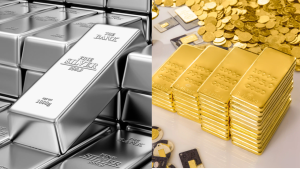

🥈 Silver vs Gold: Which Is the Better Investment in 2025 and Beyond?
By Onetrader — Smart Investing Insights
Introduction
Precious metals have always played a critical role in preserving wealth during uncertain economic periods. While gold traditionally dominates investor portfolios as a safe-haven asset, silver is increasingly gaining attention due to its dual role as both a monetary metal and an industrial commodity.
With gold reaching record highs in 2025, many investors are now asking an important question:
Is silver a better opportunity than gold going forward?
This article provides a clear, data-backed comparison of silver vs gold, focusing on returns, volatility, demand drivers, correction risk, and long-term investment potential — helping investors decide which metal fits better into their portfolio.
Also Read: Gold ETF: How It Works, Benefits, Risks and How to Invest
Also Read: Is Silver Overvalued or Still Undervalued After the Crash? | Onetrader Analysis
1️⃣ Fundamental Difference Between Gold and Silver
| Factor | Gold | Silver |
|---|---|---|
| Primary Role | Store of value | Monetary + Industrial |
| Volatility | Low | High |
| Industrial Demand | Limited | Very High |
| Price Sensitivity | Macro-driven | Macro + Industrial cycle |
| Safe Haven Status | Very Strong | Moderate |
Gold is primarily driven by macroeconomic factors like inflation, interest rates, and central bank policies.
Silver, on the other hand, is influenced by both financial markets and industrial demand, making it more volatile but potentially more rewarding.
2️⃣ Demand Drivers: Gold vs Silver
Gold Demand Structure
Gold demand comes mainly from:
- Central banks
- Investment (ETFs, bars, coins)
- Jewelry
Central banks do not buy silver — this is a major structural difference. Gold enjoys institutional price support that silver does not.
Also Read: Gold Investment: A Complete Guide to Investing in Gold
Silver Demand Structure
Silver demand is unique:
- Over 55–60% of silver demand comes from industrial usage
- Used in:
- Solar panels
- Electric vehicles (EVs)
- Electronics
- Medical equipment
- Semiconductors
With global focus on green energy and electrification, silver demand is structurally rising — especially from the solar sector, where each panel requires silver paste.
👉 This makes silver economically sensitive, unlike gold.
3️⃣ Performance Comparison: Historical Returns
Long-Term Return Comparison (2005–2025)
| Metal | Approx CAGR | Nature of Returns |
|---|---|---|
| Gold | ~9–10% | Stable, consistent |
| Silver | ~11–13% | Cyclical, volatile |
Silver often outperforms gold during commodity bull markets, but it also falls harder during downturns.
Also Read: 🟡 When to Buy Gold? A Complete Timing Strategy Using Market Cycles (2026 Guide)
Example:
- 2020–2021 rally:
- Gold rose ~25%
- Silver rose ~70%
- 2022 correction:
- Gold fell mildly
- Silver corrected sharply
👉 Higher risk, higher reward clearly applies to silver.
4️⃣ Gold-to-Silver Ratio: A Key Indicator
The Gold-to-Silver Ratio (GSR) shows how many ounces of silver equal one ounce of gold.
| Period | Ratio |
|---|---|
| Historical Average | ~60 |
| Crisis Periods | 90–120 |
| 2025 Range | 80–85 |
A high ratio indicates silver is undervalued relative to gold.
Also Read: Silver vs Gold: Which Is Better Now After the Rally and Crash? | Onetrader
📌 At current elevated levels, the ratio suggests silver has more upside potential than gold over the next commodity cycle.
5️⃣ Volatility and Risk Comparison
| Risk Factor | Gold | Silver |
|---|---|---|
| Price Stability | High | Low |
| Drawdowns | Shallow | Deep |
| Liquidity | Very High | High |
| Retail Suitability | Excellent | Moderate |
Silver can easily move 2–3× faster than gold in both directions.
👉 Conservative investors prefer gold.
👉 Opportunistic investors may prefer silver.
6️⃣ Correction Risk in 2025–2026
Gold Correction Risk
- Driven mainly by:
- Rising real yields
- Stronger USD
- Slower ETF or central bank buying
- Typical correction range: 5–15%
Silver Correction Risk
- Driven by:
- Global economic slowdown
- Weak industrial production
- Risk-off sentiment
- Typical correction range: 15–30%
Silver corrections are sharper, but they often create strong accumulation opportunities.
Also Read: Why Gold Rallied, Correction View, and Future Scope
7️⃣ Future Scope: 2025–2030 Outlook
Gold Outlook
- Supported by:
- Central bank buying
- Geopolitical risk
- Currency debasement
- Expected role:
- Wealth preservation
- Portfolio insurance
- Growth expectation:
- Moderate but stable
Silver Outlook
- Supported by:
- Renewable energy expansion
- EV penetration
- Solar capacity additions
- Expected role:
- Growth-oriented metal
- Industrial demand-driven
- Growth expectation:
- Higher upside potential during commodity supercycle
👉 Silver’s future is tightly linked to energy transition and global electrification.
8️⃣ Investment Options: Gold vs Silver
Gold Investment Options
- Sovereign Gold Bonds (SGBs)
- Gold ETFs
- Gold Mutual Funds
- Physical gold (jewelry/bars)
Silver Investment Options
- Silver ETFs
- Silver futures (advanced investors)
- Physical silver bars/coins
⚠️ Note: Silver storage and taxation can be less efficient than gold.
9️⃣ Ideal Allocation Strategy
| Investor Type | Gold | Silver |
|---|---|---|
| Conservative | 25–35% | 0–5% |
| Balanced | 15–25% | 5–10% |
| Aggressive | 10–15% | 10–20% |
Onetrader Insight:
Gold provides stability; silver provides acceleration.
The best portfolios often hold both, but in different proportions.
🔟 Which One Should You Choose?
Choose Gold if:
Also Read: Gold vs Equity: The Real Relationship Every Investor Must Understand (2025 Guide)
- You want stability
- You fear inflation or currency risk
- You prefer lower volatility
Choose Silver if:
- You expect a global growth cycle
- You can tolerate volatility
- You want higher upside potential
Conclusion
Gold and silver are not competitors — they serve different purposes.
- Gold is a defensive asset designed to preserve wealth.
- Silver is a hybrid asset offering both monetary protection and growth exposure.
For long-term investors, the smartest approach is not choosing one over the other — but balancing both intelligently based on risk appetite and market cycles.
Equity builds wealth. Gold preserves it. Silver accelerates it.
Also Read: Where is Indian Investors’ Wealth? Gold, Real Estate, or Markets?
That balance defines resilient portfolios.