
🧾 Part 2: How Does a Mutual Fund Work? | by Onetrader
🏦 Introduction
In Part 1, we understood what a mutual fund is.
Now, let’s go a step deeper and see how a mutual fund actually works — from the moment you invest money until you earn returns.
Think of this as the behind-the-scenes engine of mutual funds — where your ₹500 SIP or ₹10,000 lumpsum really goes and how it grows.
Also Read: What is a Mutual Fund? Simple Explanation with Example | by Onetrader
💰 How Does a Mutual Fund Work?
A Mutual Fund works like a bridge connecting investors and financial markets.
Here’s the process in a simple step-by-step way 👇
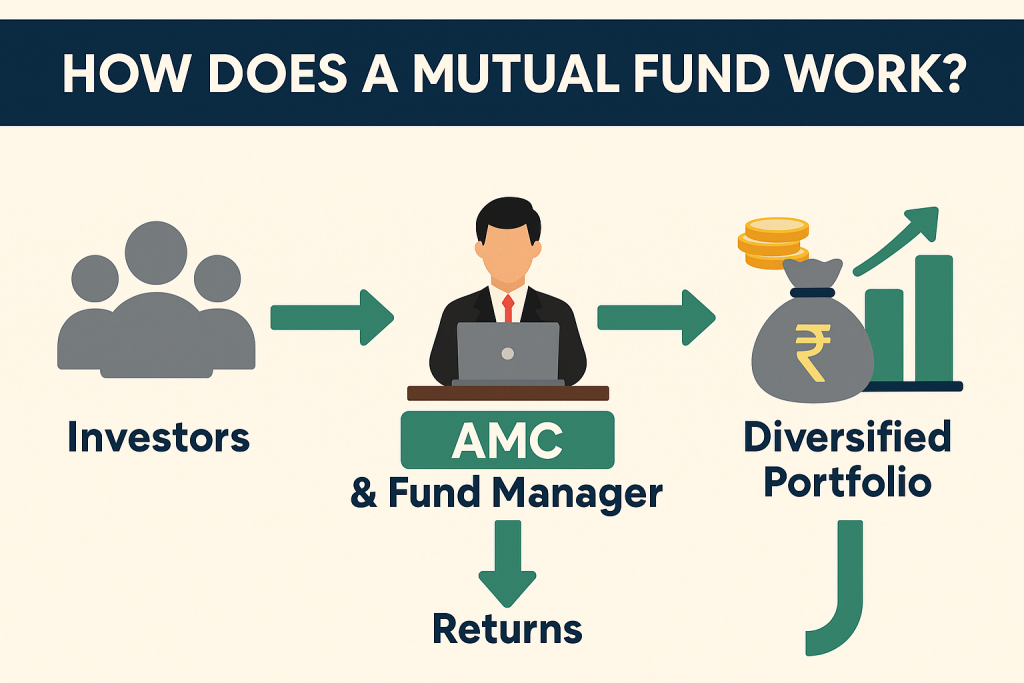
Step 1: Investors Pool Money
Thousands of investors contribute money to a common fund.
Each investor buys units of the fund based on the NAV (Net Asset Value).
Also Read: Will SIFs Prove to Be Better Than Mutual Funds? Early Performance Offers an Interesting Clue
📘 Example:
If a mutual fund’s NAV is ₹10 and you invest ₹1,000, you’ll get 100 units.
Step 2: Managed by AMC & Fund Manager
An Asset Management Company (AMC) manages the fund.
A Fund Manager decides where to invest — equities, bonds, or other instruments — based on the fund’s objective (like growth, income, or stability).
Step 3: Diversified Investments
The AMC invests the pooled money across:
- ✅ Stocks of different companies
- ✅ Government or corporate bonds
- ✅ Short-term money market instruments
- ✅ Gold or international assets (in some funds)
This diversification spreads risk while aiming for consistent returns.
Also Read: SIP Calculator: How to Calculate Your SIP Returns and Investment Amount
Step 4: Returns Generated
Returns come from:
- Dividends (company profits shared with shareholders)
- Interest income (from debt instruments)
- Capital gains (increase in value of assets)
These earnings are reflected in the NAV, which goes up or down daily.
Step 5: NAV Calculation
NAV = (Total Assets – Liabilities) / Total Units
If the fund’s total value increases, your NAV rises — giving you profit.
Also Read: SIP vs Lump Sum – Which Is Better for Long-Term Investors?
Step 6: Redemption / Withdrawal
You can redeem your mutual fund units anytime (except in locked-in schemes like ELSS).
The redemption value depends on the current NAV on that day.
📊 Visual Summary
Investor → AMC → Fund Manager → Diversified Portfolio → Returns → Back to Investor
Each step ensures your investment is professionally managed, diversified, and transparent.
💡 Key Components to Understand
| Term | Meaning |
|---|---|
| AMC (Asset Management Company) | The organization that runs mutual fund operations. |
| Fund Manager | The professional who takes investment decisions. |
| NAV | The per-unit value of the mutual fund. |
| Expense Ratio | The fee charged by the AMC to manage your investments. |
⚙️ Expense Ratio Example
If a mutual fund has an expense ratio of 1%, it means ₹10 out of every ₹1,000 invested goes towards management fees annually.
Always choose funds with lower expense ratios for long-term investing.
Also Read: How to Select the Right Mutual Fund for Better Returns
🧠 Conclusion
A Mutual Fund works like a professionally managed investment team where your money grows with thousands of others — all handled by experts.
So, next time you start a SIP, remember:
“You’re not investing alone — you’re investing with the power of many.”
Up next: Part 3 – Types of Mutual Funds 🧾
(We’ll break down Equity, Debt, Hybrid, and more.)
Also Read: What Is a Large-Cap Fund and Why Is It Preferable?
❓ FAQ Section
1. What happens when I invest in a Mutual Fund?
Your money is pooled with other investors’ money and invested by professional fund managers in various securities.
2. Who controls or manages Mutual Funds?
Mutual Funds are managed by AMCs (Asset Management Companies) under SEBI regulation, led by experienced Fund Managers.
3. How does a Mutual Fund generate profit?
Profits come from dividends, interest income, and capital appreciation on investments.
4. What is NAV in Mutual Funds?
NAV (Net Asset Value) is the per-unit price of the fund and changes daily based on the market value of holdings.
Also Read: Mutual Fund Taxation in India 2026 – New STCG & LTCG Rules Explained | Onetrader