
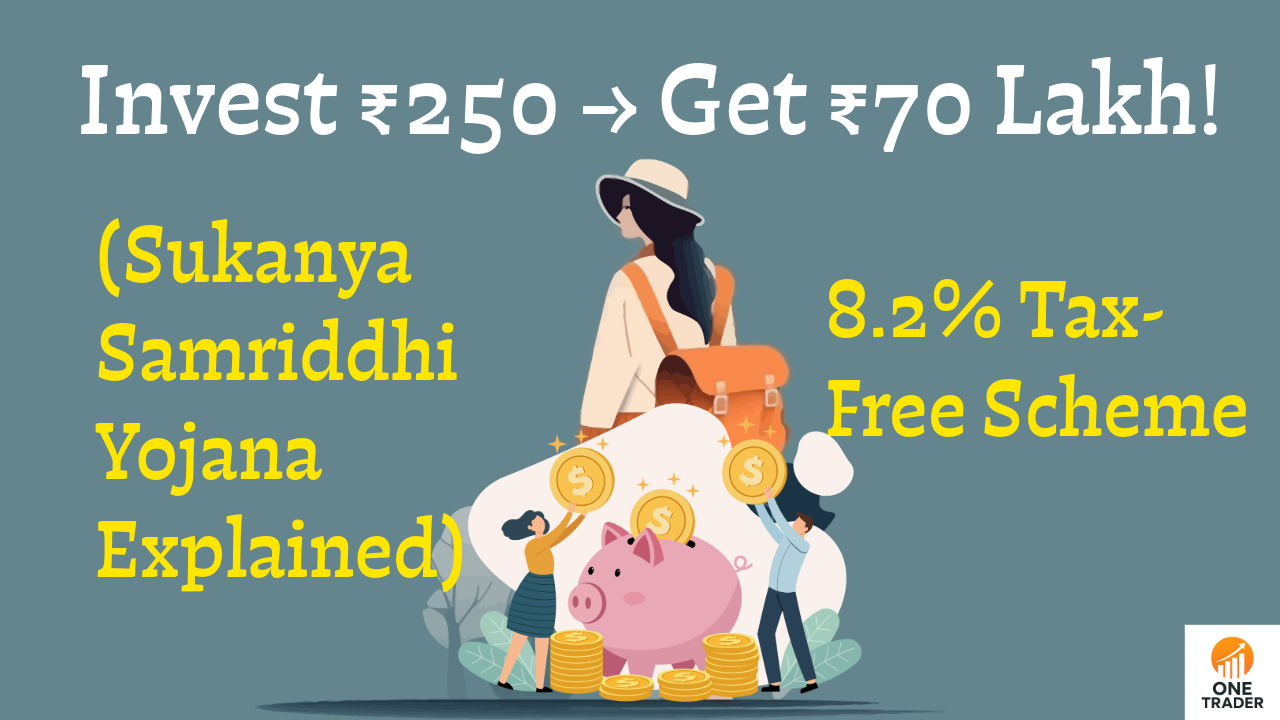
Sukanya Samriddhi Yojana (SSY) – Complete Guide, Interest Rate, Withdrawal Rules
by Onetrader Guide
Sukanya Samriddhi Yojana (SSY) is a government-backed small-savings scheme for a girl child. Deposits are allowed for 15 years from account opening, the account matures at 21 years, minimum yearly deposit is ₹250 and the maximum is ₹1,50,000. Current interest (2025): 8.2% p.a.. Partial withdrawal up to 50% is allowed for higher education or marriage after the beneficiary turns 18 (or passes 10th standard).
What is Sukanya Samriddhi Yojana (SSY)?
Launched under the Beti Bachao, Beti Padhao initiative, SSY is a long-term savings product to help parents/guardians build a secure corpus for a girl child’s education and marriage. It’s available at authorized post offices and scheduled commercial banks. The scheme offers government-guaranteed returns and EET tax benefits (contribution eligible under Section 80C; interest and maturity tax-free subject to scheme rules).
Key features (at a glance)
- Eligible child: Girl child up to 10 years of age at account opening.
- Who can open: Parent/guardian (one account per girl).
- Deposit period: 15 years from account opening.
- Maturity: 21 years from account opening (or earlier closure on marriage after 18 subject to rules).
- Minimum deposit: ₹250 per financial year.
- Maximum deposit: ₹1,50,000 per financial year (combined across all SSY deposits for the child).
- Interest rate (2025): 8.2% p.a., compounded yearly (rate set by the Government and revised periodically).
- Partial withdrawal: Up to 50% for higher education or marriage after the girl attains 18 years or passes 10th standard.
- Tax treatment: Deposits eligible under Section 80C; interest and maturity proceeds are tax-free (subject to conditions).
Latest numbers & scheme reach (2025)
- Current declared SSY interest: 8.2% p.a.
- Scheme reach: Millions of accounts opened since launch; SSY remains one of the most widely used government small-savings products for girl-child planning.
How SSY returns grow — two example scenarios (rounded)
Calculations assume 8.2% p.a. compounded yearly and that the interest rate remains constant for illustration.
Also Read: How to Read an Option Chain: A Simple Guide for Beginners
Example A — Max saver
- Deposit: ₹1,50,000 per year (₹12,500 per month equivalent) for 15 years
- Maturity: Account continues to earn interest until year 21
- Approx maturity corpus: ≈ ₹71.8 lakh (rounded)
Example B — Modest saver
- Deposit: ₹60,000 per year (₹5,000 per month equivalent) for 15 years
- Approx maturity corpus: ≈ ₹28–30 lakh (rounded)
Withdrawal, closure & transfer rules — what to know
- Partial withdrawal: Allowed once the girl reaches age 18 (or on passing 10th) for higher education or marriage — up to 50% of the balance at the end of the preceding financial year. Banks/post offices typically ask for proof (fee receipts/admission letters).
- Closure on marriage: The account can be closed on marriage after the girl turns 18 (conditions apply).
- Transfer: SSY accounts can be transferred between post offices/banks and across locations when a family moves.
Who should invest?
Ideal for: Parents/guardians seeking a low-risk, tax-efficient, guaranteed-return product for a girl child’s future needs.
Not ideal for: Investors who need flexibility or higher market-linked returns; SSY has long lock-in and limited partial withdrawal options.
Pros & Cons (summary)
Pros
- Government-backed guarantee and tax-free maturity.
- Competitive interest compared to many fixed-income instruments.
- Encourages disciplined, long-term saving for a girl child.
- Widely accessible via banks and post offices.
Cons
- Long lock-in (deposits allowed for 15 years; maturity at 21 years).
- Partial withdrawal limited to 50% and only after age 18.
- Interest rate is revisable by the government — not fixed permanently.
- Only one account per child — ensure KYC and beneficiary details are correct.
Practical Onetrader checklist (what to do next)
- Open SSY early — the sooner you start, the better compounding works.
- Prefer annual or standing-instruction deposits to avoid missing the minimum requirement.
- Keep KYC documents (birth certificate, parent/guardian ID, PAN) ready while opening.
- Plan partial withdrawals: gather admission/fee documents if you intend to withdraw for education after 18.
- Consider complementing SSY with PPF or equity SIPs depending on your risk profile and liquidity needs.
Onetrader recommendation
Use SSY as the core guaranteed component of a girl-child education/marriage corpus and complement with market-linked investments (equity SIPs) if you can tolerate risk and need higher potential returns or better liquidity.
Also Read: Securities Transaction Tax (STT) in India: What Is It and How Is It Calculated?