Estimated reading time: 5 minutes
Thank you for reading this post, Please bookmark onetrader.in website for regular updates!
📘 How ETFs Work? A Step-by-Step Breakdown:
Now that you know what an ETF is, let’s understand how it actually functions behind the scenes. Most beginners think ETFs are just like mutual funds or stocks, but the truth is: ETFs are a hybrid — they behave like stocks in the market but are structured like mutual funds.
🔁 1. The Core Idea: ETFs Track an Index or Asset
An ETF’s main job is simple:
👉 It tries to replicate the performance of a specific index, sector, commodity, or bond basket.
For example:
- A Nifty 50 ETF buys all 50 stocks in the same proportion as the Nifty index.
- A Gold ETF holds physical gold or gold futures.

So, if Nifty goes up 1%, your ETF should ideally also go up ~1% (minus a small cost called tracking error).
🏗️ 2. The Creation & Redemption Process (The Heart of ETFs):
Unlike mutual funds (where investors buy units directly from the AMC), ETFs involve a unique ecosystem with different participants:
🧑💼 Key Players:
- AMC (Asset Management Company): Designs and manages the ETF.
- Authorized Participants (APs): Usually big institutions or market makers.
- Stock Exchange: Where ETFs are traded (NSE, BSE).
- Investors: Retail and institutional buyers like you and me.
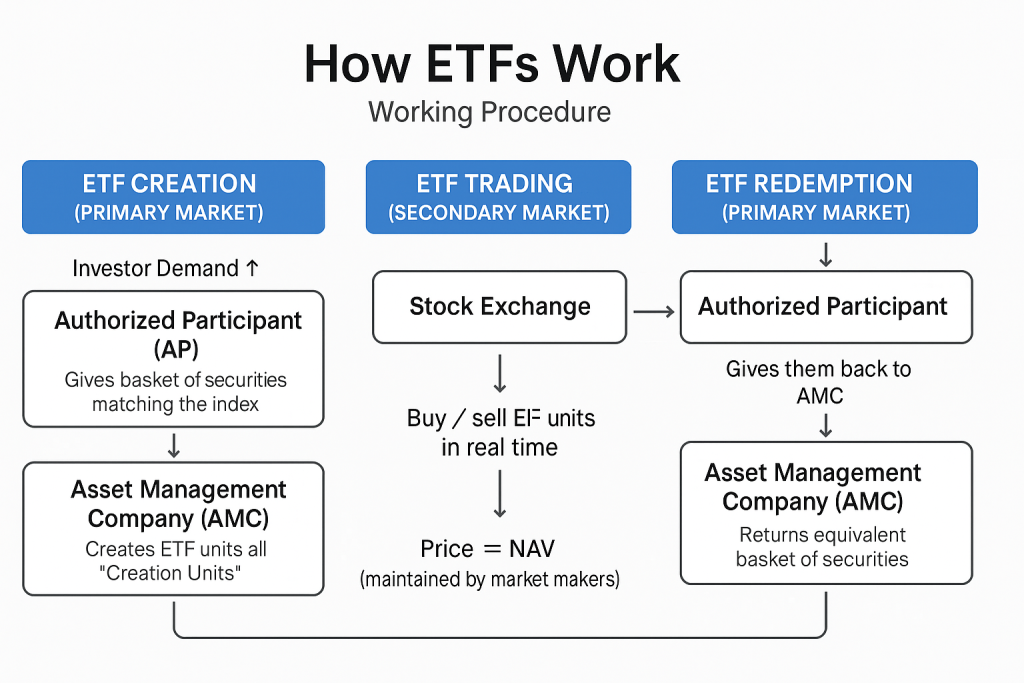
🔄 The ETF Creation Process (Primary Market):
Here’s how ETF units are born:
- Authorized Participant (AP) deposits a basket of securities (matching the index) with the AMC.
- Example: For a Nifty 50 ETF, the AP gives the AMC all 50 stocks in the same proportion as Nifty.
- In return, the AMC issues ETF units (usually in large blocks called Creation Units, e.g., 50,000 units).
- The AP can then sell these ETF units on the stock exchange to retail investors.
✅ Result: New ETF units are created without directly involving small investors.
Investor Demand ↑
│
▼
Authorized Participant (AP)
│ (Gives basket of securities matching the index)
▼
Asset Management Company (AMC)
│ (Creates ETF units called “Creation Units”)
▼
Authorized Participant receives ETF units
│
▼
AP lists them on the Stock Exchange
🔁 Redemption Process (Primary Market):
The opposite happens during redemption:
- AP collects ETF units from the market and gives them back to the AMC.
- AMC returns the equivalent basket of underlying securities.
✅ This ensures supply and demand stay balanced and ETF prices remain close to the index value (NAV).
Authorized Participant collects ETF units
│
▼
Gives them back to AMC
│
▼
AMC returns equivalent basket of securities

🏦 3. Trading on the Exchange (Secondary Market):
Once ETF units are created, they trade on exchanges just like any stock. You can:
- Buy ETF units at market price during trading hours.
- Sell anytime without waiting for NAV calculation (like mutual funds).
💡 The real-time pricing is one of the biggest advantages of ETFs.
Stock Exchange (NSE/BSE)
│
▼
Retail Investors / Institutions
│
Buy / Sell ETF units in real time
│
Price ≈ NAV (maintained by market makers)
📉 4. Role of Market Makers:
Sometimes, demand and supply for ETFs can get imbalanced. This is where market makers (often APs themselves) step in.
- They buy or sell ETF units to keep the price close to the Net Asset Value (NAV).
- This reduces liquidity risk and ensures smooth trading for investors.
📊 5. Example: Nifty 50 ETF in Action
Let’s understand this with a simple example 👇
- AMC launches a Nifty 50 ETF.
- Nifty Index = 20,000.
- NAV per ETF unit ≈ ₹200.
- AP gives AMC all 50 stocks worth ₹10 crore.
- AMC issues 50,000 ETF units worth ₹200 each.
- You log into Zerodha and buy 10 ETF units at ₹201.
- Price fluctuates throughout the day based on demand and supply.
If Nifty goes to 21,000 (+5%), the ETF price may rise ~5% to ₹210.5 (minus minor tracking error).
📌 Important Concept: Tracking Error
Even though ETFs aim to mirror their index, there’s often a small difference called tracking error due to:
- Expense ratio
- Cash drag (uninvested cash)
- Corporate actions or delays
👉 A good ETF tries to keep tracking error as low as possible (<0.5%).
✅ Key Takeaways:
- ETFs are created and redeemed through authorized participants — not directly by retail investors.
- Once issued, they trade like stocks on exchanges in the secondary market.
- Market makers ensure liquidity and price stability.
- ETFs aim to mirror the index but may slightly deviate due to tracking error.
📌 Quick Comparison – Mutual Fund vs ETF Creation
| Feature | Mutual Fund | ETF |
|---|---|---|
| Pricing | Once a day (NAV) | Real-time on stock exchange |
| Unit Creation | Directly by AMC (retail investors) | Through APs (institutional) |
| Liquidity | Redeem from AMC | Buy/Sell on exchange |
| Transparency | Monthly portfolio | Daily portfolio |
📊 Final Thoughts
Understanding how ETFs work gives you a major edge as an investor. They’re built to track markets efficiently, trade like stocks, and offer diversification at low cost — which is why they’re becoming the go-to investment tool for both retail and institutional investors in India.